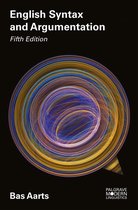
English Syntax & Argumentation 5th Edition, 2018 Bas Aarts
Summary by Julia Neugarten
Part I: Function & Form
Chapter 1: Introduction
syntax: the grammar that deals with the structure of sentences
word order, dividing sentences up into units and arranging those units
constituent = a syntactic unit
syntactic argumentation = arguing why something has a specific syntactic function
Chapter 2: Function
Subject: the constituent that tells us who performs the action denoted by the verb (agenthood)
and who or what the sentence is about. = semantic
Characteristics of the subject = syntactic criteria regarding distribution
1. denoting a person or thing, a subject is usually a noun phrase (NP)
2. the subject is usually the first NP in a sentence
3. subjects are obligatory except in imperatives
4. subjects determine the form of the verb (agreement)
5. in yes/no questions/interrogative clauses, the subject moves into the second slot, after the verb
6. the subject can be identified through the pronoun in a tag question
Note: referential it versus non-referential “it”: “It is raining” versus “I love it.”
existential there versus locative “there”: “There are ways…” versus “Let’s go there.”
Predicate: the unit whose function it is to specify what the subject is engaged in doing.
Also: everything except the subject.
dynamic predicates denote an action whereas static predicates denote a situation
elements within the predicate: verb and NP. The verb is known as predicator
Direct Object: constituents that refer to entities that typically undergo the activity or process
denoted by the verb, complements to verbs.
Characteristics of the direct object = syntactic criteria
1. often NP’s
2. usually positioned after the main verb
3. strong relationship with the preceding verb
transitive verbs require a D.O whereas intransitive verbs do not: I bought flowers” versus “I slept.”
Some verbs have both transitive and intransitive uses: “Harry moved the chair” versus “Harry
moved.” Others can have implicit complements: “I ate a sandwich.” versus “I ate.”
4. The DO becomes Subject if the sentence is turned passive, the Subject is put in a by-phrase.
Indirect Object: also complements to verbs, typically goal/receiver or beneficiary role.Verbs that
require both a DO and an IO are ditransitive verbs.
syntactic characteristics of the IO
1. usually NP
2. cannot occur without a following DO
3. IO’s always precede DO’s except in constructions with “to”: I gave it to her.
4. Can become subject of a passive sentence or end up in a “to” phrase.
Adjunct: telling us how, when, where or why. Always optional, they can be stacked and moved
around, but not placed in-between the main verb and the DO.
Chapter 3: Form: Words, Word Classes and Phrases
1
, lexeme = dictionary entry, can have multiple orthographies: “dog, dogs”
morphology = study of the internal structure of words
word classes: noun, preposition, determinative, adverb, adjective, conjunction, verb, interjection
forms, not functions of words.
Nouns (head of NP) denote people, animals, things or places = notional/semantic definition.
Nouns share some morphological characteristics, but distributional criteria are the most reliable:
nouns can be preceded by determinatives or adjectives. See a table of noun-subclasses on p. 29.
Pronouns refer back to nouns and things but they are also nouns themselves.
Determinatives specify nouns. (see p. 27, examples: “the, a, this, few etc.)
Adjectives (head of AP) qualify or modify nouns. Most possess gradability, they can be combined
with “very,” for example. The absolute form (great) can also take a comparative form (greater) and
a superlative form (greatest).
In terms of distribution, adjectives can be used in attributive position: “What a lovely coat!”
or predicative position, following a linking verb: “She is crazy” or “That seems stupid.”
Verbs (head of VP): any words that can take tense inflection. “She loves it.” “She loved it.” Verbs
must always be in agreement with their subject (1st, 2nd or 3rd person).
finite verbs carry tense whereas non-finite verbs do not.
Main/Lexical verbs: can occur independently: “Jeremy laughed.”
auxiliary verbs: cannot occur independently, can be combined: “He has been being dumb.”
Verbs can function as main or auxiliary depending on context: “He is nice.” versus “He is sleeping.”
Types of auxiliary verbs
1. modal auxiliaries: can, could, may, might, must, ought to, shall, should, will, would.
color the main verb
2. aspectual auxiliaries: be, have: progressive aspect perfect aspect
“He is laughing.” “She has broken the glass.”
3. passive auxiliary: be
encodes passivity
4. dummy auxiliary or dummy-do: do
a. added to negate a sentence without auxiliary. “He loves soup” > “He does not love soup.”
b. subject-auxiliary inversion is used to create questions: “Does he love soup?”
c. in tag questions/code
d. emphatic stress: “You do hate me!”
NICE-properties: negation, inversion, code, emphasis
Non-finite verb types
to-infinitive: “She loves to dance” to = infinitival particle
bare infinitive: “I saw him dance.”
present participle “He is dancing.”
past participle: “He has often danced.”
Prepositions (combine with NP’s to create PPs) often denote a relationship of some sort
between two entities.
Adverbs (head of AdvP) modify verbs, adjectives or other adverbs.
Subclasses
Circumstantial: specify frequency: “often” or manner: “gleefully,”
interrogative adverbs such as “why”
Degree: specify a degree: “extremely,” cannot themselves be modified: “very extremely*”
Sentence: linking function: “however” or modifying a whole sentence: “perhaps.”
2
Summary by Julia Neugarten
Part I: Function & Form
Chapter 1: Introduction
syntax: the grammar that deals with the structure of sentences
word order, dividing sentences up into units and arranging those units
constituent = a syntactic unit
syntactic argumentation = arguing why something has a specific syntactic function
Chapter 2: Function
Subject: the constituent that tells us who performs the action denoted by the verb (agenthood)
and who or what the sentence is about. = semantic
Characteristics of the subject = syntactic criteria regarding distribution
1. denoting a person or thing, a subject is usually a noun phrase (NP)
2. the subject is usually the first NP in a sentence
3. subjects are obligatory except in imperatives
4. subjects determine the form of the verb (agreement)
5. in yes/no questions/interrogative clauses, the subject moves into the second slot, after the verb
6. the subject can be identified through the pronoun in a tag question
Note: referential it versus non-referential “it”: “It is raining” versus “I love it.”
existential there versus locative “there”: “There are ways…” versus “Let’s go there.”
Predicate: the unit whose function it is to specify what the subject is engaged in doing.
Also: everything except the subject.
dynamic predicates denote an action whereas static predicates denote a situation
elements within the predicate: verb and NP. The verb is known as predicator
Direct Object: constituents that refer to entities that typically undergo the activity or process
denoted by the verb, complements to verbs.
Characteristics of the direct object = syntactic criteria
1. often NP’s
2. usually positioned after the main verb
3. strong relationship with the preceding verb
transitive verbs require a D.O whereas intransitive verbs do not: I bought flowers” versus “I slept.”
Some verbs have both transitive and intransitive uses: “Harry moved the chair” versus “Harry
moved.” Others can have implicit complements: “I ate a sandwich.” versus “I ate.”
4. The DO becomes Subject if the sentence is turned passive, the Subject is put in a by-phrase.
Indirect Object: also complements to verbs, typically goal/receiver or beneficiary role.Verbs that
require both a DO and an IO are ditransitive verbs.
syntactic characteristics of the IO
1. usually NP
2. cannot occur without a following DO
3. IO’s always precede DO’s except in constructions with “to”: I gave it to her.
4. Can become subject of a passive sentence or end up in a “to” phrase.
Adjunct: telling us how, when, where or why. Always optional, they can be stacked and moved
around, but not placed in-between the main verb and the DO.
Chapter 3: Form: Words, Word Classes and Phrases
1
, lexeme = dictionary entry, can have multiple orthographies: “dog, dogs”
morphology = study of the internal structure of words
word classes: noun, preposition, determinative, adverb, adjective, conjunction, verb, interjection
forms, not functions of words.
Nouns (head of NP) denote people, animals, things or places = notional/semantic definition.
Nouns share some morphological characteristics, but distributional criteria are the most reliable:
nouns can be preceded by determinatives or adjectives. See a table of noun-subclasses on p. 29.
Pronouns refer back to nouns and things but they are also nouns themselves.
Determinatives specify nouns. (see p. 27, examples: “the, a, this, few etc.)
Adjectives (head of AP) qualify or modify nouns. Most possess gradability, they can be combined
with “very,” for example. The absolute form (great) can also take a comparative form (greater) and
a superlative form (greatest).
In terms of distribution, adjectives can be used in attributive position: “What a lovely coat!”
or predicative position, following a linking verb: “She is crazy” or “That seems stupid.”
Verbs (head of VP): any words that can take tense inflection. “She loves it.” “She loved it.” Verbs
must always be in agreement with their subject (1st, 2nd or 3rd person).
finite verbs carry tense whereas non-finite verbs do not.
Main/Lexical verbs: can occur independently: “Jeremy laughed.”
auxiliary verbs: cannot occur independently, can be combined: “He has been being dumb.”
Verbs can function as main or auxiliary depending on context: “He is nice.” versus “He is sleeping.”
Types of auxiliary verbs
1. modal auxiliaries: can, could, may, might, must, ought to, shall, should, will, would.
color the main verb
2. aspectual auxiliaries: be, have: progressive aspect perfect aspect
“He is laughing.” “She has broken the glass.”
3. passive auxiliary: be
encodes passivity
4. dummy auxiliary or dummy-do: do
a. added to negate a sentence without auxiliary. “He loves soup” > “He does not love soup.”
b. subject-auxiliary inversion is used to create questions: “Does he love soup?”
c. in tag questions/code
d. emphatic stress: “You do hate me!”
NICE-properties: negation, inversion, code, emphasis
Non-finite verb types
to-infinitive: “She loves to dance” to = infinitival particle
bare infinitive: “I saw him dance.”
present participle “He is dancing.”
past participle: “He has often danced.”
Prepositions (combine with NP’s to create PPs) often denote a relationship of some sort
between two entities.
Adverbs (head of AdvP) modify verbs, adjectives or other adverbs.
Subclasses
Circumstantial: specify frequency: “often” or manner: “gleefully,”
interrogative adverbs such as “why”
Degree: specify a degree: “extremely,” cannot themselves be modified: “very extremely*”
Sentence: linking function: “however” or modifying a whole sentence: “perhaps.”
2