

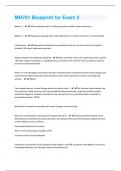
MH701 Blueprint for Exam 2 Questions With 100% Correct Solutions.
Bipolar 1 - Manic episodes with or without psychosis and/or major depression Bipolar II - Hypomanic episode with major depression; no history of manic or mixed episode Cyclothymia - Hypomanic and depressive symptoms that do not meet criteria for bipolar II disorder; NO major depressive episodes Bipolar disorder not otherwise specified - Does not meet criteria for major depression, bipolar I disorder, bipolar II disorder, or cyclothymia (e.g., less than one week of manic symptoms without psychosis or hospitalization). What is a neurobiological psychiatric disorder characterized by sustained extreme mood swings from extremely low (depression) to extremely high (manic) and an abnormal increase in energy and activity. - Bipolar Can a bipolar person's mood change every day and/or hour? - No. Extreme mood swings that occur hourly or daily are very rarely associated with bipolar disorder, and other medical and/or psychiatric diagnosis should be considered and ruled out first (e.g. hypothyroidism, borderline personality disorder, PTSD). Borderline Personality associated with mood changes every hour/day What are comorbidities associated with bipolar disorder? - Anxiety Disorders-Greater than 50% lifetime comorbidity of anxiety disorders with bipolar illness and these patients appear to have a more difficult course of illness. Decreased likelihood of recovery Poorer role functioning and quality of life Increased risk of suicide attempts Substance-use disorders-61% of patients with Bipolar I and 49% of patients with Bipolar II also have coexisting substance-use disorders (most commonly etoh).Personality Disorders-One-third of patients with bipolar disorder also have a **cluster B (borderline, narcissistic, antisocial, and histrionic) personality disorder. What is the cause of bipolar disorder? - Exact cause of bipolar disorder is not known. Kindling Theory is the predominant theory - multiple factors that potentially interact and lower the threshold at which mood changes occur. Eventually, a mood episode can start itself and become recurrent. Recurrent mood episodes are associated with repeated physiological insults that add up and kindle, like a spark bursting into fire. This could compromise endogenous compensatory mechanisms, leading to cell apoptosis that in turn causes rewiring of the brain circuits involved in mood regulation and cognition. This can render one more vulnerable to the effects of stressors, increasing risk of future episodes and thus perpetuating the vicious spiral Do genetics affect bipolar? - Genetics - studies show identical twins are far more concordant for mood disorders than fraternal twins. Overall heritability of bipolar spectrum disorders has been put at 0.71. Between 4% - 24% of first-degree relatives of individuals with bipolar I disorder are also diagnosed with bipolar I disorder. What are neurol process/physiological causes of bipolar? - Hypersensitivity of melatonin receptors Structural abnormalities in the amygdala, hippocampus, and prefrontal cortex Larger lateral ventricles Environmental factors in bipolar disorder - Sleep deprivation = trigger mania Hypersomnia = trigger MDE Traumatic and/or abusive events in childhood Potential that those with diurnal pattern are affected mostly by both fluctuating light and temperature.What is Kindling Theory? - An etiologic theory of bipolar disorder that is based on the idea that a stressful situation leads to the first bipolar episode, whether it is manic or depressive. As the disorder progresses, further episodes may occur without any outside triggers. What 2 neurotransmitters implicated in bipolar disorder? - Of the biogenic amines, norepinephrine (NE) and serotonin (SE) are the two neurotransmitters most implicated in the pathophysiology of mood disorders. What are 3 treatment goals of bipolar? - First, the patient's SAFETY must be guaranteed. Second, a complete diagnostic evaluation of the patient is necessary. Third, a treatment plan that addresses not only the immediate symptoms but also the patient's prospective well-being should be initiated. What is the first line treatment for biploar? - Mood stabilizers are identified as first line. Lithium is recommended for suicidal ideation. Risk of suicide is reduced 13-fold with long-term maintenance therapy with lithium. Drugs approved for bipolar depression - Quetiapine (SGA), olanzapine-fluoxetine (SGA- SSRI), and lurasidone (SGA) have all demonstrated consistent efficacy in bipolar depression and are approved for this stage of the disorder. What is the drug preferred for rapid cycling? - Depakote is preferred for rapid-cycling disorders Waht medications are best for ACUTE MANIA? - **Lithium**, **Valproate** Carbamazepine/Oxcarbazepine, Clonazepam/Lorazepam, Atypical Antipsychotics can be used alone or in combination to bring the patient down from the highCan antidepressants be used alone to treat bipolar depression? - Use of antidepressants should be avoided or used short term only and with a mood stabilizer. **Antidepressant monotherapy may precipitate mania or induce rapid-cycling disorders between mania and depression**. What is the first line of treatment for Acute Bipolar Depression? - Antidepressant drugs are often enhanced by a mood stabilizer in the first-line treatment for a first or isolated episode of bipolar depression. A fixed combination of ***olanzapine and fluoxetine (Symbyax)*** has been shown to be effective in treating acute bipolar depression for an 8-week period without inducing a switch to mania or hypomania. Many patients who are bipolar in the depressed phase do not respond to treatment with standard antidepressants. In these instances, lamotrigine or low-dose ziprasidone (20 to 80 mg per day) may prove effective. What is a tratment for bipolar after lithium and all adjunct medications have not been successful? - Electroconvulsive therapy may also be useful for patients with bipolar depression who do not respond to lithium or other mood stabilizers and their adjuncts, particularly in cases in which intense suicidal tendency presents as a medical emergency.
Document information
- Uploaded on
- January 9, 2024
- Number of pages
- 35
- Written in
- 2023/2024
- Type
- Exam (elaborations)
- Contains
- Questions & answers


