

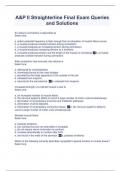
A&P II Straighterline Final Exam Queries and Solutions
An isotonic contraction is described as Select one: a. action potential frequency is high enough that no relaxation of muscle fibers occurs. b. a muscle produces constant tension during contraction. c. a muscle produces an increasing tension during contraction. d. a muscle produces increasing tension as it shortens. e. a muscle produces tension, but the length of the muscle is increasing b. a muscle produces constant tension during contraction. After contraction has occurred, the calcium is Select one: a. destroyed by cholinesterase. b. chemically bound to the cross bridges. c. secreted by the Golgi apparatus to the outside of the cell. d. released from troponin. e. returned to the sarcolemma. d. released from troponin. Increased strength of a trained muscle is due to Select one: a. an increased number of muscle fibers. b. the nervous system's ability to recruit a large number of motor units simultaneously. c. elimination of unnecessary enzymes and metabolic pathways. d. elimination of all fat deposits. e. elimination of unnecessary connective tissue. b. the nervous system's ability to recruit a large number of motor units simultaneously. Skeletal muscle fibers Select one: a. possess striations. b. can contract but are not extensible or excitable. c. do not require nerve innervation to contract. d. increase dramatically in number after birth. e. are found in the walls of the stomach. a. possess striations. Which of the following correctly describes myoglobin's special function in muscle tissue? Select one: a. breaks down glycogen b. synthesizes ATP c. acts as a reservoir for oxygen d. produces action potentials e. stores glucose c. acts as a reservoir for oxygen
Document information
- Uploaded on
- January 9, 2024
- Number of pages
- 44
- Written in
- 2023/2024
- Type
- Exam (elaborations)
- Contains
- Questions & answers


