
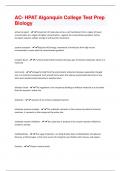
AC- HPAT Algonquin College Test Prep Biology active transport - ✔✔ movement of molecules across a cell membrane from a region of lower concentration to a region of higher concentration —against the concentration gradient. Active transport requires cellu lar energy to achieve this movement. passive transport - ✔✔ Requires NO energy, movement of molecules from high to low concentration, moves with the concentration gradient covalent bond - ✔✔ A chemical bond that involves sharing a pair of electrons between atoms in a molecule ionic bond - ✔✔ Linkage formed from the electrostatic attraction between oppositely charged ions in a chemical compound. Such a bond forms when the valence (outermost) electrons of one atom are transferred permanently to another atom. allosteric bond - ✔✔ The regulation of an enzyme by binding an effector molecule at a site other than the enzyme's active site. Substrate - ✔✔ reactant of an enzyme -catalyzed reaction substrate -enzyme complex - ✔✔ The substrate connects to the enzyme to perform chemical reactions. It connects to the enzyme at the active site. substrate enzyme inhibition - ✔✔ the substrate or product of an enzyme reaction inhibit the enzyme's activity. Carbohydrates - ✔✔ Are sugar molecules - our body breaks down carbohydrates into glucose. Glucose, or blood sugar, is the main source of energy for your body's cells, tissues, and organs. Proteins - ✔✔ Chains of amino acids
Preview 1 out of 3 pages
Exam (elaborations)
AC- HPAT Algonquin College Test Prep Biology Questions With Complete Solutions.
Preview 1 out of 3 pages
active transport - movement of molecules across a cell membrane from a region of lower concentration to a region of higher concentration—against the concentration gradient. Active transport requires cellular energy to achieve this movement. passive transport - Requires NO energy, movement of molecules from high to low concentration, moves with the concentration gradient covalent bond - A chemical bond that involves sharing a pair of electrons between atoms in a molecule ionic bond - Linkage formed from the electrostatic attraction between oppositely charged ions in a chemical compound. Such a bond forms when the valence (outermost) electrons of one atom are transferred permanently to another atom. allosteric bond - The regulation of an enzyme by binding an effector molecule at a site other than the enzyme's active site. Substrate - reactant of an enzyme-catalyzed reaction substrate-enzyme complex - The substrate connects to the enzyme to perform chemical reactions. It connects to the enzyme at the active site. substrate enzyme inhibition - the substrate or product of an enzyme reaction inhibit the enzyme's activity. Carbohydrates - Are sugar molecules- our body breaks down carbohydrates into glucose. Glucose, or blood sugar, is the main source of energy for your body's cells, tissues, and organs. Proteins - Chains of amino acidsLipids - Energy-rich organic compounds, such as fats, oils, and waxes, that are made of carbon, hydrogen, and oxygen. nucleic acids - Nucleic acids are naturally occurring chemical compounds that serve as the primary information-carrying molecules in cells. The two main classes of nucleic acids are deoxyribonucleic acid (DNA) and ribonucleic acid (RNA).
Content preview
Document information
- Uploaded on
- January 7, 2024
- Number of pages
- 3
- Written in
- 2023/2024
- Type
- Exam (elaborations)
- Contains
- Questions & answers
$7.59
Wrong document? Swap it for free
Within 14 days of purchase and before downloading, you can choose a different document. You can simply spend the amount again.
Written by students who passed
Immediately available after payment
Read online or as PDF

Reputation scores are based on the amount of documents a seller has sold for a fee and the reviews they have received for those documents. There are three levels: Bronze, Silver and Gold. The better the reputation, the more your can rely on the quality of the sellers work.
Available in package deal
Package deal
AC-HPAT Bundled Exams with complete solution

