Biology Lecture Notes
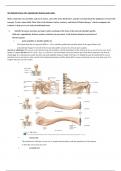
Biology Lecture Notes Y. Nagah 2 | P a g e Ion pump and ion channels establish the resting potential of a neuron As you know, ions are unequally distributed between the interior of cells and the fluid that surrounds them. As a result, the inside of a cell is negatively charged relative to the outside. Because the attraction of opposite charges across the plasma membrane is a source of potential energy, this charge difference, or voltage, is called the membrane potential. • The membrane potential of a resting neuron—one that is not sending a signal— is its resting potential and is typically between 60 and 80 mV (millivolts). • Inputs from other neurons or specific stimuli cause changes in the neuron’s membrane potential that act as signals, transmitting and processing information. • Rapid changes in membrane potential are what enable us to see a flower, read a book, or climb a tree. Thus, to understand how neurons function, we first need to examine how chemical and electrical forces form, maintain, and alter membrane potentials. Formation of the Resting Potential Potassium ions (K+ ) and sodium ions (Na+ ) play an essential role in the formation of the resting potential. Each type of ion has a concentration gradient across the plasma membrane of a neuron, (as shown in the table). • In case of mammalian neurons, the concentration of K+ is highest inside the cell, while the concentration of Na+ is highest outside. • These Na+ and K+ gradients are maintained by sodium-potassium pumps in the plasma membrane. These ion pumps use the energy of ATP hydrolysis to actively transport Na+ out of the cell and K + into the cell (as shown in the Figure). • There are also concentration gradients for chloride ions (Cl- ) and other anions, but we will ignore these for the moment. Biology Lecture Notes Y. Nagah 3 | P a g e Why, then, is there a voltage difference of 60–80 mV in a resting neuron? The answer lies in ion movement through ion channels, pores formed by clusters of specialized proteins that span the membrane. Ion channels allow ions to diffuse back and forth across the membrane. As ions diffuse through channels, they carry with them units of electrical charge. Any resulting net movement of positive or negative charge will generate a membrane potential, or voltage across the membrane. The concentration gradients of K+ and Na+ across the plasma membrane represent a chemical form of potential energy. The ion channels that convert this chemical potential energy to electrical potential energy can do so because they have selective permeability, allowing only certain ions to pass. For example, a potassium channel allows K+ to diffuse freely across the membrane, but not other ions, such as Na+ . Diffusion of K+ through open potassium channels is critical for formation of the resting potential. The K+ concentration is 140 mM inside the cell, but only 5 mM outside. The chemical concentration gradient thus favors a net outflow of K+ . Furthermore, a resting neuron has many open potassium channels, but very few open sodium channels (see the Figure). Because Na+ and other ions can’t readily cross the membrane, K+ outflow leads to a net negative charge inside the cell. This buildup of negative charge within the neuron is the major source of the membrane potential. What stops the buildup of negative charge?
Written for
- Institution
- Biology Lecture Notes
- Course
- Biology Lecture Notes
Document information
- Uploaded on
- January 7, 2024
- Number of pages
- 27
- Written in
- 2023/2024
- Type
- Exam (elaborations)
- Contains
- Questions & answers
Subjects