QUANTITATIVE CHEMISTRY
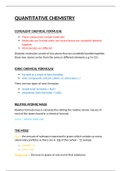
COVEALENT CHEMICAL FORMULAE
These compounds contain molecules
Molecules are formed when non-metal atoms are covalently bonded
together
All molecules are different
Diatomic molecules consist of two atoms that are covalently bonded together,
these two atoms can be from the same or different elements e.g. N 2 CO2
IONIC CHEMICAL FORMULAE
Formed as a result of ionic bonding
Ionic compounds contain cations (+) and anions (-)
There are two types of ionic formulae:
simple ionic formulae = NaCl
polyatomic ionic formulae = CaSO4
RELITIVE ATOMIC MASS
Relative formula mass is calculated by adding the relative atomic masses of
each of the atoms found in a chemical formula
a.m.u – atomic mass unit
THE MOLE
Mol – the amount of substance expressed in grams which contains as many
elementary particles as there are in 12g of the carbon – 12 isotope
o symbol = n
o unit = mol
Molar mass – the mass in grams of one mol of that substance
COVEALENT CHEMICAL FORMULAE
These compounds contain molecules
Molecules are formed when non-metal atoms are covalently bonded
together
All molecules are different
Diatomic molecules consist of two atoms that are covalently bonded together,
these two atoms can be from the same or different elements e.g. N 2 CO2
IONIC CHEMICAL FORMULAE
Formed as a result of ionic bonding
Ionic compounds contain cations (+) and anions (-)
There are two types of ionic formulae:
simple ionic formulae = NaCl
polyatomic ionic formulae = CaSO4
RELITIVE ATOMIC MASS
Relative formula mass is calculated by adding the relative atomic masses of
each of the atoms found in a chemical formula
a.m.u – atomic mass unit
THE MOLE
Mol – the amount of substance expressed in grams which contains as many
elementary particles as there are in 12g of the carbon – 12 isotope
o symbol = n
o unit = mol
Molar mass – the mass in grams of one mol of that substance