N582 Principles of Anesthesia Exam 2 Finished QUESTIONS AND ANSWERS 100% VERIFIED
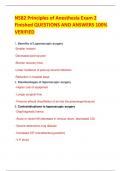
N582 Principles of Anesthesia Exam 2 Finished QUESTIONS AND ANSWERS 100% VERIFIED 1. Benefits of Laparoscopic surgery -Smaller incision -Decreased post-op pain -Shorter recovery time -Lower incidence of post-op wound infections -Reduction in hospital stays 2. Disadvantages of laparoscopic surgery - Higher cost of equipment - Longer surgical time - Pneumo effects (Insufflation of air into the pneumoperitoneum) 3. Contraindications to laparoscopic surgery - Diaphragmatic hernia - Acute or recent MI (decrease in venous return, decreased CO) - Severe obstructive lung disease - Increased ICP (trendelenburg position) - V-P shunt - Valvular heart diseases - Hypovolemia 4. Positioning during Laparoscopic surgery Trendelenburg & Reverse Trend -Advantages of Trendelenburg: increased venous return, less HD stress -Disadvantages: increases intrathoracic pressure with decreased lung compliance Steep Trendelenburg: increases CVP b/c it increases hydrostatic pressure at the level of the external auditory meatus 5. When are patients at the highest risk for complications during laparoscopic surgeries? During the initial establishment of the pneumoperitoneum; likelihood of CO2 embolism and hemorrhage are at the highest. 6. What is the working pressure for CO2 insufflation during laparoscopy procedures? 12-14 mm Hg 7. What is the preferred gas for laparoscopic insufflation? CO2 Air/O2 not used due to risk of embolism Nitric oxide can cause bowel distention, PONV, explosion Helium and argon have increased risk of embolization 8. Advantages and Disadvantages of using CO2 as the gas for insufflation Advantages - inexpensive - less likely to have embolism - can be measured - non-flammable - rapidly absorbed into vascular space - can be expired via the lungs Disadvantages - CO2 absorption can cause hypercarbia and respiratory acidosis - it's a known peritoneal and diaphragmatic irritant - can be implicated in the development of postop shoulder/between shoulder blades pain 9. Cardiovascular effects during laparoscopy - Increases HR, MAP, SVR, and PVR (from compression on the intraabdominal vessels release neuroendocrine hormones elevation in vasopressin & renin) - Decreased SV, venous return, preload, and, CO (amplified by reverse Trendelenburg position; although this is sometimes offset by Trendelenburg position) - Risk of bradydysrhythmias from vagal response during high pressures/insufflation - prolongs QT dispersion 10. Hemodynamic changes -CVP: increased or decreased -MAP: increased -SV decreased -CO increased, decreased or no chang
Written for
- Institution
- N582 Principles o
- Course
- N582 Principles o
Document information
- Uploaded on
- January 3, 2024
- Number of pages
- 29
- Written in
- 2023/2024
- Type
- Exam (elaborations)
- Contains
- Questions & answers
Subjects
-
n582 principles of anesthesia exam 2 finished q
-
n582 principles of anesthesia exam 2 finished que
Also available in package deal