

NR 503 MIDTERM EXAM LATEST 2023 -2024/NR503 MIDTERM EXAM QUESTIONS AND CORRECT ANSWERS| AGRADE Question 1 The population of a city on February 15, 2005, was 36,600. The city has a passive surveillance system that collects hospital and private physician reports of influenza cases every month. During the period between January 1 and April 1, 2005, 2,200 new cases of influenza occurred in the city. Of these cases, 775 persons were ill with inf luenza according to surveillance reports on April 1, 2005. The monthly incidence rate of active cases of influenza for the 3-month period was: 4 per 1,000 population 17 per 1,000 population 20 per 1,000 population 39 per 1,000 population 130 per 1,000 population Question 2 What would be the effect on age-specific incidence rates of uterine cancer if women with hysterectomies were excluded from the denominator of incidence calculations assuming that most women who have had hysterectomies are older than 50 years of age. The rates in all age groups would remain the same. Only rates in women older than 50 years of age would tend to decrease. Rates in women younger than 50 years would increase compared to women older than 50 years of age. Rates would increase in women older than 50 years of age but may decrease in younger women as they get older. It cannot be determined whether the rates would increase or decrease. Question 3 The ability of a single person to remain free of clinical illness following exposure to an infectious agent is known as: Hygiene Vaccination Herd immunity Immunity Latency Question 4 Which of the following reasons can explain why a person who did not consume the infective food item got sick? They were directly exposed to persons who did eat the infective food item Diarrhea is a general symptom consistent with a number of illnesses There may have been an inaccurate recall of which foods were eaten
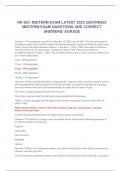
Preview 2 out of 14 pages
Exam (elaborations)
NR 503 MIDTERM EXAM LATEST /NR503 MIDTERM EXAM QUESTIONS AND CORRECT ANSWERS| AGRADE
Preview 2 out of 14 pages
NR 503 MIDTERM EXAM LATEST /NR503 MIDTERM EXAM QUESTIONS AND CORRECT ANSWERS| AGRADE Question 1 The population of a city on February 15, 2005, was 36,600. The city has a passive surveillance system that collects hospital and private physician reports of influenza cases every month. During the period between January 1 and April 1, 2005, 2,200 new cases of influenza occurred in the city. Of these cases, 775 persons were ill with influenza according to surveillance reports on April 1, 2005. The monthly incidence rate of active cases of influenza for the 3-month period was: 4 per 1,000 population 17 per 1,000 population 20 per 1,000 population 39 per 1,000 population 130 per 1,000 population Question 2 What would be the effect on age-specific incidence rates of uterine cancer if women with hysterectomies were excluded from the denominator of incidence calculations assuming that most women who have had hysterectomies are older than 50 years of age. The rates in all age groups would remain the same. Only rates in women older than 50 years of age would tend to decrease. Rates in women younger than 50 years would increase compared to women older than 50 years of age. Rates would increase in women older than 50 years of age but may decrease in younger women as they get older. It cannot be determined whether the rates would increase or decrease. Question 3 The ability of a single person to remain free of clinical illness following exposure to an infectious agent is known as: Hygiene Vaccination Herd immunity Immunity Latency Question 4 Which of the following reasons can explain why a person who did not consume the infective food item got sick? They were directly exposed to persons who did eat the infective food item Diarrhea is a general symptom consistent with a number of illnesses There may have been an inaccurate recall of which foods were eaten All of the above None of the above Question 5 Which of the food items (or combination of items) is most likely to be the infective item(s)? Pizza only Ice cream only Neither pizza nor ice cream Both pizza and ice cream Cannot be assumed from the data shown
Content preview
Document information
- Uploaded on
- January 1, 2024
- Number of pages
- 14
- Written in
- 2023/2024
- Type
- Exam (elaborations)
- Contains
- Questions & answers
$11.99
Wrong document? Swap it for free
Within 14 days of purchase and before downloading, you can choose a different document. You can simply spend the amount again.
Written by students who passed
Immediately available after payment
Read online or as PDF

Reputation scores are based on the amount of documents a seller has sold for a fee and the reviews they have received for those documents. There are three levels: Bronze, Silver and Gold. The better the reputation, the more your can rely on the quality of the sellers work.

