HESI PN PRACTICE EXAM QUESTIONS AND ANSWERS (MED-SURG) A+ SOLUTIONS
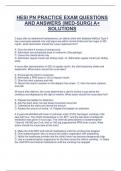
HESI PN PRACTICE EXAM QUESTIONS AND ANSWERS (MED-SURG) A+ SOLUTIONS 2 days after an abdominal hysterectomy, an elderly client with diabetes Mellitus Type II has a syncopal episode. Her vital signs are within normal limites and her sugar is 325 mg/dL. what intervention should the nurse implement first? A. Give the client 4 ounces of orange juice B. Administer next scheduled dose of metformin (Glucophage) C. Cancel the clients dinner tray D. Administer regular insulin per sliding scale - D. Administer regular insulin per sliding scale 4 hours after administration of 20U of regular insulin, the client becomes shake and diaphoretic. What action should the nurse take? A. Encourage the client to excercise B. Administer a PRN dose of 10U of regular insulin C. Give the client crackers and milk D. Record the client's reaction on the diabetic flow sheet - C. Give the client crackers and milk 36 hours after delivery, the nurse determines a client's fundus is just above the umbilicus and displaced to the right of midline. What action should the nurse take first? A. Palpate the bladder for distention B. Ask the client when her last bowel movement occurred C. Catheterize the client and record the amount D. Assess the amount of lochia - A. Palpate the bladder for distention A 3 year-old admitted with fever of unknown origin (FUO) has begun vomiting in the past half hour. The child's temperature is 101.80 F, and the last dose of antipyretic medication was given 5 hours ago. The child has prescriptions of acetaminophen (Tylenol) 160 MG per 5 mL elixir or 160 mg suppositories PRN fever or pain. What action should the nurse take at this time? A. Make the child NPO and hold all medications untill the vomiting has stopped B. Give acetaminophen elixir to ensure the child's cooperation with swallowing C. Notify the healthcare provider that the child's fever has become dangerously high D. Use an acetaminophen suppository for the fever since the child is vomiting - A. Make the child NPO and hold all medications untill the vomiting has stopped A 3-week-old infant is admitted for surgical repair of Pyloric Stenosis. What interventions should the nurse expect to implement to establish hydration in the immediate postoperative period? A. Diaper weights and urin specific gravity B. Gastronomy feedings in supine position C. Nipple feedings with glucose water D. Gavage feedings with 15mL of formula - C. Nipple feedings with glucose water A 6-month old male with Bronchiolitis is admitted to the hospital. In monitoring the respiratory status of this child, which symptom indicates the nurse that he is experiencing Respiratory Distress? A. Respiratory of 62 breaths/minute B. Abdominal breathing C. A high-pitched cry D. Dry flushed skin - C. A high-pitched cry A 26 year-old primigravida who delivered a 7-pound male infant 26 hours ago tells the nurse that she is confused about when she and her husband can return to having sexual intercourse. What info should the nurse reinforce with this client? A. They can have intercourse when the episiotomy is healed and the lochial flow has stopped B. They should wait to resume sexual activities until the fatigue assorted with a new baby has passed C. They can resume sexual activity at 6 weeks postpartum D. It is best to wait until both parties feel up to having sexual intercourse - A. They can have intercourse when the episiotomy is healed and the lochial flow has stopped A 26-year-old gravida 4, para 0 had a spontaneous abortion at 9 weeks gestation. At one-house post dilation and curettage (D&C) the nurse assess the vital signs and vaginal bleeding. The client begins to cry softly. How should the nurse intervene? A. Offer to call the social worker to discuss the possiblity of abortion B. Reassure the client that the infertility specialist can help C. Express sorrow for the client's grief and offer to sit with her D. Chart the vital signs and amount of vaginal bleeding - C. Express sorrow for the client's grief and offer to sit with her A 60 year-old client with cancer of the liver is in Hepatic Coma and unresponsive. What should the nurse say to family members who are inquiring about the condition of their loved one? A. "Your loved one's condition is very critical, and there has been no response in the last 24 hours" B. "The nurses have not been able to arouse the client and the healthcare provider knows the outcome." C. "You need to discuss the condition with the charge nurse in a family conference." D. "The client's condition is extremely critical. Has your family made funeral arrangements?" - A. "Your loved one's condition is very critical, and there has been no response in the last 24 hours" A 67-year-old woman who lives alone tripped on a rug in her home and fractured her right hip. The nurse knows that which predisposing factor contributes to the occurrence of hip fractures among elderly women. A. Urinary retention resulting in renal calculi formation B. Failing eyesight resulting in an unsafe environment C. Osteoporosis resulting from hormonal changes D. Transient ischemic attacks (TIAs) which impair mental activity - C. Osteoporosis resulting from hormonal changes A 75-year-old male client with Alzheimer's Disease (AD) is admitted to an extended care facility. What intervention should the nurse include into his client's Nursing care plan? A. Describe the activities available to the residents and encourage him to choose the ones he prefers B. Introduce the client to the Nursing staff and the residents as soon as possible C. Plan to have the same Nursing staff provide care for the client whenever possible D. Encourage the client to remain on the unit for 3 weeks until he is oriented to his new surroundings - C. Plan to have the same Nursing staff provide care for the client whenever possible A child with Chronic Asthma is scheduled for Chest Physiotherapy. When should the nurse administer the meter-dosed inhalar (MDI) puff of bronchodilator relative to postural drainage treatments? A. Before postural drainage B. During postural drainage C. After postural drainage D. Between treatements - C. After postural drainage A client asks the nurse to explain the location of the prostate gland. What is the best response? A. Close the rectal wall the prostate gland sits behind the symphysis pubis extending around the beginning of the urethra B. At the bottom of the scrotal sac, the prostate gland rests beneath the testes, held in place by the spermatic fascia C. Attach to the front and sides of the pubic arch, the prostate is a mess of cavernous tissue held together by fibrous tissue D. Located at the lateral edge of the posterior segment of the testes, the prostate creates a bulge continuous with the vas deferens - A. Close the rectal wall the prostate gland sits behind the symphysis pubis extending around the beginning of the urethra A client at 28 weeks gestation is admitted to the antepartum unit and is being treated for preterm labor. She has a prescription for brethine (Terbutaline) 250 micrograms subcutaneously q4h. The medication is available for injection in 1 mg per ML vials. How many mL should the nurse administer? A. 0.025 B. 0.0025 C. 0.25 D. 25.0 - C. 0.25 A client begins an antidepressant drug during the second day of hospitalization. Which assessment is most important for the nurse to include in this client's plan of care while the client is taking the antidepressant? A. Appetite B. Mood C. Withdrawl D. Energy level - B. Mood A client comes to the antepartal clinic and tells the nurse that she is 6 weeks preg
Document information
- Uploaded on
- January 1, 2024
- Number of pages
- 47
- Written in
- 2023/2024
- Type
- Exam (elaborations)
- Contains
- Questions & answers