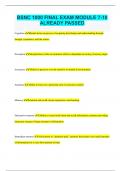
BSNC 1000 FINAL EXAM MODULE 7-10 ALREADY PASSED
BSNC 1000 FINAL EXAM MODULE 7-10 ALREADY PASSED Cognition Mental action or process of acquiring knowledge and understanding through thought, experience, and the senses. Perception Interpretation of the environment which is dependent on acuity of sensory input Awareness Ability to perceive or to be sensitive to stimuli in environment Attention Ability to focus on a particular area of conscious content Memory Retention and recall of past experiences and learning Declarative memory Ability to consciously learn and recall information, memory providing long-term storage of large amounts of information Immediate memory Also known as "attention span", memory that retains very small amounts of information for a very short amount of time Working memory Memory that allows for small amount of information to be actively maintained and manipulated Procedural memory Retention and retrieval of motor skills Executive function Higher thinking processes that allow for flexibility, adaptability, and goal-directedness Cerebral cortex Part of the brain that is responsible for carrying out intellectual functions Hippocampus Part of the brain that plays a significant role in committing information to long-term memory Confusion Disturbance of consciousness, impaired ability to think clearly, to perceive, respond to, and remember current stimuli Frontal lobe Part of the brain associated with personality, working memory, executive function, intellect, and speech Delirium State of disturbed consciousness and altered cognition with rapid onset occurring over hours or a few days - characterized by motor restlessness, transient hallucinations, and disorientation Dementia Acquired and progressive deterioration of all cognitive functions Primary dementia Dementia that is irreversible and not secondary to another disease Secondary dementia Dementia that occurs as a result of another disease process Focal cognitive disorders Affect a single area of cognitive function; may be associated with a neurocognitive disorder or seen independently Intellectual disability Limitations of cognitive functioning (conceptual skills, social skills, and ADLs) and below-average intelligence Learning disability Challenges in taking data signals in and processing the information received; may occur in people with average or above-average intelligence Avoidance of substance abuse is an example of ___ prevention of cognitive disorders Primary Alzheimer's disease Most common type of dementia - Dementia characterized by loss of short-term memory and denial of any memory loss Vascular dementia Dementia caused by brain injury resulting from ischemic or hemorrhagic damage - Form of dementia caused by cerebrovascular disease -Second most common type of dementia Frontotemporal dementia Atrophy of frontal and anterior temporal lobes Age Strongest risk factor for vascular dementia Men are at a slightly ___ risk of developing vascular dementia than women Higher Inflammation Immunologic defense against tissue injury, infection, or allergy - Protective process initiated to minimize or remove a pathologic agent or stimulus Chemotaxis Complex process that attracts WBCs to an area of inflammation -Process in which WBCs move towards a higher concentration of chemotactic factors - Third step of the cellular stage of inflammation Proinflammatory hormones Mediating factors in inflammatory response including prostaglandins, cytokines, and histamines Alcohol Substance that harms the gastric muco
École, étude et sujet
- Établissement
- BSNC 1000
- Cours
- BSNC 1000
Infos sur le Document
- Publié le
- 31 décembre 2023
- Nombre de pages
- 24
- Écrit en
- 2023/2024
- Type
- Examen
- Contient
- Questions et réponses
Sujets
-
bsnc 1000 final exam module 7 10 already passed

Document également disponible en groupe