

Labor, Delivery, & Postpartum
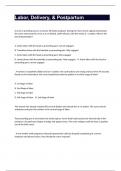
Labor, Delivery, & Postpartum A nurse is providing care to a woman 38 weeks pregnant. During the most recent vaginal examination, the nurse notes that the cervix is 6 cm dilated, 100% effaced, with the vertex at -1 station. What is the best interpretation? A. Active labor with the head as presenting part, not yet engaged B. Transition phase with the backside as presenting part, fully engaged C. Active labor with the head as presenting part, fully engaged D. Latent phase with the backside as presenting part, fully engaged - A. Active labor with the head as presenting part, not yet engaged A woman is completely dilated and at +2 station. Her contractions are strong and last 50-to-70 seconds. Based on this information, the nurse should know that the patient is in which stage of labor? A. 1st Stage of labor B. 2nd Stage of labor C. 3rd Stage of labor D. 4th Stage of labor - B. 2nd Stage of labor This woman has already reached full cervical dilation and already lies at +2 station. The nurse should anticipate caring for this mother in the second stage of labor. The presenting part is now below the ischial spines. As the fetal head touches the internal side of the perineum, the perineum begins to bulge and appear tense. The circle enlarges until the fetus is pushed out of the birth canal. A new mother with pregnancy-induced hypertension calls the hospital complaining of a severe headache and blurred vision. How should the nurse respond? A. Tell the patient to hang up and call 911 immediately. B. Tell the patient to take ibuprofen. C. Ask the patient how often she experiences these symptoms. D. Tell the patient to drive to the hospital for an evaluation. - A. Tell the patient to hang up and call 911 immediately. Pregnancy-induced hypertension (PIH), also called preeclampsia, must be monitored closely. Symptoms of worsening PIH include sudden weight gain, swelling or edema, severe headache, reports of seeing spots, blood in the urine, dizziness, or nausea and vomiting. If preeclampsia worsens, the baby may need to be delivered or magnesium may need to be given IV to prevent seizures. The patient needs to call 911 in order to be treated immediately in order to reduce her blood pressure and prevent complications. Pregnancy-induced hypertension can last for several weeks after delivery. A nurse is providing education to parents living in homes built in the 1950s. In regards to reducing the risk of lead poisoning in infant formula preparation, which of the following should the nurse suggest to the parents? SELECT ALL THAT APPLY A. "Use bottled water." B. "Allow tap water to run for 3 minutes." C. "Never use formula." D. "Boiling all tap water for 5 minutes is sufficient." E. "Never use hot water from the tap." - B. "Allow tap water to run for 3 minutes." E. "Never use hot water from the tap." Contaminated water is a major cause of lead poisoning in infants living in houses built prior to 1978 (due to lead pipes). Allowing tap water to run for 3 minutes or more will flush the pipes and reduce the risk of lead poisoning. Once you have done this, fill a container to store in the fridge and use it throughout the day. Only use code water from the tap. Hot water from tap is likely to contain higher levels of lead because it comes through the house's plumbing, rather than directly from the local water supply. After performing Leopold's maneuvers on a patient in labor, the nurse should prepare the patient for a vaginal delivery after determining if the fetus is in which of the following positions? A. Transverse lie B. Vertex presentation C. Oblique lie D. Face presentation - B. Vertex presentation The vertex presentation is the most favorable presentation for normal vaginal birth. The fetus's head is the first part to contact the cervix and the fetus' long axis is parallel with the long axis of the mother. A patient has requested an oral contraceptive to reduce the risk of pregnancy. The physician prescribes Ethinyl estradiol 30-drospirenone 3 to be cycled for 21 days, followed by a 7-day break. Which classification of contraceptive is Ethinyl estradiol 30-drospirenone 3? A. Multiphasic B. Implant C. Monophasic D. Extended cycle - C. Monophasic Ethinyl estradiol 30-drospirenone 3 (Yasmin) is a monophasic oral contraceptive. Monophasic contraceptives contain the same dose of estrogen and progesterone for the entire dosing schedule. The patient receives 21 days of the active drug, which is then followed by a 7 day period of a placebo to allow withdrawal bleeding. A patient is admitted at 22 weeks gestation for preterm labor. The nurse administers nifedipine as ordered. The patient is most likely to complain of which side effects? SELECT ALL THAT APPLY A. Confusion and blurred vision B. Headache C. Epistaxis D. Metallic taste E. Flushing F. Dizziness G. Nausea - B. Headache E. Flushing F. Dizziness G. Nausea Nifedipine is a calcium channel blocker that is commonly used to delay premature labor. Common side effects include headache, dizziness, edema, flushing, nausea, and gingival hyperplasia. MNEMONIC CCB Side Effects = SHED the GAPS Stevens-Johnson syndrome Headache Edema Dizziness Gingival hyperplasia Angina Palpitations Sleepiness
Información del documento
- Subido en
- 30 de diciembre de 2023
- Número de páginas
- 21
- Escrito en
- 2023/2024
- Tipo
- Examen
- Contiene
- Preguntas y respuestas

