

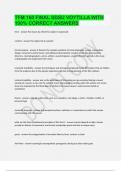
TFM 160 FINAL SDSU VOYTILLA WITH 100% CORRECT ANSWERS.
form the means by which the subject is expressed content the subject of an artwork formal analysis it dissects the complex synthesis of cinematography, sound. composition, design, movement, performance, and editing orchestrated by creative artists like screenwriters, directors, cinematographers, actors, editors, sound designers, and art directors as well as the many craftspeopple who implement their vision cinematic invisibility the techniques and strategies employed by the filmmakers that are hidden from the audience due to the passive experience ans fast moving pictures of the film medium cultural invisibility just as the techniques of filmmaking can go unnoticed during a casual viewing of a movie, so too can the cultural mores and prejudices lurking under the surface of a movie. these are employed by the filmmaker to reinforce the casual viewer's subconscious beliefs or worldviews theme a shared, public idea, such as a metaphor, and adage, a myth, a familiar conflict, or personal type cinematic language the accepted systems, methods, or conventions by which the movies communicate with the viewer what are the three fundamental principles of film form? movies depend on light, movies provide an illusion of movement, and movies manipulate space and time in unique ways genre the categorization of narrative films by form, content, or both Anti-Hero seemingly unsympathetic protagonist chasing less than noble goals diegesis the total world of the story inciting incident the event or situation during the exposition stage of the narrative that sets the rest of he narrative in motion, presents the character with the goal that will drive the rest of the narrative rising action development of the action of the narrative toward a climax; when the narrative builds towards a peak in the second act, a breaking point of sorts, as the conflict intensifies and the goal remains out of reach crisis a critical turning point in a story when the protagonist must engage in a seemingly insurmountable obstacle, the peak of the narrative, major obstacles climax the highest point of conflict in a conventional narrative; the protagonist's ultimate attempt to attain the goal, when the protagonist faces the crisis resolution the concluding narrative events that follow the climax and celebrate or reflect upon the story outcome; the capacity of the camera lens & film stock to provide fine detail in an image; the third act of the falling action to wrap up loose ends whats the difference between story and plot? story consists of (1) all the narrative elements that are explicitly presented on-screen plus (2) all the events that are implicit or that we infer to have happened but are not explicitly presented. Diegetic elements The plot consists of the specific actions and events the filmmakers select and the order in which they arrange those events to effectively convey the narrative to the viewer. Non diegetic elements mise-en-scene "staging or putting an action or scene" everything you see on screen was put there to help tell a story composition is part of the process of visualizing and planning the design of a movie -the organization, distribution, balance, and general relationship of stationary objects and gigues as well as of light, shade, line, and color within the frame. -helps ensure the aesthetic unity and harmony of the movie as well as guide our looking and interpret the characters physical, emotional, and psychological relationships to one another Framing -process by which the cinematographer determines what will appear within the borders of the moving image (the frame) during a shots -the border between what the filmmaker wants us to see and everything else -the dimensions of height and width that provide the shape of the movies images Kinesis the aspects of composition that takes into account everything that moves on the screen or the apparent movement of the frame itself Blocking the actual physical relationship among figures and settings & the process during rehearsal of establishing those relationships three-point lighting key light, fill light, backlight key light Also known as main light or source light. The brightest light falling on a subject. fill light lighting, positioned at the opposite side of the camera from the key light, that can fill in the shadows created where they use a variety of props and other equipment to simulate sounds such as footsteps in the mud, jingling car keys, or cutlery hitting a plate. backlight Lighting, usually positioned behind and in line with the subject and the camera, used to create highlights on the subject as a means of separating it from the background and increasing its appearance of three-dimensionality. lighting ratio The relationship and balance between illumination and shadow—the balance between key light and fill light. If the ratio is high, shadows are deep, and the result is called low-key lighting. If the ratio is low, shadows are faint or nonexistent and illumination is even, and the result is called high-key lighting what are the differences among a setup, a shot and a take? Setup -one camera position and everything associated with it -the basic component of the film's production process Shot -one uninterrupted run of the camera -the recording on film, video, or other medium resulting from that run= -the basic building block of the film Take -the number of times a particular shot is taken What are the names of the most commonly used shots used in a movie? 1. close up 2. long shot 3. medium shot close up shot -full head, sometimes shoulders, of character long shot -generally contains the full body of one or more characters -almost filling the frame but also shoes some surrounding area above or below and to the side medium shot -between long shot and close up -waist up -most frequently used because it replicates our human experience of proximity without intimacy eye-level shot made from the observer's eye level and usually implies that the camera's attitude toward the subject being photographed is neutral low-angle shot shot made with the camera below the action, and typically places the observer in a position of inferiority dutch-angle shot the camera is tilted from its normal horizontal and vertical position so that it is no longer straight, giving the viewer the impression that the world in the frame is out of balance aerial-view shot extreme type of point of view shot, taken from an aircraft or very high crane and implies the observer's omniscience what are the basic types of camera movement? Pan shot Tilt shot (dutch angle) Dolly Shot Zoom Crane Shot what are the four criteria for analysis used when evaluating an actor's performance? 1. appropriateness 2. inherent thoughtfulness 3. expressive coherence ness/unity appropriateness & transparency physically and vocally they fit the part transparency-when you look at them, they are the character and not the actor inherent thoughtfulness how do they use their voice, body, and tone and we go through their emotional life believably expressive coherence from start to end, does the performance work together as a whole wholeness/unity is everything integrating in overall production, gels what are the three basic phases of making a movie? preproduction, production, postproduction
Document information
- Uploaded on
- December 30, 2023
- Number of pages
- 11
- Written in
- 2023/2024
- Type
- Exam (elaborations)
- Contains
- Questions & answers


