
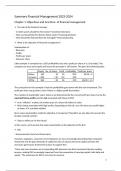
Summary Financial Management 2023-2024
Chapter 1: Objectives and functions of financial management
The role of the financial manager
f
- In which assets should the firm invest? Investment decisions
- How can/should the firm finance these assets? Financing decisions
- How should the financial flows be managed? Financial planning
- f
What is the objective of financial management?
Maximization of
- Revenues
- Profits
- Profits per share
- Value per share
Little example: A company has a 20% profitability rate and a profit per share of € 2 (no debts). The
company can issue new equity and invest the proceeds in 10% bonds. This gives the following table:
Equity No. of shares Profit Profitability Profit per share
Before 100 10 20 20% 20/10 = 2
Increase +100 +10 +10 10%
TOTAL 200 20 30 15% 30/20 = 1,5
The conclusion for this example is that the profitability goes down with this new investment. The
profit per share can go down, even if there is a higher profit then before.
The creation of shareholder value: Value is not determined by the current profit per share, but by the
expected future profits and the risk associated with these profits!
In an “efficient” market, the market price of a share will reflect its value
Risk is being associated with high profits. Depending on the risk, you will value your profit higher
or lower: It is a positive relation
But is value maximization really the objective of companies? Shouldn’t we also take into account the
broader societal context?
Topic to reflect on (in the future)
In this course, we’ll assume that value maximization is the objective of the firm
ESG
= Environmental, Social and Governance
Investors, regulators, consumers and employees are now increasingly demanding that companies
should not only be good stewards of capital but also of natural and social capital and have the
necessary governance framework in place to support this.”
“More and more investors are incorporating ESG elements into their investment decision making
process, making ESG increasingly important from the perspective of securing capital, both debt and
equity.” The awareness for ESG is very hard to measure.
1
, Corporate governance
There is a potential conflict of interest between the management of the company and the
shareholders of the company: How can shareholders make sure that the management of the
company will maximize shareholder value, instead of making themselves rich?
The agency-theory looks at this problem
The ‘agent’ (manager) acts in the interests of the ‘principal’ (shareholder)
In reality, the interests of the agent can be different from those of the principal: The agent may
care more about his own interests than those of the principal
This is made possible by the fact that the shareholder lacks the information to have a full picture
of what the manager is doing: The manager can use the firm to pursue his own interests, at the
expense of shareholder value
Not only this problem is present in a company, but also other agency-relations in a company:
- Controlling shareholders versus minority shareholders: Family firms listed on a stock exchange
- Shareholders versus debtholders: Maximizing shareholder value may be at the expense of the value
of the debtholders
- Also customers, suppliers, employees and the state have interests in the firm
Chapter 2: Basic valuation concepts
2.1) Present value and future value
2
,The concepts of future and present value are already discussed in the course ‘Financial markets’ in
the first bachelor. In this course, we revise this knowledge and discuss some new and extended
subjects.
2.1.1) Future value (FV)
Assume you invest €1000 for 1 year at 5%. What will be the value after one year?
Value after one year = Principle + interest = 1000 + 50 = 1050
Interest = 1000 x 0,05 = 50
Future value = 1000 x (1 + 0,05) = 1050
If you invest this sum again for one year, what will be the value after two years?
The FV = 1000 x (1,05) x (1,05) = 1000 x (1,05) 2 = 1102,50
If we need to create a formula, it would be the following:
t
E=B × ( 1+i )
- E = end value or future value
- B = present value
- i = interest rate over the period
- t = number of periods
- (1 + i)t = Discount factor
The principle of compounded interest is present in this equation: Interest is calculated on the initial
principal, which also includes all of the accumulated interest from previous periods.
The longer the period, the higher the interest
Example: 8% interest, 100 euro PV Inital value End value Interest
100 108,00 8,00
Interest = End value – Initial value
108,00 116,64 8,64
Interest rises every year
116,64 125,97 9,33
The higher the interest rate, the higher the FV
2.1.2) Present value (PV)
Based on the formula of the FV, we can determine the formula for the PV
B=E / (1+i )t
The higher the interest rate, the lower the PV
2.2) Interest periodicity smaller than one year
If the interest is paid more than once a year (half-yearly, quarterly), there is a different formula
required for the FV:
( )
m×n
i
E=B × 1+
m
- m = number of interest payments
- n = number of years
The end value increases as the number of interest settlements per year and the number of years
increase
3
, In the case of continuous interest settlement, we use this formula:
d
i×n
E=B × e
The present value also changes with several interest payments:
( )
m ×n
i
B=E / 1+
m
i×n
E=B × e
The present value decreases as the interest rate rises (negative relation)
2.3) Future and present value of a series of different cash flows
In most economic problems cash flows C t (t = 1, ..., n) are received or paid at different points in time.
n
FV =E=∑ ( 1+i )
n−t
×C t
t=1
n
Ct
PV =B=∑
t =1 ( 1+i )t
2.4) The valuation of annuities and perpetuities
Perpetuity = The present value of an infinite series of equal cash flows
∞ ∞
C 1 C
B=∑ t
=C ∑ t
=
t =1 ( 1+i ) t =1 ( 1+i ) i
The present value of an infinite series of constantly growing cash flows: If the infinite series cashflows
is not constant but grows at a constant growth rate g, then
C 1=C0 ( 1+ g )
2
C 2=C1 ( 1+ g )=C 0 (1+ g)
…
2
C n=C 0 (1+g)
The present value of an infinite series of constantly growing cash flows with growth rate (g) lower
than discount rate (g < i ), is
∞ ∞
Ct (1+ g )t C 1
B=∑ =C 0 × ∑ =
( 1+ i) i−g
t t
t =1 ( 1+i ) t=1
Annuity = The present value of a finite series of equal cash flows
If the series of equal cash flows is finite, ending in year n, the present value will be
( ) ( ) ( )
∞ ∞ ∞
C 1 1 1 1/i ( 1+i )n−1
B=∑ t
=C × ∑ ( 1+i )t − ∑ ( 1+ i)t =C × i − ( 1+ i )n =C × i× ( 1+i )n
t =1 ( 1+i ) t =1 t =n+1
The factor by which the constant annuity flow is multiplied to obtain the present value is called the
annuity factor (AF). The future value of a finite series of equal cash flows: E=B × ( 1+i )t
2.5) Real and nominal interest rates on loans with a periodicity less than one year
4
Chapter 1: Objectives and functions of financial management
The role of the financial manager
f
- In which assets should the firm invest? Investment decisions
- How can/should the firm finance these assets? Financing decisions
- How should the financial flows be managed? Financial planning
- f
What is the objective of financial management?
Maximization of
- Revenues
- Profits
- Profits per share
- Value per share
Little example: A company has a 20% profitability rate and a profit per share of € 2 (no debts). The
company can issue new equity and invest the proceeds in 10% bonds. This gives the following table:
Equity No. of shares Profit Profitability Profit per share
Before 100 10 20 20% 20/10 = 2
Increase +100 +10 +10 10%
TOTAL 200 20 30 15% 30/20 = 1,5
The conclusion for this example is that the profitability goes down with this new investment. The
profit per share can go down, even if there is a higher profit then before.
The creation of shareholder value: Value is not determined by the current profit per share, but by the
expected future profits and the risk associated with these profits!
In an “efficient” market, the market price of a share will reflect its value
Risk is being associated with high profits. Depending on the risk, you will value your profit higher
or lower: It is a positive relation
But is value maximization really the objective of companies? Shouldn’t we also take into account the
broader societal context?
Topic to reflect on (in the future)
In this course, we’ll assume that value maximization is the objective of the firm
ESG
= Environmental, Social and Governance
Investors, regulators, consumers and employees are now increasingly demanding that companies
should not only be good stewards of capital but also of natural and social capital and have the
necessary governance framework in place to support this.”
“More and more investors are incorporating ESG elements into their investment decision making
process, making ESG increasingly important from the perspective of securing capital, both debt and
equity.” The awareness for ESG is very hard to measure.
1
, Corporate governance
There is a potential conflict of interest between the management of the company and the
shareholders of the company: How can shareholders make sure that the management of the
company will maximize shareholder value, instead of making themselves rich?
The agency-theory looks at this problem
The ‘agent’ (manager) acts in the interests of the ‘principal’ (shareholder)
In reality, the interests of the agent can be different from those of the principal: The agent may
care more about his own interests than those of the principal
This is made possible by the fact that the shareholder lacks the information to have a full picture
of what the manager is doing: The manager can use the firm to pursue his own interests, at the
expense of shareholder value
Not only this problem is present in a company, but also other agency-relations in a company:
- Controlling shareholders versus minority shareholders: Family firms listed on a stock exchange
- Shareholders versus debtholders: Maximizing shareholder value may be at the expense of the value
of the debtholders
- Also customers, suppliers, employees and the state have interests in the firm
Chapter 2: Basic valuation concepts
2.1) Present value and future value
2
,The concepts of future and present value are already discussed in the course ‘Financial markets’ in
the first bachelor. In this course, we revise this knowledge and discuss some new and extended
subjects.
2.1.1) Future value (FV)
Assume you invest €1000 for 1 year at 5%. What will be the value after one year?
Value after one year = Principle + interest = 1000 + 50 = 1050
Interest = 1000 x 0,05 = 50
Future value = 1000 x (1 + 0,05) = 1050
If you invest this sum again for one year, what will be the value after two years?
The FV = 1000 x (1,05) x (1,05) = 1000 x (1,05) 2 = 1102,50
If we need to create a formula, it would be the following:
t
E=B × ( 1+i )
- E = end value or future value
- B = present value
- i = interest rate over the period
- t = number of periods
- (1 + i)t = Discount factor
The principle of compounded interest is present in this equation: Interest is calculated on the initial
principal, which also includes all of the accumulated interest from previous periods.
The longer the period, the higher the interest
Example: 8% interest, 100 euro PV Inital value End value Interest
100 108,00 8,00
Interest = End value – Initial value
108,00 116,64 8,64
Interest rises every year
116,64 125,97 9,33
The higher the interest rate, the higher the FV
2.1.2) Present value (PV)
Based on the formula of the FV, we can determine the formula for the PV
B=E / (1+i )t
The higher the interest rate, the lower the PV
2.2) Interest periodicity smaller than one year
If the interest is paid more than once a year (half-yearly, quarterly), there is a different formula
required for the FV:
( )
m×n
i
E=B × 1+
m
- m = number of interest payments
- n = number of years
The end value increases as the number of interest settlements per year and the number of years
increase
3
, In the case of continuous interest settlement, we use this formula:
d
i×n
E=B × e
The present value also changes with several interest payments:
( )
m ×n
i
B=E / 1+
m
i×n
E=B × e
The present value decreases as the interest rate rises (negative relation)
2.3) Future and present value of a series of different cash flows
In most economic problems cash flows C t (t = 1, ..., n) are received or paid at different points in time.
n
FV =E=∑ ( 1+i )
n−t
×C t
t=1
n
Ct
PV =B=∑
t =1 ( 1+i )t
2.4) The valuation of annuities and perpetuities
Perpetuity = The present value of an infinite series of equal cash flows
∞ ∞
C 1 C
B=∑ t
=C ∑ t
=
t =1 ( 1+i ) t =1 ( 1+i ) i
The present value of an infinite series of constantly growing cash flows: If the infinite series cashflows
is not constant but grows at a constant growth rate g, then
C 1=C0 ( 1+ g )
2
C 2=C1 ( 1+ g )=C 0 (1+ g)
…
2
C n=C 0 (1+g)
The present value of an infinite series of constantly growing cash flows with growth rate (g) lower
than discount rate (g < i ), is
∞ ∞
Ct (1+ g )t C 1
B=∑ =C 0 × ∑ =
( 1+ i) i−g
t t
t =1 ( 1+i ) t=1
Annuity = The present value of a finite series of equal cash flows
If the series of equal cash flows is finite, ending in year n, the present value will be
( ) ( ) ( )
∞ ∞ ∞
C 1 1 1 1/i ( 1+i )n−1
B=∑ t
=C × ∑ ( 1+i )t − ∑ ( 1+ i)t =C × i − ( 1+ i )n =C × i× ( 1+i )n
t =1 ( 1+i ) t =1 t =n+1
The factor by which the constant annuity flow is multiplied to obtain the present value is called the
annuity factor (AF). The future value of a finite series of equal cash flows: E=B × ( 1+i )t
2.5) Real and nominal interest rates on loans with a periodicity less than one year
4



