
CHEM133 Week 6 Lesson 3 Quiz Questions and Answers APU
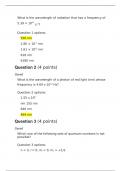
1. Question: What is the wavelength of radiation that has a frequency of 5.39 × 10¹⁴ s–1? 2. Question: What is the wavelength of a photon of red light (nm) whose frequency is 4.64 x 10¹⁴ Hz? 3. Question: Which one of the following sets of quantum numbers is not possible? 4. Question: In Bohr's atomic theory, when an electron moves from one energy level to another energy level more distant from the nucleus: 5. Question: Calculate the wavelength of a neutron that has a velocity of 250 cm/s. 6. Question: Which one of the following sets of quantum numbers represents an electron with the highest energy? 7. Question: Order the elements S, Cal, and F in terms of increasing ionization energy. 8. Question: For an electron in a given atom, the larger n, the 9. Question: Calculate the energy, in joules, required to excite a hydrogen atom by causing an electronic transition from the n = 1 to the n = 4 principal energy level. 10. Question: Which orbitals do not have a node at the nucleus? 11. Question: How many electrons can a single orbital hold? 12. Question: For an orbital, a node is 13. Question: What are the possible values of l if n = 4? 14. Question: Which element has the highest first electron affinity? 15. Question: What is the energy of a photon of electromagnetic radiation with a wavelength of 665 nm appears as orange light to the human eye? 16. Question: Describe the shape of one of the d orbitals. 17. Question: For a hydrogen atom, which electronic transition would result in the emission of a photon with the highest energy? 18. Question: What is the de Broglie wavelength (m) of an electron with a velocity of 8.20 × 10⁶ m/s. (The mass of the electron is 9.11 × 10⁻²⁸ g.) 19. Question: Place the following in order of increasing radius: 20. Question: Which of the following transitions (in a hydrogen atom) represent emission of the longest wavelength photon? 21. Question: Of the following, which element has the highest first ionization energy? 22. Question: Write the complete electron configuration of germanium, element 32. 23. Question: In which orbital below would an electron (on average) be closest to the nucleus? 24. Question: What is the ground state electron configuration for Zr2+? 25. Question: What is the frequency of electromagnetic radiation with a wavelength of 445 nm appears as blue light to the human eye?
Document information
- Uploaded on
- December 25, 2023
- Number of pages
- 16
- Written in
- 2022/2023
- Type
- Exam (elaborations)
- Contains
- Questions & answers


