

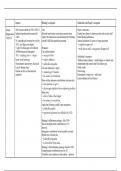
Impact Brüning’s response Schleicher and Papen’s response
Great Nat’l income shrunk by 39% 1929-32 Aim: Papen’s measures:
Depression Industrial production decreased by Discredit and weaken social and economic base Granted tax rebates to employers that took on new staff
1929-33 >40% Exploit the Depression to demonstrate that Germany Ended binding arbitration
No. unemployed increased to 6 mil by couldn’t fulfil the reparations payment General relaxation of system of wage agreement
1932 - real figure was higher → employers approved
⅓ ppl of working age were affected Measures: → trade unions and L-wing parties disapproved
50,000 businesses bankrupted Cut welfare benefits
1931 - banking crisis → 5 major → cuts gov’t debts Schleicher’s measures:
banks went bankrupt → reduces inflation ‘Military-labour alliance’ - build bridges w/ catholic and
Homelessness and poverty increased → politically unpopular independent trade unions and Nazi labour orgs.
Lack of foreign loans Cut state employees’ wages Public works
Decline in price of food and raw → maintain gov’t finances Price-fixing
materials → less money in circulation Restoration of wage-cuts + relief-cuts
Land settlement in East Prussia
Raise welfare insurance contributions (increase tax)
→ eases pressure on gov’t
→ discourages employers from employing workers
Raise taxes
→ able to ‘balance the budget’
→ less money in circulation
Argue that Germany couldn’t pay reparations
→ politically popular
→ reparations payments are abolished by 1932
Brüning’s deflationary package - July 1930:
Rise in unemployment contributions by 1%
Beer tax
Emergency contribution levied on public servants
Higher rate of income tax
→ politically unpopular
→ worsened the Depression
Brüning’s 2nd deflationary package October 1930:
Unemployment contributions rose by 2%
All public sector employees had salaries + pension
Great Nat’l income shrunk by 39% 1929-32 Aim: Papen’s measures:
Depression Industrial production decreased by Discredit and weaken social and economic base Granted tax rebates to employers that took on new staff
1929-33 >40% Exploit the Depression to demonstrate that Germany Ended binding arbitration
No. unemployed increased to 6 mil by couldn’t fulfil the reparations payment General relaxation of system of wage agreement
1932 - real figure was higher → employers approved
⅓ ppl of working age were affected Measures: → trade unions and L-wing parties disapproved
50,000 businesses bankrupted Cut welfare benefits
1931 - banking crisis → 5 major → cuts gov’t debts Schleicher’s measures:
banks went bankrupt → reduces inflation ‘Military-labour alliance’ - build bridges w/ catholic and
Homelessness and poverty increased → politically unpopular independent trade unions and Nazi labour orgs.
Lack of foreign loans Cut state employees’ wages Public works
Decline in price of food and raw → maintain gov’t finances Price-fixing
materials → less money in circulation Restoration of wage-cuts + relief-cuts
Land settlement in East Prussia
Raise welfare insurance contributions (increase tax)
→ eases pressure on gov’t
→ discourages employers from employing workers
Raise taxes
→ able to ‘balance the budget’
→ less money in circulation
Argue that Germany couldn’t pay reparations
→ politically popular
→ reparations payments are abolished by 1932
Brüning’s deflationary package - July 1930:
Rise in unemployment contributions by 1%
Beer tax
Emergency contribution levied on public servants
Higher rate of income tax
→ politically unpopular
→ worsened the Depression
Brüning’s 2nd deflationary package October 1930:
Unemployment contributions rose by 2%
All public sector employees had salaries + pension


