Written by students who passed Immediately available after payment Read online or as PDF Wrong document? Swap it for free 4.6 TrustPilot
logo-home
Document preview thumbnail
Preview 2 out of 9 pages
Summary

Cultural Studies Summary Lectures 1-12

Document preview thumbnail
Preview 2 out of 9 pages

Cultural Studies summary of the lectures, after lectures I revise with the book and add on where needed / make my phrasing more clear

Content preview

Cultural Studies Summary
each subject: definition, explanation and use them in an analysis
Underlined when it’s mentioned in the syllabus

Cultural studies, is an interdisciplinary field which perspectives from different disciplines can be selectively
drawn on to examine the relations of culture and power

Culture  Dynamic, changing, continually contested. Don’t ask what culture is, ask what it does and how
it’s used.
High Culture  The best of what a society produces: literature, fine arts, ballet, classical music
Ordinary Culture (“culturalism”)  Culture is a society’s way of life: everyday lived experiences of a
community, their traditions and habits.
Cultural Materialism (Raymond Williams)  Explores how and why meanings are inscribed at the moment
of production. Connections between cultural practice and political economy. (based on Marxism)
- Lived culture
- Recorded culture
- Selective tradition

Capitalism

Karl Marx’s Historical Materialism Ideology

Marxism: culture is always determined by materialism  Culture only becomes possible under certain
material circumstances determined by economic factors (if you’re poor or sick, or working a lot, there’s no
time for creativity). The material circumstances are formed by society, and their organisation of production
(long working days).
Totality of the relations of productions  everything is connected to everything, but some things have more
impact than others.
Pro systemic change
Economic determinism  economic structure of society is the base and determines the production of
relations in society. Superstructure  culture, politics, etc. (the rest)

Culture according to Marx: is political because it has a function: expressive of the social relations of
class power  the ruling / higher class of society is (economically) dominant (material dominance) and
intellectually dominant (immaterial) because they have time (not working all day)
Function of culture  is to naturalise a social order and obscure the underlying relation of exploitation
Criticism from Cultural studies on Marxism economic determinism  things/society are/is always complex
and multidisciplinary; this theory is too primitive.
Capitalism

Stuart Hall  Founding father of cultural studies, opinion Marxism economic determinism  Social formation
is not the result of a single factor / culture is not a totality: it is a complex concept structured in
dominance (which one is dominant? The determining factor)`

Ideology  maps of different meanings on how to understand the world, a universal truth: how it should be
(historical worldview).
Louis Althusser  opinion Marxism economic determinism: economy determining in the ‘last instance’:
culture is complex, but when it comes down to it economic decisions will be the most important.
Ideological State Apparatuses  the authority (teacher, police, priest, government) creates awareness of
“a sense of self” / “me” in society and how you should behave, without them society would fall apart (their
function). A subject (person) that is part of society and behaves as it should has a true experience (where
they’re convinced they would behave like this anyway) (Karl Marx disagrees  anything outside economic
determinism is misguidance).

, Hegemony  A dynamic theory that implies there is always a dominant meaning of culture / the process of
making, maintaining and reproducing (forcing) the governing set of meanings of a given culture (consent
by society) (in the complexity and diversity) (example: a teacher tells you which books to read)
Antonio Gramsci


Globalization  1) Intensified compression of the world, 2) Increasing consciousness of the world

1) Intensified compression of the world  economic interactions, communication technologies and
transportation technologies.
2) Increasing consciousness of the world  (more related to cultural studies) of global economic flows,
(travelling is much easier because of) transportation technology, globalisation

Globalisation & Cultural Studies  awareness and experience of globalisation in culture and the
interconnection internationally.

Culture (religion for example) can determine & influence economics and politics


60’s 70’s change in global economy from Fordism to Post-Fordism & from Industrial Society to Post-
industrial Society

Fordism  use the same time, amount and model of products: advertise to create an incentive to buy the
product (inflexible)
Economic crisis of overproduction, solution:
Post Fordism  move away from mass production (Fordism) to small scale specific production: listen to
the market, see what the demand is and then produce based on this (post Fordism) which made the
economy much more flexible (who wants to buy this product, and why)

Industrial Society  inflexible production through machines, from 9 to 5
Post Industrial Society  increasingly hard labour (factories) producing products are being outsourced to
newly industrial countries (Asia) because the labour over there is cheaper. The number of desk jobs went
up enormously: it became a service centre labour (processing information / technology). The diversity of
jobs became high, this specialisation requires different knowledge which needs education  Social
Formation  This lead to a social change in favour of language because:
- we learn knowledge through language
- language shapes culture (it creates: it’s constitutive)  meaning, values, knowledge
- how we express ourselves in our free time


Material objects  language gives meaning to the function of material objects / distinguishes
Social practices  describe social practices to highlight them (example: the way we frame / phrase an
argument is as if it is war and this has influence of your behaviour in the argument also).

Ferdinand de Saussure  founding father of structuralism: he claimed that if we want to understand
language, then we first need to understand how signs work.
Semiotics  How you give meaning to words / the world. (the study of how signs work & their function).
Structuralism  tries to understand what structures are involved in signs (language is just one form of
signs). Study the components and how they’re connected to each other, also known as grammar:
underlying structure. (example: underlying a fairy tale is one common structure: always a hero, always a
villain etc.)
Parole  the individual way in which language is being used in practise (example: choice of words)
Langue  rules & structure that underlie all language (grammar)

Connected book
 image
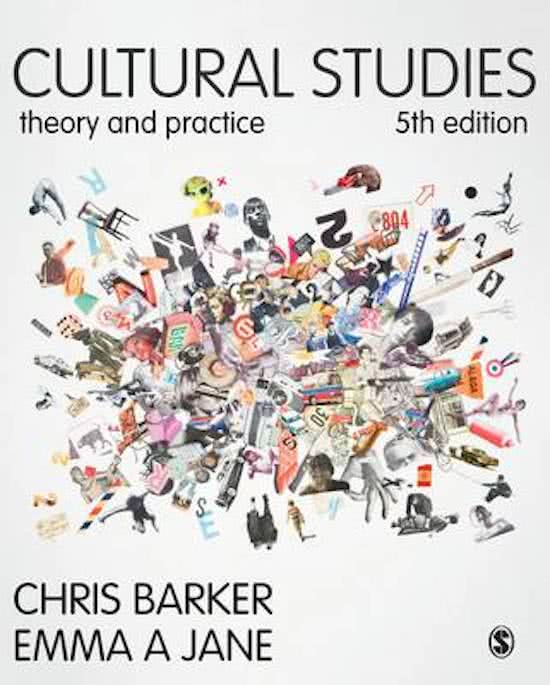
Emma A. Jane, Dr. Chris Barker Cultural Studies
Publisher: mei 2016 ISBN: 9781473919457 Edition: 1

Document information

Study
Summarized whole book?
No
Which chapters are summarized?
Relevant subjects
Uploaded on
March 13, 2018
Number of pages
9
Written in
2017/2018
Type
Summary
$4.17

Wrong document? Swap it for free Within 14 days of purchase and before downloading, you can choose a different document. You can simply spend the amount again.
Written by students who passed
Immediately available after payment
Read online or as PDF

Seller avatar
Reputation scores are based on the amount of documents a seller has sold for a fee and the reviews they have received for those documents. There are three levels: Bronze, Silver and Gold. The better the reputation, the more your can rely on the quality of the sellers work.
mientjj001
3.6
(7)
Sold
46
Followers
29
Items
7
Last sold
3 year ago

Reviews from verified buyers


Why students choose Stuvia

Created by fellow students, verified by reviews

Quality you can trust: written by students who passed their tests and reviewed by others who've used these notes.

Didn't get what you expected? Choose another document

No worries! You can instantly pick a different document that better fits what you're looking for.

Pay as you like, start learning right away

No subscription, no commitments. Pay the way you're used to via credit card and download your PDF document instantly.

Student with book image

“Bought, downloaded, and aced it. It really can be that simple.”

Alisha Student

Working on your references?

Create accurate citations in APA, MLA and Harvard with our free citation generator.

Working on your references?

Frequently asked questions