BRM Articles
Summary of the Academic Articles
SPSS and SAS procedures for estimating indirect effects in simple mediation
models (Preacher & Hayer, 2004)
- Mediation analysis is conducted in order to indirectly assess the effect of a proposed
cause on some outcome through a proposed mediator. It provides a functional
understanding of the relationships among variables.
- A mediator accounts for the relation between the predictor and the criterion. For
instance, one variable (M) mediates the effect of X on Y.
- Baron & Kenny (1986) describe a procedure developed by Sobel that provides a more
direct test of an indirect effect (in simple mediation). The Sobel test is conducted by
comparing the strength of the indirect effect of X on Y to the point null hypothesis that
it equals zero. The indirect effect of X on Y in this situation is defined as the product of
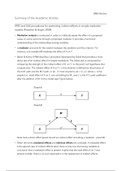
the X-M path and the M-Y path, or ab . In most situations, ab = (c -c'), where c is the
simple (i.e., total) effect of X on Y, not controlling for M , and c' is the X-Y path coefficient
after the addition of M to the model (see Figure below).
Note here a direct effect (panel A) and an indirect effect (including a mediator - panel B).
- Often the terms mediated effects and indirects effects are confused. A mediated effect
is the special case of indirect effects when there is only one intervening variables.A
conclusion that a mediation effect is present implies that the total effect X on Y was
present initially. There is no such assumption in the assessment of indirect effects.
Summary of the Academic Articles
SPSS and SAS procedures for estimating indirect effects in simple mediation
models (Preacher & Hayer, 2004)
- Mediation analysis is conducted in order to indirectly assess the effect of a proposed
cause on some outcome through a proposed mediator. It provides a functional
understanding of the relationships among variables.
- A mediator accounts for the relation between the predictor and the criterion. For
instance, one variable (M) mediates the effect of X on Y.
- Baron & Kenny (1986) describe a procedure developed by Sobel that provides a more
direct test of an indirect effect (in simple mediation). The Sobel test is conducted by
comparing the strength of the indirect effect of X on Y to the point null hypothesis that
it equals zero. The indirect effect of X on Y in this situation is defined as the product of
the X-M path and the M-Y path, or ab . In most situations, ab = (c -c'), where c is the
simple (i.e., total) effect of X on Y, not controlling for M , and c' is the X-Y path coefficient
after the addition of M to the model (see Figure below).
Note here a direct effect (panel A) and an indirect effect (including a mediator - panel B).
- Often the terms mediated effects and indirects effects are confused. A mediated effect
is the special case of indirect effects when there is only one intervening variables.A
conclusion that a mediation effect is present implies that the total effect X on Y was
present initially. There is no such assumption in the assessment of indirect effects.