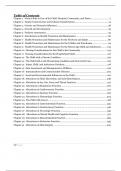
TEST BANK PRINCIPLES OF PEDIATRIC NURSING CARING FOR CHILDREN 7TH EDITION BY BALLTable of Contents Chapter 1 Nurse's Role in Care of the Child: Hospital, Community, and Home .............................. 2
Chapter 2 Family-Centered Care and Cultural Considerations ....................................................... 14 Chapter 3 Genetic and Genomic Influences.................................................................................... 28 Chapter 4 Growth and Development .............................................................................................. 39 Chapter 5 Pediatric Assessment ...................................................................................................... 53 Chapter 6 Introduction to Health Promotion and Maintenance .................................................... 66 Chapter 7 Health Promotion and Maintenance for the Newborn and Infant ................................ 80 Chapter 8 Health Promotion and Maintenance for the Toddler and Preschooler ......................... 94 Chapter 9 Health Promotion and Maintenance for the School-Age Child and Adolescent.......... 109 Chapter 10 Nursing Considerations for the Child in the Community ............................................ 125 Chapter 11 Nursing Considerations for the Hospitalized Child ..................................................... 137 Chapter 12 The Child with a Chronic Condition ............................................................................ 150 Chapter 13 The Child with a Life-Threatening Condition and End-of-Life Care .......................... 163 Chapter 14 Infant, Child, and Adolescent Nutrition ...................................................................... 178 Chapter 15 Pain Assessment and Management in Children .......................................................... 192 Chapter 16 Immunizations and Communicable Diseases ............................................................ 205 Chapter 17 Social and Environmental Influences on the Child ..................................................... 221 Chapter 18 Alterations in Fluid, Electrolyte, and Acid-Base Balance ........................................... 238 Chapter 19 Alterations in Eye, Ear, Nose, and Throat Function.................................................... 251 Chapter 20 Alterations in Respiratory Function .......................................................................... 262 Chapter 21 Alterations in Cardiovascular Function ....................................................................... 277 Chapter 22 Alterations in Immune Function ................................................................................ 292 Chapter 23 Alterations in Hematologic Function ......................................................................... 304 Chapter 24 The Child with Cancer ................................................................................................. 318 Chapter 25 Alterations in Gastrointestinal Function.................................................................... 332 Chapter 26 Alterations in Genitourinary Function ....................................................................... 346 Chapter 27 Alterations in Neurologic Function ............................................................................ 359 Chapter 28 Alterations in Mental Health and Cognitive Function ............................................... 372 Chapter 29 Alterations in Musculoskeletal Function ................................................................... 384 Chapter 30 Alterations in Endocrine Function............................................................................. 395 Chapter 31 Alterations in Skin Integrity ....................................................................................... 409
1 | P a g eChapter 1 Nurse's Role in Care of the Child: Hospital,
Community, and Home
1) Which nursing role is not directly involved when providing family-centered approach to the
pediatric population?
1. Advocacy
2. Case management
3. Patient education
4. Researcher
Answer: 4
Explanation: 1. A researcher is not involved in the family-centered approach to patient care of
children and their families. Advocacy, case management, and patient education are all roles
directly involved in the care of children and their families.
2. A researcher is not involved in the family-centered approach to patient care of children and
their families. Advocacy, case management, and patient education are all roles directly involved
in the care of children and their families.
3. A researcher is not involved in the family-centered approach to patient care of children and
their families. Advocacy, case management, and patient education are all roles directly involved
in the care of children and their families.
4. A researcher is not involved in the family-centered approach to patient care of children and
their families. Advocacy, case management, and patient education are all roles directly involved
in the care of children and their families.
Page Ref: 4
Cognitive Level: Analyzing
Client Need &Sub: Safe and Effective Care Environment: Management of Care
Standards: QSEN Competencies: Patient-centered care | AACN Essential Competencies:
Essential II: Basic organizational and systems leadership for quality care and patient safety |
NLN Competencies: Professional identity | Nursing/Integrated Concepts: Nursing Process:
Assessment/Coordination of care
Learning Outcome: LO 1.2 Compare the roles of nurses in child healthcare.
MNL LO: Family-centered care
2) A nurse is working with pediatric clients in a research facility. The nurse recognizes that
federal guidelines are in place that delineate which pediatrics clients must give assent for
participation in research trials. Based upon the client's age, the nurse would seek assent
from which children?
Select all that apply.
1. The precocious 4-year-old commencing as a cystic fibrosis research-study participant.
2. The 7-year-old leukemia client electing to receive a newly developed medication, now being
researched.
3. The 10-year-old commencing in an investigative study for clients with precocious puberty.
4. The 13-year-old client commencing participation in a research program for Attention Deficit
Hyperactivity Disorder (ADHD) treatments.
Answer: 2, 3, 4
Explanation: 1. Federal guidelines mandate that research participants 7 years old and older
must receive developmentally appropriate information about healthcare procedures and
treatments and give assent.
2. Federal guidelines mandate that research participants 7 years old and older must receive
developmentally appropriate information about healthcare procedures and treatments and
2 | P a g egive assent.
3. Federal guidelines mandate that research participants 7 years old and older must receive
developmentally appropriate information about healthcare procedures and treatments and
give assent.
4. Federal guidelines mandate that research participants 7 years old and older must receive
developmentally appropriate information about healthcare procedures and treatments and
give assent.
Page Ref: 11, 12
Cognitive Level: Applying
Client Need &Sub: Psychosocial Integrity
Standards: QSEN Competencies: Patient-centered care | AACN Essential Competencies:
Essential V: Healthcare policy, finance, and regulatory environments | NLN Competencies:
Nursing judgement | Nursing/Integrated Concepts: Nursing Process: Planning/Coordination of
care
Learning Outcome: LO 1.6 Examine three unique pediatric legal and ethical issues in pediatric
nursing practice.
MNL LO: Developmentally appropriate care
3) The nurse in a pediatric acute care unit is assigned the following tasks. Which task is not
appropriate for the nurse to complete?
1. Diagnose an 8-year-old with acute otitis media and prescribe an antibiotic.
2. Listen to the concerns of an adolescent about being out of school for a lengthy surgical
recovery.
3. Provide information to a mother of a newly diagnosed 4-year-old diabetic about local
support- group options.
4. Diagnose a 6-year-old with Diversional Activity Deficit related to placement in isolation.
Answer: 1
Explanation: 1. The role of the pediatric nurse includes providing nursing assessment, directing
nursing care interventions, and educating client and family at developmentally appropriate
levels; client advocacy, case management, minimization of distress, and enhancement of coping.
Advanced practice nurse practitioners perform assessment, diagnosis, and management of
health conditions.
2. The role of the pediatric nurse includes providing nursing assessment, directing nursing
care interventions, and educating client and family at developmentally appropriate levels;
client advocacy, case management, minimization of distress, and enhancement of coping.
Advanced practice nurse practitioners perform assessment, diagnosis, and management of
health conditions.
3. The role of the pediatric nurse includes providing nursing assessment, directing nursing
care interventions, and educating client and family at developmentally appropriate levels;
client advocacy, case management, minimization of distress, and enhancement of coping.
Advanced practice nurse practitioners perform assessment, diagnosis, and management of
health conditions.
4. The role of the pediatric nurse includes providing nursing assessment, directing nursing
care interventions, and educating client and family at developmentally appropriate levels;
client advocacy, case management, minimization of distress, and enhancement of coping.
Advanced practice nurse practitioners perform assessment, diagnosis, and management of
health conditions.
Page Ref: 2-4
Cognitive Level: Applying
Client Need &Sub: Safe and Effective Care Environment: Management of Care
3 | P a g eStandards: QSEN Competencies: Patient-centered care | AACN Essential Competencies:
Essential II: Basic organizational and systems leadership for quality care and patient safety |
NLN Competencies: Professional identity | Nursing/Integrated Concepts: Nursing Process:
Implementation/Coordination of care
Learning Outcome: LO 1.2 Compare the roles of nurses in child healthcare.
MNL LO: Pediatric nursing care
4) A 7-year-old child is admitted for acute appendicitis. The parents are questioning the nurse
about expectations during the child's recovery. Which information tool would be most useful in
answering a parent's questions about the timing of key events?
1. Healthy People 2020
2. Clinical pathways
3. Child mortality statistics
4. National clinical practice guidelines
Answer: 2
Explanation: 1. Clinical pathways are interdisciplinary documents provided by a hospital to
suggest ideal sequencing and timing of events and interventions for specific diseases to improve
efficiency of care and enhance recovery. This pathway serves as a model outlining the typical
hospital stay for individuals with specified conditions. Healthy People 2020 contains objectives
set by the U.S. government to improve the health and reduce the incidence of death in the
twenty-first century. Child mortality statistics can be compared with those from other decades for
the evaluation of achievement toward health-care goals. National clinical practice guidelines
promote uniformity in care for specific disease conditions by suggesting expected outcomes from
specific interventions.
2. Clinical pathways are interdisciplinary documents provided by a hospital to suggest ideal
sequencing and timing of events and interventions for specific diseases to improve efficiency of
care and enhance recovery. This pathway serves as a model outlining the typical hospital stay for
individuals with specified conditions. Healthy People 2020 contains objectives set by the U.S.
government to improve the health and reduce the incidence of death in the twenty-first century.
Child mortality statistics can be compared with those from other decades for the evaluation of
achievement toward health-care goals. National clinical practice guidelines promote uniformity
in care for specific disease conditions by suggesting expected outcomes from specific
interventions.
3. Clinical pathways are interdisciplinary documents provided by a hospital to suggest ideal
sequencing and timing of events and interventions for specific diseases to improve efficiency of
care and enhance recovery. This pathway serves as a model outlining the typical hospital stay for
individuals with specified conditions. Healthy People 2020 contains objectives set by the U.S.
government to improve the health and reduce the incidence of death in the twenty-first century.
Child mortality statistics can be compared with those from other decades for the evaluation of
achievement toward health-care goals. National clinical practice guidelines promote uniformity
in care for specific disease conditions by suggesting expected outcomes from specific
interventions.
4. Clinical pathways are interdisciplinary documents provided by a hospital to suggest ideal
sequencing and timing of events and interventions for specific diseases to improve efficiency of
care and enhance recovery. This pathway serves as a model outlining the typical hospital stay for
individuals with specified conditions. Healthy People 2020 contains objectives set by the U.S.
government to improve the health and reduce the incidence of death in the twenty-first century.
Child mortality statistics can be compared with those from other decades for the evaluation of
achievement toward health-care goals. National clinical practice guidelines promote uniformity
in care for specific disease conditions by suggesting expected outcomes from specific
interventions.
4 | P a g ePage Ref: 1, 2
Cognitive Level: Applying
Client Need &Sub: Psychosocial Integrity
Standards: QSEN Competencies: Patient-centered care | AACN Essential Competencies:
Essential II: Basic organizational and systems leadership for quality care and patient safety |
NLN Competencies: Nursing judgement | Nursing/Integrated Concepts: Nursing Process:
Planning/Health teaching and health promotion
Learning Outcome: LO 1.1 Describe the continuum of pediatric healthcare.
MNL LO: Family-centered care
5) The nurse recognizes that the pediatric client is from a cultural background different from
that of the hospital staff. Which goal is most appropriate for this client when planning nursing
care?
1. Overlook or minimize the differences that exist.
2. Facilitate the family's ability to comply with the care needed.
3. Avoid inadvertently offending the family by imposing the nurse's perspective.
4. Encourage complementary beneficial cultural practices as primary
therapies. Answer: 2
Explanation: 1. The incorporation of the family's cultural perspective into the care plan is most
likely to result in the family's ability to accept medical care and comply with the regimen
prescribed. Since culture develops from social learning, attempts to ignore or minimize cultural
consideration will result in mistrust, suspicion, or offenses that can have negative effects upon
the health of children by reducing the resources available to promote health and prevent illness.
Complementary therapy may be used later if other primary therapies prove to be ineffective.
2. The incorporation of the family's cultural perspective into the care plan is most likely to
result in the family's ability to accept medical care and comply with the regimen prescribed.
Since culture develops from social learning, attempts to ignore or minimize cultural
consideration will result in mistrust, suspicion, or offenses that can have negative effects upon
the health of children by reducing the resources available to promote health and prevent
illness. Complementary therapy may be used later if other primary therapies prove to be
ineffective.
3. The incorporation of the family's cultural perspective into the care plan is most likely to result
in the family's ability to accept medical care and comply with the regimen prescribed. Since
culture develops from social learning, attempts to ignore or minimize cultural consideration
will result in mistrust, suspicion, or offenses that can have negative effects upon the health of
children by reducing the resources available to promote health and prevent illness.
Complementary therapy may be used later if other primary therapies prove to be ineffective.
4. The incorporation of the family's cultural perspective into the care plan is most likely to
result in the family's ability to accept medical care and comply with the regimen prescribed.
Since culture develops from social learning, attempts to ignore or minimize cultural
consideration will result in mistrust, suspicion, or offenses that can have negative effects upon
the health of children by reducing the resources available to promote health and prevent
illness. Complementary therapy may be used later if other primary therapies prove to be
ineffective. Page Ref: 3
Cognitive Level: Applying
Client Need &Sub: Health Promotion and Maintenance
Standards: QSEN Competencies: Patient-centered care | AACN Essential Competencies:
Essential II: Basic organizational and systems leadership for quality care and patient safety |
NLN Competencies: Professional identity | Nursing/Integrated Concepts: Nursing Process:
Planning/Coordination of care
5 | P a g eLearning Outcome: LO 1.3 Analyze the current societal influences on pediatric healthcare and
nursing practice.
MNL LO: Family-centered care
6) The telephone triage nurse at a pediatric clinic knows each call is important. Which call would
require attentiveness from the nurse because of an increased risk of mortality?
1. A 3-week-old infant born at 35 weeks' gestation with gastroenteritis
2. A term 2-week-old infant of American Indian descent with an upper respiratory infection
3. A postterm 4-week-old infant non-Hispanic black descent with moderate emesis after feeding
4. A 1-week-old infant born at 40 weeks' gestation with symptoms of colic
Answer: 1
Explanation: 1. The leading causes of death in the neonatal period (birth to 28 days of age) are
short gestation, low birth weight, and congenital malformations. The preterm infant
experiencing gastroenteritis at 3 weeks of age is at the greatest risk for mortality; therefore,
would require extra attentiveness from the registered nurse.
2. The leading causes of death in the neonatal period (birth to 28 days of age) are short
gestation, low birth weight, and congenital malformations. The preterm infant experiencing
gastroenteritis at 3 weeks of age is at the greatest risk for mortality; therefore, would require
extra attentiveness from the registered nurse.
3. The leading causes of death in the neonatal period (birth to 28 days of age) are short
gestation, low birth weight, and congenital malformations. The preterm infant experiencing
gastroenteritis at 3 weeks of age is at the greatest risk for mortality; therefore, would require
extra attentiveness from the registered nurse.
4. The leading causes of death in the neonatal period (birth to 28 days of age) are short
gestation, low birth weight, and congenital malformations. The preterm infant experiencing
gastroenteritis at 3 weeks of age is at the greatest risk for mortality; therefore, would require
extra attentiveness from the registered nurse.
Page Ref: 6, 7
Cognitive Level: Applying
Client Need &Sub: Health Promotion and Maintenance
Standards: QSEN Competencies: Informatics/Patient-centered care | AACN Essential
Competencies: Essential IV: Information management and application of patient care technology
| NLN Competencies: Professional identity | Nursing/Integrated Concepts: Nursing Process:
Planning/Coordination of care
Learning Outcome: LO 1.4 Report the most common causes of child mortality by age group and
reasons for hospitalization.
MNL LO: Developmentally appropriate care
7) Despite the availability of Children's Health Insurance Programs (CHIP), many eligible
children are not enrolled. Which nursing intervention would be the most appropriate to
help children become enrolled in CHIP?
1. Assess details of the family's income and expenditures
2. Case management to limit costly, unnecessary duplication of services
3. Advocate for the child by encouraging the family to investigate SCHIP eligibility
4. Educate the family about the need for keeping regular well-child-visit
appointments Answer: 3
Explanation: 1. In the role of an advocate, a nurse will advance the interests of another; by
suggesting the family investigate its CHIP eligibility, the nurse is directing their action toward
the child's best interest. Financial assessment is more commonly the function of a social
worker. The case-management activity mentioned will not provide a source of funding nor will
the educational effort described.
6 | P a g e2. In the role of an advocate, a nurse will advance the interests of another; by suggesting the
family investigate its CHIP eligibility, the nurse is directing their action toward the child's best
interest. Financial assessment is more commonly the function of a social worker. The case-
management activity mentioned will not provide a source of funding nor will the educational
effort described.
3. In the role of an advocate, a nurse will advance the interests of another; by suggesting the
family investigate its CHIP eligibility, the nurse is directing their action toward the child's best
interest. Financial assessment is more commonly the function of a social worker. The case-
management activity mentioned will not provide a source of funding nor will the educational
effort described.
4. In the role of an advocate, a nurse will advance the interests of another; by suggesting the
family investigate its CHIP eligibility, the nurse is directing their action toward the child's best
interest. Financial assessment is more commonly the function of a social worker. The case-
management activity mentioned will not provide a source of funding nor will the educational
effort described.
Page Ref: 2-4
Cognitive Level: Applying
Client Need &Sub: Health Promotion and Maintenance
Standards: QSEN Competencies: Patient-centered care | AACN Essential Competencies:
Essential VI: Interprofessional communication and collaboration for improving patient health
outcomes | NLN Competencies: Human flourishing | Nursing/Integrated Concepts: Nursing
Process: Planning/Coordination of care
Learning Outcome: LO 1.2 Compare the roles of nurses in child healthcare.
MNL LO: Family-centered care
8) A supervisor is reviewing documentation of the nurses in the unit. Which client
documentation is the most accurate and contains all the required part for a narrative
entry?
1. "2/2/05 1630 Catheterized using an 8 French catheter, 45 mL clear yellow urine obtained,
specimen sent to lab, squirmed and cried softly during insertion of catheter. Quiet in
mother's arms following catheter removal. M. May RN"
2. "1/9/05 2 pm nasogastric tube placement confirmed and irrigated with 30 ml sterile
water. Suction set at low, intermittent. Oxygen via nasal canal at 2 L/min. Nares patent,
pink, and nonirritated. K. Earnst RN"
3. "4:00 tracheostomy dressing removed with dime-size stain of dry serous exudate. Site
cleansed with normal saline. Dried with sterile gauze. New sterile tracheostomy sponge and
trach ties applied. Respirations regular and even throughout the procedure. F. Luck RN"
4. "Feb. '05 Port-A-Cath assessed with Huber needle. Blood return present. Flushed with
NaCl solution, IV gamma globulins hung and infusing at 30 cc/hr. Child smiling and playful
throughout the procedure. P. Potter, RN"
Answer: 1
Explanation: 1. The client record should include the date and time of entry, nursing care
provided, assessments, an objective report of the client's physiologic response, exact quotes,
and the nurse's signature and title.
2. The client record should include the date and time of entry, nursing care provided,
assessments, an objective report of the client's physiologic response, exact quotes, and the
nurse's signature and title.
3. The client record should include the date and time of entry, nursing care provided,
assessments, an objective report of the client's physiologic response, exact quotes, and the
nurse's signature and title.
7 | P a g e4. The client record should include the date and time of entry, nursing care provided,
assessments, an objective report of the client's physiologic response, exact quotes, and the
nurse's signature and title.
Page Ref: 2-4
Cognitive Level: Applying
Client Need &Sub: Safe and Effective Care Environment: Management of Care
Standards: QSEN Competencies: Informatics | AACN Essential Competencies: Essential IV:
Information management and application of patient care technology | NLN Competencies:
Professional identity | Nursing/Integrated Concepts: Nursing Process:
Assessment/Coordination of care
Learning Outcome: LO 1.2 Compare the roles of nurses in child healthcare.
MNL LO: Pediatric nursing care
9) A 12-year-old pediatric client is in need of surgery. Which member of the healthcare team is
legally responsible for obtaining informed consent for an invasive procedure?
1. Nurse
2. Physician
3. Unit secretary
4. Social worker
Answer: 2
Explanation: 1. Informed consent is legal preauthorization for an invasive procedure. It is the
physician's legal responsibility to obtain this, because it consists of an explanation about the
medical condition, a detailed description of treatment plans, the expected benefits and risks
related to the proposed treatment plan, alternative treatment options, the client's questions,
and the guardian's right to refuse treatment.
2. Informed consent is legal preauthorization for an invasive procedure. It is the physician's
legal responsibility to obtain this, because it consists of an explanation about the medical
condition, a detailed description of treatment plans, the expected benefits and risks related to
the proposed treatment plan, alternative treatment options, the client's questions, and the
guardian's right to refuse treatment.
3. Informed consent is legal preauthorization for an invasive procedure. It is the physician's
legal responsibility to obtain this, because it consists of an explanation about the medical
condition, a detailed description of treatment plans, the expected benefits and risks related to
the proposed treatment plan, alternative treatment options, the client's questions, and the
guardian's right to refuse treatment.
4. Informed consent is legal preauthorization for an invasive procedure. It is the physician's
legal responsibility to obtain this, because it consists of an explanation about the medical
condition, a detailed description of treatment plans, the expected benefits and risks related to
the proposed treatment plan, alternative treatment options, the client's questions, and the
guardian's right to refuse treatment.
Page Ref: 11, 12
Cognitive Level: Applying
Client Need &Sub: Safe and Effective Care Environment: Management of Care
Standards: QSEN Competencies: Informatics | AACN Essential Competencies: Essential IV:
Information management and application of patient care technology | NLN Competencies:
Professional identity | Nursing/Integrated Concepts: Nursing Process: Planning/Communication
Learning Outcome: LO 1.5 Contrast the policies for obtaining informed consent of minors to
policies for adults.
MNL LO: Developmentally appropriate care
10) A child is being prepared for an invasive procedure. The mother of the child has legal
8 | P a g ecustody but is not present. After details of the procedure are explained, who can provide legal
consent on behalf of a minor child for treatment?
1. The divorced parent without custody
2. A cohabitating boyfriend of the child's mother
3. A grandparent who lives in the home with the child
4. A babysitter with written proxy
Answer: 4
Explanation: 1. A parent may grant proxy consent in writing to another adult so that children
are not denied necessary healthcare. In the case of divorced parents, the parent with custody
may be the only parent allowed by some states to give informed consent. Residence in the same
household with a child does not authorize an adult to sign consent for treatment.
2. A parent may grant proxy consent in writing to another adult so that children are not denied
necessary healthcare. In the case of divorced parents, the parent with custody may be the only
parent allowed by some states to give informed consent. Residence in the same household with
a child does not authorize an adult to sign consent for treatment.
3. A parent may grant proxy consent in writing to another adult so that children are not denied
necessary healthcare. In the case of divorced parents, the parent with custody may be the only
parent allowed by some states to give informed consent. Residence in the same household with
a child does not authorize an adult to sign consent for treatment.
4. A parent may grant proxy consent in writing to another adult so that children are not denied
necessary healthcare. In the case of divorced parents, the parent with custody may be the only
parent allowed by some states to give informed consent. Residence in the same household with
a child does not authorize an adult to sign consent for treatment.
Page Ref: 11, 12
Cognitive Level: Applying
Client Need &Sub: Safe and Effective Care Environment: Management of Care
Standards: QSEN Competencies: Informatics | AACN Essential Competencies: Essential IV:
Information management and application of patient care technology | NLN Competencies:
Professional identity | Nursing/Integrated Concepts: Nursing Process: Planning
Learning Outcome: LO 1.5 Contrast the policies for obtaining informed consent of minors to
policies for adults.
MNL LO: Family-centered care
11) A 12-year-old child is admitted to the unit for a surgical procedure. The child is accompanied
by two parents and a younger sibling. What is the level of involvement in treatment decision
making for this child?
1. Emancipated minor
2. Mature minor
3. Assent
4. None
Answer: 3
Explanation: 1. Assent requires the ability to generally understand what procedure and
treatments are planned, to understand what participation is required, and to make a statement
of agreement or disagreement with the plan. Usually, in Piaget's stage of formal operations, 11-
to 13-year-olds should be able to problem solve using abstract concepts and are able to give
valid assent when parents sign the informed consent. An emancipated minor is a self-
supporting adolescent who is not subject to the control of a parent or guardian. A mature
minor is a 14- or 15-year-old whom the state law designates as being able to understand
medical risks and who is thus permitted to give informed consent for treatment.
2. Assent requires the ability to generally understand what procedure and treatments are
9 | P a g eplanned, to understand what participation is required, and to make a statement of agreement or
disagreement with the plan. Usually, in Piaget's stage of formal operations, 11- to 13-year-olds
should be able to problem solve using abstract concepts and are able to give valid assent when
parents sign the informed consent. An emancipated minor is a self-supporting adolescent who
is not subject to the control of a parent or guardian. A mature minor is a 14- or 15-year-old
whom the state law designates as being able to understand medical risks and who is thus
permitted to give informed consent for treatment.
3. Assent requires the ability to generally understand what procedure and treatments are
planned, to understand what participation is required, and to make a statement of agreement or
disagreement with the plan. Usually, in Piaget's stage of formal operations, 11- to 13-year-olds
should be able to problem solve using abstract concepts and are able to give valid assent when
parents sign the informed consent. An emancipated minor is a self-supporting adolescent who
is not subject to the control of a parent or guardian. A mature minor is a 14- or 15-year-old
whom the state law designates as being able to understand medical risks and who is thus
permitted to give informed consent for treatment.
4. Assent requires the ability to generally understand what procedure and treatments are
planned, to understand what participation is required, and to make a statement of agreement or
disagreement with the plan. Usually, in Piaget's stage of formal operations, 11- to 13-year-olds
should be able to problem solve using abstract concepts and are able to give valid assent when
parents sign the informed consent. An emancipated minor is a self-supporting adolescent who
is not subject to the control of a parent or guardian. A mature minor is a 14- or 15-year-old
whom the state law designates as being able to understand medical risks and who is thus
permitted to give informed consent for treatment.
Page Ref: 11, 12
Cognitive Level: Analyzing
Client Need &Sub: Safe and Effective Care Environment: Management of Care
Standards: QSEN Competencies: Patient-centered care | AACN Essential Competencies:
Essential V: Healthcare policy, finance, and regulatory environments | NLN
Competencies:
Professional identity | Nursing/Integrated Concepts: Nursing Process: Planning/Communication
Learning Outcome: LO 1.5 Contrast the policies for obtaining informed consent of minors to
policies for adults.
MNL LO: Developmentally appropriate care
12) Which nursing intervention is most appropriate when providing education to the
pediatric client and family?
1. Giving primary care for high-risk children who are in hospital settings
2. Giving primary care for healthy children
3. Working toward the goal of informed choices with the family
4. Obtaining a physician consultation for any technical procedures at
delivery Answer: 3
Explanation: 1. The educator works with the family toward the goal of making informed choices
through education and explanation.
2. The educator works with the family toward the goal of making informed choices through
education and explanation.
3. The educator works with the family toward the goal of making informed choices through
education and explanation.
4. The educator works with the family toward the goal of making informed choices through
education and explanation.
10 | P a g ePage Ref: 3
Cognitive Level: Applying
Client Need &Sub: Safe and Effective Care Environment: Management of Care
Standards: QSEN Competencies: Patient-centered care | AACN Essential Competencies:
Essential II: Basic organizational and systems leadership for quality care and patient safety |
NLN Competencies: Professional identity | Nursing/Integrated Concepts: Nursing Process:
Planning/Health teaching and health promotion
Learning Outcome: LO 1.2 Compare the roles of nurses in child healthcare.
MNL LO: Family-centered care
13) What is the pediatric nurse's best defense against an accusation of malpractice or negligence?
1. Following the physician's written orders
2. Meeting the scope and standards of practice for pediatric nursing
3. Being a nurse practitioner or clinical nurse specialist
4. Acting on the advice of the nurse manager
Answer: 2
Explanation: 1. Meeting the scope and standards of practice for pediatric nursing would cover
the pediatric nurse against an accusation of malpractice or negligence because the standards are
rigorous and cover all bases of excellent nursing practice. Following the physician's written
orders or acting on the advice of the nurse manager are not enough to defend the nurse from
accusations because the orders and/or advice may be wrong or unethical. Being a clinical nurse
specialist or nurse practitioner does not defend the nurse against these accusations if he or she
does not follow the Society of Pediatric Nurses standards of practice.
2. Meeting the scope and standards of practice for pediatric nursing would cover the pediatric
nurse against an accusation of malpractice or negligence because the standards are rigorous
and cover all bases of excellent nursing practice. Following the physician's written orders or
acting on the advice of the nurse manager are not enough to defend the nurse from accusations
because the orders and/or advice may be wrong or unethical. Being a clinical nurse specialist or
nurse practitioner does not defend the nurse against these accusations if he or she does not
follow the Society of Pediatric Nurses standards of practice.
3. Meeting the scope and standards of practice for pediatric nursing would cover the pediatric
nurse against an accusation of malpractice or negligence because the standards are rigorous
and cover all bases of excellent nursing practice. Following the physician's written orders or
acting on the advice of the nurse manager are not enough to defend the nurse from accusations
because the orders and/or advice may be wrong or unethical. Being a clinical nurse specialist or
nurse practitioner does not defend the nurse against these accusations if he or she does not
follow the Society of Pediatric Nurses standards of practice.
4. Meeting the scope and standards of practice for pediatric nursing would cover the pediatric
nurse against an accusation of malpractice or negligence because the standards are rigorous
and cover all bases of excellent nursing practice. Following the physician's written orders or
acting on the advice of the nurse manager are not enough to defend the nurse from accusations
because the orders and/or advice may be wrong or unethical. Being a clinical nurse specialist or
nurse practitioner does not defend the nurse against these accusations if he or she does not
follow the Society of Pediatric Nurses standards of practice.
Page Ref: 9-11
Cognitive Level: Analyzing
Client Need &Sub: Safe and Effective Care Environment: Management of Care
Standards: QSEN Competencies: Patient-centered care | AACN Essential Competencies:
Essential V: Healthcare policy, finance, and regulatory environments | NLN
Competencies: Professional identity | Nursing/Integrated Concepts: Nursing Process:
Planning/Ethics
11 | P a g eLearning Outcome: LO 1.6 Examine three unique pediatric legal and ethical issues in pediatric
nursing practice.
MNL LO: Pediatric nursing care
14) Which legal or ethical offense would be committed if a nurse tells family members the
condition of a newborn baby without first consulting the parents?
1. A breach of privacy
2. Negligence
3. Malpractice
4. A breach of ethics
Answer: 1
Explanation: 1. A breach of privacy would have been committed in this situation, because it
violates the right to privacy of this family. The right to privacy is the right of a person to keep his
or her person and property free from public scrutiny, including other family members.
Negligence and malpractice are punishable legal offenses and are more serious. A breach of
ethics would not apply to this situation.
2. A breach of privacy would have been committed in this situation, because it violates the right
to privacy of this family. The right to privacy is the right of a person to keep his or her person
and property free from public scrutiny, including other family members. Negligence and
malpractice are punishable legal offenses and are more serious. A breach of ethics would not
apply to this situation.
3. A breach of privacy would have been committed in this situation, because it violates the right
to privacy of this family. The right to privacy is the right of a person to keep his or her person
and property free from public scrutiny, including other family members. Negligence and
malpractice are punishable legal offenses and are more serious. A breach of ethics would not
apply to this situation.
4. A breach of privacy would have been committed in this situation, because it violates the right
to privacy of this family. The right to privacy is the right of a person to keep his or her person
and property free from public scrutiny, including other family members. Negligence and
malpractice are punishable legal offenses and are more serious. A breach of ethics would not
apply to this situation.
Page Ref: 9-11
Cognitive Level: Applying
Client Need &Sub: Safe and Effective Care Environment: Management of Care
Standards: QSEN Competencies: Patient-centered care | AACN Essential Competencies:
Essential V: Healthcare policy, finance, and regulatory environments | NLN
Competencies:
Professional identity | Nursing/Integrated Concepts: Nursing Process: Implementation/Ethics
Learning Outcome: LO 1.6 Examine three unique pediatric legal and ethical issues in pediatric
nursing practice.
MNL LO: Family-centered care
15) Pediatric nurses have foundational knowledge obtained in nursing school and add
specific competencies related to the pediatric client. Which would be considered an
additional specific expected competency of the pediatric nurse?
1. Physical assessment
2. Anatomical and developmental differences
3. Nursing process
4. Management of healthcare
conditions Answer: 2
Explanation: 1. Assessing anatomical and developmental differences would be a specific
12 | P a g eexpected competency for the pediatric nurse that would not be learned in nursing school.
Physical assessment, nursing process, and management of health conditions are all
foundational knowledge learned in nursing school.
2. Assessing anatomical and developmental differences would be a specific expected
competency for the pediatric nurse that would not be learned in nursing school.
Physical assessment, nursing process, and management of health conditions are all
foundational knowledge learned in nursing school.
3. Assessing anatomical and developmental differences would be a specific expected
competency for the pediatric nurse that would not be learned in nursing school.
Physical assessment, nursing process, and management of health conditions are all
foundational knowledge learned in nursing school.
4. Assessing anatomical and developmental differences would be a specific expected
competency for the pediatric nurse that would not be learned in nursing school.
Physical assessment, nursing process, and management of health conditions are all
foundational knowledge learned in nursing school.
Page Ref: 2-4
Cognitive Level: Applying
Client Need &Sub: Safe and Effective Care Environment: Management of Care
Standards: QSEN Competencies: Patient-centered care | AACN Essential Competencies:
Essential II: Basic organizational and systems leadership for quality care and patient safety |
NLN Competencies: Nursing judgement | Nursing/Integrated Concepts: Nursing Process:
Assessment/Education
Learning Outcome: LO 1.2 Compare the roles of nurses in child healthcare.
MNL LO: Pediatric nursing care
16) Which of the following are components of family-centered care? Select all that apply.
1. Recognizing and building on family strengths
2. Meeting the emotional, social, and developmental needs of the child and family
3. Respect all parenting practices
4. Support all cultural practices
5. Encourage parent-to-parent
support Answer: 1, 2, 5
Explanation: 1. Recognizing and building on family strengths are one of the components of
family-centered care.
2. Meeting the emotional, social, and developmental needs of the child and family are included
in the components of family-centered care.
3. Respecting all parenting practices is not one of the components of family-centered care.
4. Supporting all cultural practices is not one of the components of family-centered care.
5. Encouraging parent-to-parent support is one of the components of family-centered
care. Page Ref: 6
Cognitive Level: Applying
Client Need &Sub: Safe and Effective Care Environment: Management of Care
Standards: QSEN Competencies: Patient-centered care | AACN Essential Competencies:
Essential II: Basic organizational and systems leadership for quality care and patient safety |
NLN Competencies: Human flourishing | Nursing/Integrated Concepts: Nursing Process:
Intervention/Coordination of care
Learning Outcome: LO 1.1 Describe the continuum of pediatric healthcare.
MNL LO: Family-centered care
17) A three-week-old infant is returned post-pyloromyotomy three hours ago. The father is
refusing pain medication for the infant and states, "The baby is hungry. Can I give the baby a
13 | P a g ebottle?" How should the nurse best advocate for the infant? Select all that apply.
1. Call the physician to ask if the child can feed yet.
2. The FLACC scale rating is 8 out of 10; try swaddling and rocking the infant.
3. Ask the parent to obtain a FLACC scale rating and let the nurse know what rating they get.
4. Educate the parent about the surgery and why the infant should not have anything by mouth.
5. Inform the parent about the meaning of the pain scale and the need for pain
medication. Answer: 4, 5
Explanation: 1. Calling the physician to ask if the infant can feed yet is not the best way to
advocate for the infant.
2. Swaddling and rocking the infant may calm the child but is not the best way to advocate for
the infant.
3. Asking the parent to obtain a FLACC scale rating and let the nurse know what rating they get.
This is not the parents' duty. It is the nurse's responsibility to assess pain.
4. Educating the parent about the surgery and why the infant should not have anything by
mouth is a good way to advocate for the infant.
5. Informing the parent about the meaning of the pain scale and the need for pain medication is
a good way to advocate for the infant.
Page Ref: 3
Cognitive Level: Analyzing
Client Need &Sub: Safe and Effective Care Environment: Management of Care
Standards: QSEN Competencies: Patient-centered care | AACN Essential Competencies:
Essential II: Basic organizational and systems leadership for quality care and patient safety |
NLN Competencies: Human flourishing | Nursing/Integrated Concepts: Nursing Process:
Assessment/Health teaching and health promotion
Learning Outcome: LO 1.2 Compare the roles of nurses in child healthcare.
MNL LO: Developmentally appropriate care
Chapter 2 Family-Centered Care and Cultural Considerations
1) The nurse is planning care for an adolescent client who will be hospitalized for several weeks
following a traumatic brain injury. Which interventions will enhance family-centered care for
this client and family? Select all that apply.
1. Making all ADL decisions for the adolescent and family
2. Asking the adolescent what foods to include during meal time
3. Allowing the family time to pray each day with the adolescent
4. Encouraging the adolescent's friends to visit during visiting hours
5. Leaving all questions for the healthcare provider
Answer: 2, 3, 4
Explanation: 1. Interventions that will enhance family-centered care for this client and family
include asking the adolescent to be an active member of care by making food choices, allowing
the family to pray each day with the adolescent, and encouraging the adolescent's friends to
visit during visiting hours. These interventions each promote the concepts of family-centered
care.
Making all decisions for the adolescent and family and leaving all questions for the healthcare
provider do not promote the concepts of family-centered care.
2. Interventions that will enhance family-centered care for this client and family include
asking the adolescent to be an active member of care by making food choices, allowing the
family to pray each day with the adolescent, and encouraging the adolescent's friends to visit
during visiting hours. These interventions each promote the concepts of family-centered care.
Making all decisions for the adolescent and family and leaving all questions for the healthcare
14 | P a g eprovider do not promote the concepts of family-centered care.
3. Interventions that will enhance family-centered care for this client and family include
asking the adolescent to be an active member of care by making food choices, allowing the
family to pray each day with the adolescent, and encouraging the adolescent's friends to visit
during visiting hours. These interventions each promote the concepts of family-centered care.
Making all decisions for the adolescent and family and leaving all questions for the healthcare
provider do not promote the concepts of family-centered care.
4. Interventions that will enhance family-centered care for this client and family include
asking the adolescent to be an active member of care by making food choices, allowing the
family to pray each day with the adolescent, and encouraging the adolescent's friends to visit
during visiting hours. These interventions each promote the concepts of family-centered care.
Making all decisions for the adolescent and family and leaving all questions for the healthcare
provider do not promote the concepts of family-centered care.
5. Interventions that will enhance family-centered care for this client and family include
asking the adolescent to be an active member of care by making food choices, allowing the
family to pray each day with the adolescent, and encouraging the adolescent's friends to visit
during visiting hours. These interventions each promote the concepts of family-centered care.
Making all decisions for the adolescent and family and leaving all questions for the healthcare
provider do not promote the concepts of family-centered care.
Page Ref: 18, 19
Cognitive Level: Applying
Client Need &Sub: Health Promotion and Maintenance
Standards: QSEN Competencies: Patient-centered care | AACN Essential Competencies:
Essential II: Basic organizational and systems leadership for quality care and patient safety |
NLN Competencies: Nursing judgement | Nursing/Integrated Concepts: Nursing Process:
Implementation/Coordination of care
Learning Outcome: LO 2.7 Develop a family-centered nursing care plan for the child and
family.
MNL LO: Examine health promotion, stress reduction therapies, and safety for hospitalized
child and family.
2) A new pediatric hospital will open soon. While planning nursing care, the hospital
administration is considering two models of providing healthcare: family-focused care
and family-centered care. Which action best demonstrates family-centered care?
1. Telling the family what must be done for the family's health
2. Assuming the role of an expert professional to direct the healthcare
3. Intervening for the child and family as a unit
4. Conferring with the family in deciding which healthcare option will be chosen
Answer: 4
Explanation: 1. The benefit of employing the family-centered-care philosophy is that the
priorities and needs as seen by the family are addressed as a partnership between a family and a
nurse develops. In family-focused care, the healthcare worker assumes the role of professional
expert while missing the multiple contributions the family brings to the healthcare meeting.
2. The benefit of employing the family-centered-care philosophy is that the priorities and needs
as seen by the family are addressed as a partnership between a family and a nurse develops. In
family-focused care, the healthcare worker assumes the role of professional expert while missing
the multiple contributions the family brings to the healthcare meeting.
3. The benefit of employing the family-centered-care philosophy is that the priorities and needs
as seen by the family are addressed as a partnership between a family and a nurse develops. In
15 | P a g efamily-focused care, the healthcare worker assumes the role of professional expert while missing
the multiple contributions the family brings to the healthcare meeting.
4. The benefit of employing the family-centered-care philosophy is that the priorities and needs
as seen by the family are addressed as a partnership between a family and a nurse develops. In
family-focused care, the healthcare worker assumes the role of professional expert while missing
the multiple contributions the family brings to the healthcare meeting.
Page Ref: 18, 19
Cognitive Level: Applying
Client Need &Sub: Psychosocial Integrity
Standards: QSEN Competencies: Patient-centered care | AACN Essential Competencies:
Essential II: Basic organizational and systems leadership for quality care and patient safety |
NLN Competencies: Professional identity | Nursing/Integrated Concepts: Nursing Process:
Planning/Coordination of care
Learning Outcome: LO 2.1 Describe key concepts of family-centered care.
MNL LO: Examine the concepts related to the hospitalization of a child.
3) A school-age client tells you that "Grandpa, Mommy, Daddy, and my brother live at my
house." Which type of family will the nurse identify in the medical record based on this
description?
1. Binuclear family
2. Extended family
3. Gay or lesbian family
4. Traditional nuclear family
Answer: 2
Explanation: 1. An extended family contains a parent or a couple who share the house with their
children and another adult relative. A binuclear family includes the divorced parents who have
joint custody of their biologic children, while the children alternate spending varying amounts of
time in the home of each parent. A gay or lesbian family is comprised of two same-sex domestic
partners; they may or may not have children. The traditional nuclear family consists of an
employed provider parent, a homemaking parent, and the biologic children of this union.
2. An extended family contains a parent or a couple who share the house with their children
and another adult relative. A binuclear family includes the divorced parents who have joint
custody of their biologic children, while the children alternate spending varying amounts of
time in the home of each parent. A gay or lesbian family is comprised of two same-sex
domestic partners; they may or may not have children. The traditional nuclear family consists
of an employed provider parent, a homemaking parent, and the biologic children of this union.
3. An extended family contains a parent or a couple who share the house with their children
and another adult relative. A binuclear family includes the divorced parents who have joint
custody of their biologic children, while the children alternate spending varying amounts of
time in the home of each parent. A gay or lesbian family is comprised of two same-sex
domestic partners; they may or may not have children. The traditional nuclear family consists
of an employed provider parent, a homemaking parent, and the biologic children of this union.
4. An extended family contains a parent or a couple who share the house with their children
and another adult relative. A binuclear family includes the divorced parents who have joint
custody of their biologic children, while the children alternate spending varying amounts of
time in the home of each parent. A gay or lesbian family is comprised of two same-sex
domestic partners; they may or may not have children. The traditional nuclear family consists
of an employed provider parent, a homemaking parent, and the biologic children of this union.
Page Ref: 19, 20
Cognitive Level: Applying
16 | P a g eClient Need &Sub: Psychosocial Integrity
Standards: QSEN Competencies: Patient-centered care | AACN Essential Competencies:
Essential IX: Baccalaureate generalist nursing practice | NLN Competencies: Professional
identity | Nursing/Integrated Concepts: Nursing Process: Assessment/Coordination of
care Learning Outcome: LO 2.2 Compare the characteristics of different types of
families.
MNL LO: Examine health promotion, stress reduction therapies, and safety for
hospitalized child and family.
4) The nurse is performing an assessment of a child's biologic family history. Which situation
would necessitate the nurse's asking the mother for information should use the term "child's
father" instead of "your husband"?
1. Traditional nuclear family
2. Traditional extended family
3. Two-income nuclear family
4. Cohabitating informal stepfamily
Answer: 4
Explanation: 1. The mother from the cohabitating informal stepfamily does not have a husband;
the nurse should be asking about the "child's father." In the traditional nuclear family, the
traditional extended family, and the two-income nuclear family, the child's father is the same
person as the mother's husband.
2. The mother from the cohabitating informal stepfamily does not have a husband; the nurse
should be asking about the "child's father." In the traditional nuclear family, the traditional
extended family, and the two-income nuclear family, the child's father is the same person as
the mother's husband.
3. The mother from the cohabitating informal stepfamily does not have a husband; the nurse
should be asking about the "child's father." In the traditional nuclear family, the traditional
extended family, and the two-income nuclear family, the child's father is the same person as
the mother's husband.
4. The mother from the cohabitating informal stepfamily does not have a husband; the nurse
should be asking about the "child's father." In the traditional nuclear family, the traditional
extended family, and the two-income nuclear family, the child's father is the same person as
the mother's husband.
Page Ref: 19, 20
Cognitive Level: Applying
Client Need &Sub: Psychosocial Integrity
Standards: QSEN Competencies: Patient-centered care | AACN Essential Competencies:
Essential IX: Baccalaureate generalist nursing practice | NLN Competencies: Nursing
judgement
| Nursing/Integrated Concepts: Nursing Process: Assessment/Coordination of care
Learning Outcome: LO 2.2 Compare the characteristics of different types of families.
MNL LO: Examine the role of the nurse in promoting culturally competent family-centered
care.
5) Several children arrived at the emergency department accompanied by their fathers.
Which father may legally sign emergency medical consent for treatment?
1. The divorced one from the binuclear family
2. The stepfather from the blended or reconstituted family
3. The divorced one when the single-parent mother has custody
4. The nonbiologic one from the heterosexual cohabitating family
Answer: 1
17 | P a g eExplanation: 1. The divorced father from the binuclear family may sign informed consent
because he has equal legal rights with the mother under joint-custody arrangements. The
nonbiologic stepfather from the blended or reconstituted family, the divorced biologic father
when the single-parent mother has custody, and the nonbiologic father from the heterosexual
cohabitating family are without legal authority to seek emergency medical care for the child.
2. The divorced father from the binuclear family may sign informed consent because he has
equal legal rights with the mother under joint-custody arrangements. The nonbiologic
stepfather from the blended or reconstituted family, the divorced biologic father when the
single-parent mother has custody, and the nonbiologic father from the heterosexual
cohabitating family are without legal authority to seek emergency medical care for the child.
3. The divorced father from the binuclear family may sign informed consent because he has
equal legal rights with the mother under joint-custody arrangements. The nonbiologic
stepfather from the blended or reconstituted family, the divorced biologic father when the
single-parent mother has custody, and the nonbiologic father from the heterosexual
cohabitating family are without legal authority to seek emergency medical care for the child.
4. The divorced father from the binuclear family may sign informed consent because he has
equal legal rights with the mother under joint-custody arrangements. The nonbiologic
stepfather from the blended or reconstituted family, the divorced biologic father when the
single-parent mother has custody, and the nonbiologic father from the heterosexual
cohabitating family are without legal authority to seek emergency medical care for the child.
Page Ref: 20
Cognitive Level: Applying
Client Need &Sub: Psychosocial Integrity
Standards: QSEN Competencies: Patient-centered care | AACN Essential Competencies:
Essential II: Basic organizational and systems leadership for quality care and patient safety |
NLN Competencies: Professional identity | Nursing/Integrated Concepts: Nursing Process:
Planning/Coordination of care
Learning Outcome: LO 2.2 Compare the characteristics of different types of families.
MNL LO: Examine the role of the nurse in promoting culturally competent family-centered
care.
6) The community health nurse is assessing several families for various strengths and needs
in regard to after-school and backup childcare arrangements. Which family type will benefit
the most from this assessment and subsequent interventions?
1. The binuclear family
2. The extended family
3. The single-parent family
4. The traditional nuclear family
Answer: 3
Explanation: 1. The single-parent family most typically lacks social, emotional, and financial
resources. Nursing considerations for such families should include referrals to options that will
enable the parent to fulfill work commitments while providing the child with access to resources
that can support the child's growth and development. The binuclear family, the extended family,
and the traditional nuclear family generally have at least two adults who can share in the care and
the nurturing of its children.
2. The single-parent family most typically lacks social, emotional, and financial resources.
Nursing considerations for such families should include referrals to options that will enable
the parent to fulfill work commitments while providing the child with access to resources that
can support the child's growth and development. The binuclear family, the extended family,
and the traditional nuclear family generally have at least two adults who can share in the care
18 | P a g eand the nurturing of its children.
3. The single-parent family most typically lacks social, emotional, and financial resources.
Nursing considerations for such families should include referrals to options that will enable
the parent to fulfill work commitments while providing the child with access to resources that
can support the child's growth and development. The binuclear family, the extended family,
and the traditional nuclear family generally have at least two adults who can share in the care
and the nurturing of its children.
4. The single-parent family most typically lacks social, emotional, and financial resources.
Nursing considerations for such families should include referrals to options that will enable
the parent to fulfill work commitments while providing the child with access to resources that
can support the child's growth and development. The binuclear family, the extended family,
and the traditional nuclear family generally have at least two adults who can share in the care
and the nurturing of its children.
Page Ref: 19, 20
Cognitive Level: Applying
Client Need &Sub: Psychosocial Integrity
Standards: QSEN Competencies: Patient-centered care | AACN Essential Competencies:
Essential VII: Clinical prevention and population health | NLN Competencies: Nursing
judgement | Nursing/Integrated Concepts: Nursing Process: Assessment/Health teaching and
health promotion
Learning Outcome: LO 2.2 Compare the characteristics of different types of families.
MNL LO: Apply key concepts of family-centered care.
7) The nurse is working on parenting skills with a group of mothers. Which mother would need
the fewest discipline-related suggestions?
1. Authoritarian
2. Authoritative
3. Indifferent
4. Permissive
Answer: 2
Explanation: 1. The parental style that results in positive outcomes for the behavior and
learning of its children is the authoritative style. Nurses have observed that children from
homes using this parental style more frequently have personalities manifesting self-reliance,
self-control, and social competence. These parents should be praised for using the preferred
approach. Children in the authoritarian parenting family are denied opportunity to develop
some skills in the areas of self-direction, communication, and negotiation. Under the
permissive parental style, children do not learn the socially acceptable limits of behaviors. The
indifferent parental style results in children who often exhibit destructive behaviors and
delinquency.
2. The parental style that results in positive outcomes for the behavior and learning of its
children is the authoritative style. Nurses have observed that children from homes using this
Content preview
Table of Contents
Chapter 1 Nurse's Role in Care of the Child: Hospital, Community, and Home .............................. 2
Chapter 2 Family-Centered Care and Cultural Considerations ....................................................... 14
Chapter 3 Genetic and Genomic Influences.................................................................................... 28
Chapter 4 Growth and Development .............................................................................................. 39
Chapter 5 Pediatric Assessment ...................................................................................................... 53
Chapter 6 Introduction to Health Promotion and Maintenance .................................................... 66
Chapter 7 Health Promotion and Maintenance for the Newborn and Infant ................................ 80
Chapter 8 Health Promotion and Maintenance for the Toddler and Preschooler ......................... 94
Chapter 9 Health Promotion and Maintenance for the School-Age Child and Adolescent.......... 109
Chapter 10 Nursing Considerations for the Child in the Community ............................................ 125
Chapter 11 Nursing Considerations for the Hospitalized Child ..................................................... 137
Chapter 12 The Child with a Chronic Condition ............................................................................150
Chapter 13 The Child with a Life-Threatening Condition and End-of-Life Care .......................... 163
Chapter 14 Infant, Child, and Adolescent Nutrition ...................................................................... 178
Chapter 15 Pain Assessment and Management in Children .......................................................... 192
Chapter 16 Immunizations and Communicable Diseases ............................................................ 205
Chapter 17 Social and Environmental Influences on the Child ..................................................... 221
Chapter 18 Alterations in Fluid, Electrolyte, and Acid-Base Balance ........................................... 238
Chapter 19 Alterations in Eye, Ear, Nose, and Throat Function.................................................... 251
Chapter 20 Alterations in Respiratory Function .......................................................................... 262
Chapter 21 Alterations in Cardiovascular Function ....................................................................... 277
Chapter 22 Alterations in Immune Function................................................................................ 292
Chapter 23 Alterations in Hematologic Function ......................................................................... 304
Chapter 24 The Child with Cancer .................................................................................................318
Chapter 25 Alterations in Gastrointestinal Function.................................................................... 332
Chapter 26 Alterations in Genitourinary Function....................................................................... 346
Chapter 27 Alterations in Neurologic Function ............................................................................ 359
Chapter 28 Alterations in Mental Health and Cognitive Function............................................... 372
Chapter 29 Alterations in Musculoskeletal Function ................................................................... 384
Chapter 30 Alterations in Endocrine Function............................................................................. 395
Chapter 31 Alterations in Skin Integrity ....................................................................................... 409
1|Page
,Chapter 1 Nurse's Role in Care of the Child: Hospital,
Community, and Home
1) Which nursing role is not directly involved when providing family-centered approach to the
pediatric population?
1. Advocacy
2. Case management
3. Patient education
4. Researcher
Answer: 4
Explanation: 1. A researcher is not involved in the family-centered approach to patient care of
children and their families. Advocacy, case management, and patient education are all roles
directly involved in the care of children and their families.
2. A researcher is not involved in the family-centered approach to patient care of children and
their families. Advocacy, case management, and patient education are all roles directly involved
in the care of children and their families.
3. A researcher is not involved in the family-centered approach to patient care of children and
their families. Advocacy, case management, and patient education are all roles directly involved
in the care of children and their families.
4. A researcher is not involved in the family-centered approach to patient care of children and
their families. Advocacy, case management, and patient education are all roles directly involved
in the care of children and their families.
Page Ref: 4
Cognitive Level: Analyzing
Client Need &Sub: Safe and Effective Care Environment: Management of Care
Standards: QSEN Competencies: Patient-centered care | AACN Essential Competencies:
Essential II: Basic organizational and systems leadership for quality care and patient safety |
NLN Competencies: Professional identity | Nursing/Integrated Concepts: Nursing Process:
Assessment/Coordination of care
Learning Outcome: LO 1.2 Compare the roles of nurses in child healthcare.
MNL LO: Family-centered care
2) A nurse is working with pediatric clients in a research facility. The nurse recognizes that
federal guidelines are in place that delineate which pediatrics clients must give assent for
participation in research trials. Based upon the client's age, the nurse would seek assent
from which children?
Select all that apply.
1. The precocious 4-year-old commencing as a cystic fibrosis research-study participant.
2. The 7-year-old leukemia client electing to receive a newly developed medication, now being
researched.
3. The 10-year-old commencing in an investigative study for clients with precocious puberty.
4. The 13-year-old client commencing participation in a research program for Attention Deficit
Hyperactivity Disorder (ADHD) treatments.
Answer: 2, 3, 4
Explanation: 1. Federal guidelines mandate that research participants 7 years old and older
must receive developmentally appropriate information about healthcare procedures and
treatments and give assent.
2. Federal guidelines mandate that research participants 7 years old and older must receive
developmentally appropriate information about healthcare procedures and treatments and
2|Page
,give assent.
3. Federal guidelines mandate that research participants 7 years old and older must receive
developmentally appropriate information about healthcare procedures and treatments and
give assent.
4. Federal guidelines mandate that research participants 7 years old and older must receive
developmentally appropriate information about healthcare procedures and treatments and
give assent.
Page Ref: 11, 12
Cognitive Level: Applying
Client Need &Sub: Psychosocial Integrity
Standards: QSEN Competencies: Patient-centered care | AACN Essential Competencies:
Essential V: Healthcare policy, finance, and regulatory environments | NLN Competencies:
Nursing judgement | Nursing/Integrated Concepts: Nursing Process: Planning/Coordination of
care
Learning Outcome: LO 1.6 Examine three unique pediatric legal and ethical issues in pediatric
nursing practice.
MNL LO: Developmentally appropriate care
3) The nurse in a pediatric acute care unit is assigned the following tasks. Which task is not
appropriate for the nurse to complete?
1. Diagnose an 8-year-old with acute otitis media and prescribe an antibiotic.
2. Listen to the concerns of an adolescent about being out of school for a lengthy surgical
recovery.
3. Provide information to a mother of a newly diagnosed 4-year-old diabetic about local
support- group options.
4. Diagnose a 6-year-old with Diversional Activity Deficit related to placement in isolation.
Answer: 1
Explanation: 1. The role of the pediatric nurse includes providing nursing assessment, directing
nursing care interventions, and educating client and family at developmentally appropriate
levels; client advocacy, case management, minimization of distress, and enhancement of coping.
Advanced practice nurse practitioners perform assessment, diagnosis, and management of
health conditions.
2. The role of the pediatric nurse includes providing nursing assessment, directing nursing
care interventions, and educating client and family at developmentally appropriate levels;
client advocacy, case management, minimization of distress, and enhancement of coping.
Advanced practice nurse practitioners perform assessment, diagnosis, and management of
health conditions.
3. The role of the pediatric nurse includes providing nursing assessment, directing nursing
care interventions, and educating client and family at developmentally appropriate levels;
client advocacy, case management, minimization of distress, and enhancement of coping.
Advanced practice nurse practitioners perform assessment, diagnosis, and management of
health conditions.
4. The role of the pediatric nurse includes providing nursing assessment, directing nursing
care interventions, and educating client and family at developmentally appropriate levels;
client advocacy, case management, minimization of distress, and enhancement of coping.
Advanced practice nurse practitioners perform assessment, diagnosis, and management of
health conditions.
Page Ref: 2-4
Cognitive Level: Applying
Client Need &Sub: Safe and Effective Care Environment: Management of Care
3|Page
, Standards: QSEN Competencies: Patient-centered care | AACN Essential Competencies:
Essential II: Basic organizational and systems leadership for quality care and patient safety |
NLN Competencies: Professional identity | Nursing/Integrated Concepts: Nursing Process:
Implementation/Coordination of care
Learning Outcome: LO 1.2 Compare the roles of nurses in child healthcare.
MNL LO: Pediatric nursing care
4) A 7-year-old child is admitted for acute appendicitis. The parents are questioning the nurse
about expectations during the child's recovery. Which information tool would be most useful in
answering a parent's questions about the timing of key events?
1. Healthy People 2020
2. Clinical pathways
3. Child mortality statistics
4. National clinical practice guidelines
Answer: 2
Explanation: 1. Clinical pathways are interdisciplinary documents provided by a hospital to
suggest ideal sequencing and timing of events and interventions for specific diseases to improve
efficiency of care and enhance recovery. This pathway serves as a model outlining the typical
hospital stay for individuals with specified conditions. Healthy People 2020 contains objectives
set by the U.S. government to improve the health and reduce the incidence of death in the
twenty-first century. Child mortality statistics can be compared with those from other decades for
the evaluation of achievement toward health-care goals. National clinical practice guidelines
promote uniformity in care for specific disease conditions by suggesting expected outcomes from
specific interventions.
2. Clinical pathways are interdisciplinary documents provided by a hospital to suggest ideal
sequencing and timing of events and interventions for specific diseases to improve efficiency of
care and enhance recovery. This pathway serves as a model outlining the typical hospital stay for
individuals with specified conditions. Healthy People 2020 contains objectives set by the U.S.
government to improve the health and reduce the incidence of death in the twenty-first century.
Child mortality statistics can be compared with those from other decades for the evaluation of
achievement toward health-care goals. National clinical practice guidelines promote uniformity
in care for specific disease conditions by suggesting expected outcomes from specific
interventions.
3. Clinical pathways are interdisciplinary documents provided by a hospital to suggest ideal
sequencing and timing of events and interventions for specific diseases to improve efficiency of
care and enhance recovery. This pathway serves as a model outlining the typical hospital stay for
individuals with specified conditions. Healthy People 2020 contains objectives set by the U.S.
government to improve the health and reduce the incidence of death in the twenty-first century.
Child mortality statistics can be compared with those from other decades for the evaluation of
achievement toward health-care goals. National clinical practice guidelines promote uniformity
in care for specific disease conditions by suggesting expected outcomes from specific
interventions.
4. Clinical pathways are interdisciplinary documents provided by a hospital to suggest ideal
sequencing and timing of events and interventions for specific diseases to improve efficiency of
care and enhance recovery. This pathway serves as a model outlining the typical hospital stay for
individuals with specified conditions. Healthy People 2020 contains objectives set by the U.S.
government to improve the health and reduce the incidence of death in the twenty-first century.
Child mortality statistics can be compared with those from other decades for the evaluation of
achievement toward health-care goals. National clinical practice guidelines promote uniformity
in care for specific disease conditions by suggesting expected outcomes from specific
interventions.
4|Page