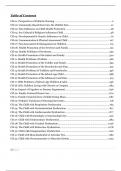
TEST BANK WONG'S ESSENTIALS OF PEDIATRIC NURSING 10TH EDITIONTable of Contents
CH 01: Perspectives of Pediatric Nursing ....................................................................................... 2 CH 02: Community-Based Nurs Care the Child & Fam ............................................................... 21 CH 03: Fam Influences on Child Health Promotion .................................................................... 28 CH 04: Soc Cultural & Religious Influences Child ........................................................................ 48 CH 05: Developmental & Genetic Influences on Child ................................................................. 70 CH 06: Communication & Physical Assessment Child ............................................................... 107 CH 07: Pain Assessment & Management in Children ................................................................. 175 CH 08: Health Promotion of the Newborn and Family ............................................................... 191 CH 09: Health Problems of Newborns ........................................................................................ 239 CH 10: Health Promotion of the Infant and Family ....................................................................320 CH 11: Health Problems of Infants .............................................................................................. 366 CH 12: Health Promotion of the Toddler and Family ................................................................. 395 CH 13: Health Promotion of the Preschooler and Fam ............................................................... 431 CH 14: Health Problems of Toddlers and Preschooler ................................................................ 456 CH 15: Health Promotion of the School-Age Child .................................................................... 488 CH 16: Health Promotion of the Adolescent and Fam ................................................................ 514 CH 17: Hlth Problems of School-Age Children & Adol ................................................................ 536 CH 18: QOL Children Living with Chronic or Complex .............................................................. 583 CH 19: Impact of Cognitive or Sensory Impairment ................................................................... 626 CH 20: Family-Centered Home Care .......................................................................................... 670 CH 21: Family-Centered Care of Child During Illnes .................................................................. 687 CH 22: Pediatric Variations of Nursing Interventio .................................................................... 718 CH 23: The Child with Respiratory Dysfunction ......................................................................... 765 CH 24: The Child with Gastrointestinal Dysfunction ................................................................. 817 CH 25: The Child with Cardiovascular Dysfunction ................................................................... 877 CH 26: Child with Hematologic or Immunologic Dys ................................................................ 931 CH 27: Child with Genitourinary Dysfunction ............................................................................ 983 CH 28: The Child with Cerebral Dysfunction ............................................................................ 1026 CH 29: The Child with Endocrine Dysfunction ......................................................................... 1078 CH 30: Child with Integumentary Dysfunction ........................................................................ 1120 CH 31: Child with Musculoskeletal or Articular Dys ................................................................. 1182 CH 32: Child with Neuromuscular or Muscular Dysfun ........................................................... 1223
1 | P a g eItem Bank: Hockenberry Wong Essentials of Pediatric Nurs 19Ed
CH 01: Perspectives of Pediatric Nursing
1. Question Name: 0001
Type: MC
Perspectives of Pediatric Nursing
Objective: CH 01:
Item Bank:
Hockenberry Wong Essentials of Pediatric Nurs 19Ed
A nurse is planning a teaching session for parents of preschool children. Which
statement explains why the nurse should include information about morbidity
and mortality?
A. Life-span statistics are included in the data.
B. It explains effectiveness of treatment.
C. Cost-effective treatment is detailed for the general population.
*
D. High-risk age groups for certain disorders or hazards are identified.
Correct Answer:
D
Explanation/Rati
onale:
ANS: D
Analysis of morbidity and mortality data provides the parents with information about
which groups of individuals are at risk for which health problems. Life-span statistics is
a part of the mortality data. Treatment modalities and cost are not included in
morbidity and mortality data.
PTS: 1
DIF: Cognitive Level: Apply
REF: 6-
8 TOP: Integrated Process: Nursing Process: Planning
MSC: Area of Client Needs: Health Promotion and Maintenance
Reference/Notes:
Keywords:
Points:
1.00
Active Date Created:
Penalty:
0.00
03/17/13 17:03:50
Score Mode:
Date Modified:
03/17/13 17:03:50
Date Used: Difficulty:
Discrimination:
Item Analysis: Last
Low
No. of Students Responded:
Responded:
0
Correct Responses (%):
Total Group:
0.00
Upper 27% of Group: 0.00
Point Biserial:
Lower 27% of Group: 0.00
0.00
Response Frequencies (%)
A
B
2 | P a g e
C
D
Correct Responses (%):
Total Group:
0.00
Upper 27% of Group: 0.00
Point Biserial:
Lower 27% of Group: 0.00
0.00
Item Analysis: Cumulative
0
No. of Students
EasyLast:
Cumulativ
e:
0.00 0.00 0.00 0.0
0
0.00 0.00 0.00 0.0
0
2. Question Name: 0002 Type: MC Objective: CH 01: Perspectives of Pediatric Nursing
Item Bank: Hockenberry Wong Essentials of Pediatric Nurs 19Ed
A clinic nurse is planning a teaching session about childhood obesity prevention for
parents of school-age children. The nurse should include which associated risk of
obesity in the teaching plan?
A. Type I diabetes
B. Respiratory disease
C. Celiac disease
*
D. Type II diabetes
Correct Answer:
D
Explanation/Rati
onale:
ANS: D
Childhood obesity has been associated with the rise of type II diabetes in children.
Type I diabetes is not associated with obesity and has a genetic component.
Respiratory disease is not associated with obesity, and celiac disease is the inability to
metabolize gluten in foods and is not associated with obesity.
PTS: 1
DIF: Cognitive Level: Apply
REF:
3 TOP: Integrated Process: Nursing Process:
Planning
MSC: Area of Client Needs: Health Promotion and Maintenance
Reference/Notes:
Keywords:
Points:
1.00
Active Date Created:
Penalty:
0.00
03/17/13 17:03:50
Score Mode:
Date Modified:
03/17/13 17:03:50
Date Used: Difficulty:
Discrimination:
Item Analysis: Last
Low
No. of Students Responded:
Responded:
0
Correct Responses (%):
Total Group:
0.00
Upper 27% of Group: 0.00
Point Biserial:
Lower 27% of Group: 0.00
0.00
Response Frequencies (%)
3 | P a g e
Correct Responses (%):
Total Group:
0.00
Upper 27% of Group: 0.00
Point Biserial:
Lower 27% of Group: 0.00
0.00
Item Analysis: Cumulative
0
No. of Students
EasyA
Last:
Cumulativ
e:
B
C
D
0.00 0.00 0.00 0.0
0
0.00 0.00 0.00 0.0
0
3. Question Name: 0003
Type: MC
Perspectives of Pediatric Nursing
Hockenberry Wong Essentials of Pediatric Nurs 19Ed
Which is the leading cause of death in infants younger than 1 year?
*
A. Congenital anomalies
B. Sudden infant death syndrome
C. Respiratory distress syndrome
D. Bacterial sepsis of the newborn
Correct Answer:
A
Explanation/Rati
onale:
ANS: A
Congenital anomalies account for 20.1% of deaths in infants younger than 1 year.
Sudden
infant death syndrome accounts for 8.2% of deaths in this age group. Respiratory
distress syndrome accounts for 3.4% of deaths in this age group. Infections
specific to the perinatal period account for 2.7% of deaths in this age group.
PTS: 1
DIF: Cognitive Level: Remember REF:
7 TOP: Integrated Process: Nursing Process:
Assessment
MSC: Area of Client Needs: Health Promotion and Maintenance
Reference/Notes:
Keywords:
Points:
1.00
Active Date Created:
Penalty:
0.00
03/17/13 17:03:50
Score Mode:
Date Modified:
03/17/13 17:03:50
Date Used: Difficulty:
Discrimination:
Item Analysis: Last
Low
No. of Students Responded:
Responded:
0
Correct Responses (%):
Total Group:
0.00
Upper 27% of Group: 0.00
Point Biserial:
Lower 27% of Group: 0.00
0.00
4 | P a g e
Correct Responses (%):
Total Group:
0.00
Upper 27% of Group: 0.00
Point Biserial:
Lower 27% of Group: 0.00
0.00
Item Analysis: Cumulative
0
No. of Students
Easy
Objective: CH 01:
Item Bank:Response Frequencies (%)
A
B
Last:
Cumulativ
e:
C
D
0.00 0.00 0.00 0.0
0
0.00 0.00 0.00 0.0
0
4. Question Name: 0004
Type: MC
Perspectives of Pediatric Nursing
Objective: CH 01:
Item Bank:
Hockenberry Wong Essentials of Pediatric Nurs 19Ed
Which leading cause of death topic should the nurse emphasize to a group of African-
American boys ranging in ages 15 to 19 years?
A. Suicide
B. Cancer
*
C. Firearm homicide
D. Occupational injuries
Correct Answer:
C
Explanation/Rati
onale:
ANS: C
Firearm homicide is the second overall cause of death in this age group and the
leading cause of death in African-American males. Suicide is the third-leading cause
of death in this population. Cancer, although a major health problem, is the fourth-
leading cause of death in this age group. Occupational injuries do not contribute to a
significant death rate for this age group.
PTS: 1
5 | 8 TOP:
DIF: Cognitive Level: Understand REF:
Integrated Process: Nursing Process:
Planning
MSC: Area of Client Needs: Health Promotion and Maintenance
Reference/Notes:
Keywords:
Points:
1.00
Active Date Created:
Penalty:
0.00
03/17/13 17:03:50
Score Mode:
Date Modified:
03/17/13 17:03:50
Date Used: Difficulty:
Discrimination:
Item Analysis: Last
Low
No. of Students Responded:
Responded:
0
Correct Responses (%):
Total Group:
5 | P a g e
0.00
Correct Responses (%):
Total Group:
0.00
Item Analysis: Cumulative
0
No. of Students
EasyPoint Biserial:
Upper 27% of Group: 0.00
Lower 27% of Group: 0.00
0.00
Response Frequencies (%)
A
B
Last:
Cumulativ
e:
C
D
0.00 0.00 0.00 0.0
0
0.00 0.00 0.00 0.0
0
Point Biserial:
Upper 27% of Group: 0.00
Lower 27% of Group: 0.00
0.00
5. Question Name: 0005
Type: MC
Perspectives of Pediatric Nursing
Hockenberry Wong Essentials of Pediatric Nurs 19Ed
Which is the major cause of death for children older than 1 year?
A. Cancer
B. Heart disease
*
C. Unintentional injuries
D. Congenital anomalies
Correct Answer:
C
Explanation/Rati
onale:
ANS: C
Unintentional injuries (accidents) are the leading cause of death after age 1 year
through adolescence. Congenital anomalies are the leading cause of death in those
younger than 1 year. Cancer ranks either second or fourth, depending on the age
group, and heart disease ranks fifth in the majority of the age groups.
PTS: 1
DIF: Cognitive Level: Remember REF:
8
TOP: Integrated Process: Nursing Process: Planning
MSC: Area of Client Needs: Health Promotion and Maintenance
Reference/Notes:
Keywords:
Points:
1.00
Active Date Created:
Penalty:
0.00
03/17/13 17:03:50
Score Mode:
Date Modified:
03/17/13 17:03:50
Date Used: Difficulty:
Discrimination:
Item Analysis: Last
Low
No. of Students Responded:
Responded:
0
Correct Responses (%):
Total Group:
0.00
Upper 27% of Group: 0.00
6 | P a g e
Correct Responses (%):
Total Group:
0.00
Upper 27% of Group: 0.00
Item Analysis: Cumulative
0
No. of Students
Easy
Objective: CH 01:
Item Bank:Lower 27% of Group: 0.00
Point Biserial:
0.00
Response Frequencies (%)
A
B
Last:
Cumulativ
e:
C
D
0.00 0.00 0.00 0.0
0
0.00 0.00 0.00 0.0
0
Lower 27% of Group: 0.00
Point Biserial:
0.00
6. Question Name: 0006
Type: MC
Perspectives of Pediatric Nursing
Objective: CH 01:
Item Bank:
Hockenberry Wong Essentials of Pediatric Nurs 19Ed
Which is the leading cause of death from unintentional injuries for females ranging in
age from 1 to 14?
A. Mechanical suffocation
B. Drowning
*
C. Motor-vehicle-related fatalities
D. Fire- and burn-related fatalities
Correct Answer:
C
Explanation/Rati
onale:
ANS: C
Motor-vehicle-related fatalities are the leading cause of death for females ranging in
age from 1 to 14, either as passengers or as pedestrians. Mechanical suffocation is
fourth or fifth, depending on the age. Drowning is the second- or third-leading cause
of death, depending on the age. Fire- and burn-related fatalities are the second-leading
cause of death.
PTS: 1
DIF: Cognitive Level: Remember REF:
4 TOP: Integrated Process: Nursing Process:
Assessment
MSC: Area of Client Needs: Health Promotion and Maintenance
Reference/Notes:
Keywords:
Points:
1.00
Active Date Created:
Penalty:
0.00
03/17/13 17:03:50
Score Mode:
Date Modified:
03/17/13 17:03:50
Date Used: Difficulty:
Discrimination:
Item Analysis: Last
Low
No. of Students Responded:
Responded:
7 | P a g e
0
Item Analysis: Cumulative
0
No. of Students
EasyCorrect Responses (%):
Total Group:
0.00
Upper 27% of Group: 0.00
Point Biserial:
Lower 27% of Group: 0.00
0.00
Response Frequencies (%)
A
B
Last:
Cumulativ
e:
C
D
0.00 0.00 0.00 0.0
0
0.00 0.00 0.00 0.0
0
Correct Responses (%):
Total Group:
0.00
Upper 27% of Group: 0.00
Point Biserial:
Lower 27% of Group: 0.00
0.00
7. Question Name: 0007
Type: MC
Perspectives of Pediatric Nursing
Objective: CH 01:
Item Bank:
Hockenberry Wong Essentials of Pediatric Nurs 19Ed
Which factor most impacts the type of injury a child is susceptible to, according to the
child’s age?
A. Physical health of the child
*
B. Developmental level of the child
C. Educational level of the child
D. Number of responsible adults in the home
Correct Answer:
B
Explanation/Rati
onale:
ANS: B
The child’s developmental stage determines the type of injury that is likely to occur.
The child’s physical health may facilitate the child’s recovery from an injury but does
not impact the type of injury. Educational level is related to developmental level, but it
is not as important as the child’s developmental level in determining the type of injury.
The number of responsible adults in the home may affect the number of unintentional
injuries, but the type of injury is related to the child’s developmental stage.
PTS: 1
3-4 TOP:
DIF: Cognitive Level: Understand REF:
Integrated Process: Nursing Process:
Planning
MSC: Area of Client Needs: Health Promotion and Maintenance
Reference/Notes:
Keywords:
Points:
1.00
Active Date Created:
Penalty:
0.00
03/17/13 17:03:50
Score Mode:
Date Modified:
03/17/13 17:03:50
8 | P a g e
Date Used: Difficulty:
EasyDiscrimination:
Low
Item Analysis: Last
No. of Students Responded:
Responded:
0
Correct Responses (%):
Total Group:
0.00
Upper 27% of Group: 0.00
Point Biserial:
Lower 27% of Group: 0.00
0.00
Response Frequencies (%)
A
B
Last:
Cumulativ
e:
C
D
0.00 0.00 0.00 0.0
0
0.00 0.00 0.00 0.0
0
Correct Responses (%):
Total Group:
0.00
Upper 27% of Group: 0.00
Point Biserial:
Lower 27% of Group: 0.00
0.00
Item Analysis: Cumulative
0
No. of Students
8. Question Name: 0008
Type: MC
Perspectives of Pediatric Nursing
Hockenberry Wong Essentials of Pediatric Nurs 19Ed
Which is now referred to as the “new morbidity”?
A. Limitations in the major activities of daily living
B. Unintentional injuries that cause chronic health problems
C. Discoveries of new therapies to treat health problems
*
D. Behavioral, social, and educational problems that alter health
Correct Answer: D
Explanation/Rationale:
ANS: D
The new morbidity reflects the behavioral, social, and educational problems that
interfere with the child’s social and academic development. It is currently estimated
that the incidence of these issues is from 5% to 30%. Limitations in major activities of
daily living and unintentional injuries that result in chronic health problems are
included in morbidity data. Discovery of new therapies would be reflected in changes
in morbidity data over time.
PTS: 1
DIF: Cognitive Level: Remember REF:
3 TOP: Integrated Process: Nursing Process:
Assessment
MSC: Area of Client Needs: Health Promotion and Maintenance
Reference/Notes:
Keywords:
Points:
1.00
Active Date Created:
Penalty:
0.00
03/17/13 17:03:50
Score Mode:
Date Modified:
03/17/13 17:03:50
Date Used: Difficulty:
Discrimination:
Item Analysis: Last
9 | P a g e
Low
Item Analysis: Cumulative
Easy
Objective: CH 01:
Item Bank:No. of Students Responded:
Responded:
0
0
Correct Responses (%):
Total Group:
0.00
Upper 27% of Group: 0.00
Point Biserial:
Lower 27% of Group: 0.00
0.00
Response Frequencies (%)
A
B
Last:
Cumulativ
e:
C
D
0.00 0.00 0.00 0.0
0
0.00 0.00 0.00 0.0
0
Correct Responses (%):
Total Group:
0.00
Upper 27% of Group: 0.00
Point Biserial:
Lower 27% of Group: 0.00
0.00
No. of Students
9. Question Name: 0009
Type: MC
Perspectives of Pediatric Nursing
Objective: CH 01:
Item Bank:
Hockenberry Wong Essentials of Pediatric Nurs 19Ed
A nurse on a pediatric unit is practicing family-centered care. Which is most descriptive
of the care the nurse is delivering?
A. Taking over total care of the child to reduce stress on the family
B. Encouraging family dependence on health care systems
*
C. Recognizing that the family is the constant in a child’s
life
D. Excluding families from the decision-making
process
Correct Answer:
C
Explanation/Rati
onale:
ANS: C
The three key components of family-centered care are respect, collaboration, and
support. Family-centered care recognizes the family as the constant in the child’s life.
Taking over total care does not include the family in the process and may increase
stress instead of reducing stress. The family should be enabled and empowered to
work with the health care system. The family is expected to be part of the decision-
making process.
PTS: 1
8 TOP:
DIF: Cognitive Level: Remember REF:
Integrated Process: Nursing Process:
Implementation MSC: Area of Client Needs: Health
Promotion and Maintenance
Reference/Notes:
10 | P a g eKeywords:
Points:
1.00
Penalty:
Active Date Created:
0.00
03/17/13 17:03:50
Score Mode:
Date Modified:
03/17/13 17:03:50
Date Used: Difficulty:
Discrimination:
Item Analysis: Last
Low
No. of Students Responded:
Responded:
0
Correct Responses (%):
Total Group:
0.00
Upper 27% of Group: 0.00
Point Biserial:
Lower 27% of Group: 0.00
0.00
Response Frequencies (%)
A
B
Last:
Cumulativ
e:
C
D
0.00 0.00 0.00 0.0
0
0.00 0.00 0.00 0.0
0
Correct Responses (%):
Total Group:
0.00
Upper 27% of Group: 0.00
Point Biserial:
Lower 27% of Group: 0.00
0.00
Item Analysis: Cumulative
0
No. of Students
Easy
10. Question Name: 0010
Type: MC
Objective: CH 01: Perspectives of Pediatric Nursing
Item
Bank: Hockenberry Wong Essentials of Pediatric Nurs 19Ed
The nurse is preparing an in-service education to staff about atraumatic care for
pediatric patients. Which intervention should the nurse include?
A. Prepare the child for separation from parents during hospitalization by reviewing a
video.
*
B. Prepare the child before any unfamiliar treatment or procedure by demonstrating on
a stuffed animal.
C. Help the child accept the loss of control associated with hospitalization.
D. Help the child accept pain that is connected with a treatment or procedure.
Correct Answer:
B
Explanation/Rati
onale:
ANS: B
Preparing the child for any unfamiliar treatments, controlling pain, allowing privacy,
providing play activities for expression of fear and aggression, providing choices, and
respecting cultural differences are components of atraumatic care. In the provision of
atraumatic care, the separation of child from parents during hospitalization is
minimized. The nurse should promote a sense of control for the child. Preventing and
minimizing bodily injury and pain are major components of atraumatic care.
PTS: 1
11 | P a g e
DIF: Cognitive Level: Understand REF:
9TOP: Integrated Process: Nursing Process:
Implementation MSC: Area of Client Needs:
Psychosocial Integrity
Reference/Notes:
Keywords:
Points:
1.00
Active Date Created:
Penalty:
0.00
03/17/13 17:03:50
Score Mode:
Date Modified:
03/17/13 17:03:50
Date Used: Difficulty:
Discrimination:
Item Analysis: Last
Low
No. of Students Responded:
Responded:
0
Correct Responses (%):
Total Group:
0.00
Upper 27% of Group: 0.00
Point Biserial:
Lower 27% of Group: 0.00
0.00
Response Frequencies (%)
A
B
Last:
Cumulativ
e:
C
D
0.00 0.00 0.00 0.0
0
0.00 0.00 0.00 0.0
0
Correct Responses (%):
Total Group:
0.00
Upper 27% of Group: 0.00
Point Biserial:
Lower 27% of Group: 0.00
0.00
Item Analysis: Cumulative
0
No. of Students
Easy
11. Question Name: 0011
Type: MC
Objective: CH 01: Perspectives of Pediatric Nursing
Item
Bank: Hockenberry Wong Essentials of Pediatric Nurs 19Ed
Which is most suggestive that a nurse has a nontherapeutic relationship with a
patient and family?
*
A. Staff is concerned about the nurse’s actions with the patient and family.
B. Staff assignments allow the nurse to care for same patient and family over an
extended time.
C. Nurse is able to withdraw emotionally when emotional overload occurs but still
remains committed.
D. Nurse uses teaching skills to instruct patient and family rather than doing
everything for them.
Correct Answer:
A
Explanation/Rati
onale:
ANS: A
An important clue to a nontherapeutic staff-patient relationship is concern of other
staff members. Allowing the nurse to care for the same patient over time would be
12 | P a g etherapeutic for the patient and family. Nurses who are able to somewhat withdraw
emotionally can protect themselves while providing therapeutic care. Nurses using
teaching skills to instruct patient and family will assist in transitioning the child and
family to self-care.
PTS: 1
DIF: Cognitive Level: Analyze REF: 9
TOP: Integrated Process: Nursing Process:
Assessment MSC: Area of Client Needs:
Psychosocial Integrity
Reference/Notes:
Keywords:
Points:
1.00
Active Date Created:
Penalty:
0.00
03/17/13 17:03:50
Score Mode:
Date Modified:
03/17/13 17:03:50
Date Used: Difficulty:
Discrimination:
Item Analysis: Last
Low
No. of Students Responded:
Responded:
0
Correct Responses (%):
Total Group:
Upper 27% of Group:
Lower 27% of Group:
Point Biserial:
R
esponse Freque ncies (%)
A
Last:
Cumulative:
0.00
0.00
B
0.00
0.00
0.00
0.00
0.00
0.00
C
0.00
0.00
D
0.00
0.00
Correct Responses (%):
Total Group:
Upper 27% of Group:
Lower 27% of Group:
Point Biserial:
0.00
0.00
0.00
0.00
Item Analysis: Cumulative
0
No. of Students
Easy
12. Question Name: 0012
Type: MC
Objective: CH 01: Perspectives of Pediatric Nursing
Bank: Hockenberry Wong Essentials of Pediatric Nurs 19Ed
Which is most descriptive of clinical reasoning?
A. A simple developmental process
*
B. Purposeful and goal-directed
C. Based on deliberate and irrational thought
D. Assists individuals in guessing what is most appropriate
Correct Answer:
B
Explanation/Rati
onale:
ANS: B
13 | P a g e
ItemClinical reasoning is a complex, developmental process based on rational and
deliberate thought. Clinical reasoning is not a developmental process. Clinical
reasoning is based on rational and deliberate thought. Clinical reasoning is not a
guessing process.
PTS: 1
12 TOP:
DIF: Cognitive Level: Understand REF:
Integrated Process: Nursing
Process: Planning
MSC: Area of Client Needs: Safe and Effective Care Environment: Management of Care
Reference/Notes:
Keywords:
Points:
1.00
Active Date Created:
Penalty:
0.00
03/17/13 17:03:50
Score Mode:
Date Modified:
03/17/13 17:03:50
Date Used: Difficulty:
Discrimination:
Item Analysis: Last
Low
No. of Students Responded:
Responded:
0
Correct Responses (%):
Total Group:
0.00
Upper 27% of Group: 0.00
Point Biserial:
Lower 27% of Group: 0.00
0.00
Response Frequencies (%)
A
B
Last:
Cumulativ
e:
C
D
0.00 0.00 0.00 0.0
0
0.00 0.00 0.00 0.0
0
Correct Responses (%):
Total Group:
0.00
Upper 27% of Group: 0.00
Point Biserial:
Lower 27% of Group: 0.00
0.00
Item Analysis: Cumulative
0
No. of Students
Easy
13. Question Name: 0013
Type: MC
Perspectives of Pediatric Nursing
Objective: CH 01:
Item Bank:
Hockenberry Wong Essentials of Pediatric Nurs 19Ed
A nurse makes the decision to apply a topical anesthetic to a child’s skin before drawing
blood. Which ethical principle is the nurse demonstrating?
A. Autonomy
*
B. Beneficence
C. Justice
D. Truthfulness
Correct Answer:
B
Explanation/Rati
onale:
14 | P a g eANS: B
Beneficence is the obligation to promote the patient’s well-being. Applying a topical
anesthetic before drawing blood promotes reducing the discomfort of the
venipuncture. Autonomy is the patient’s right to be self-governing. Justice is the
concept of fairness. Truthfulness is the concept of honesty.
PTS: 1
11 TOP:
DIF: Cognitive Level: Understand REF:
Integrated Process: Nursing
Process: Implementation MSC: Area of Client Needs:
Physiological Integrity
Reference/Notes:
Keywords:
Points:
1.00
Active Date Created:
Penalty:
0.00
03/17/13 17:03:50
Score Mode:
Date Modified:
03/17/13 17:03:50
Date Used: Difficulty:
Discrimination:
Item Analysis: Last
Low
No. of Students Responded:
Responded:
0
Correct Responses (%):
Total Group:
0.00
Upper 27% of Group: 0.00
Point Biserial:
Lower 27% of Group: 0.00
0.00
Response Frequencies (%)
A
B
Last:
Cumulativ
e:
C
D
0.00 0.00 0.00 0.0
0
0.00 0.00 0.00 0.0
0
Correct Responses (%):
Total Group:
0.00
Upper 27% of Group: 0.00
Point Biserial:
Lower 27% of Group: 0.00
0.00
Item Analysis: Cumulative
0
No. of Students
Easy
14. Question Name: 0014
Type: MC
Objective: CH 01: Perspectives of Pediatric Nursing
Item
Bank: Hockenberry Wong Essentials of Pediatric Nurs 19Ed
Which action by the nurse demonstrates use of evidence-based practice (EBP)?
A. Gathering equipment for a procedure
B. Documenting changes in a patient’s status
*
C. Questioning the use of daily central line dressing changes
D. Clarifying a physician’s prescription for morphine
Correct Answer:
C
Explanation/Rati
15 | P a g eonale:
ANS: C
The nurse who questions the daily central line dressing change is ascertaining whether
clinical interventions result in positive outcomes for patients. This demonstrates
evidence-based practice (EBP), which implies questioning why something is effective
and whether a better approach exists. Gathering equipment for a procedure and
documenting changes in a patient’s status are practices that follow established
guidelines. Clarifying a physician’s prescription for morphine constitutes safe nursing
care.
PTS: 1
DIF: Cognitive Level: Apply
REF: 11
TOP: Integrated Process: Nursing Process: Evaluation
MSC: Area of Client Needs: Safe and Effective Care Environment: Management of Care
Reference/Notes:
Keywords:
Points:
1.00
Active Date Created:
Penalty:
0.00
03/17/13 17:03:50
Score Mode:
Date Modified:
03/17/13 17:03:50
Date Used: Difficulty:
Discrimination:
Item Analysis: Last
Low
No. of Students Responded:
Responded:
0
Correct Responses (%):
Total Group:
0.00
Upper 27% of Group: 0.00
Point Biserial:
Lower 27% of Group: 0.00
0.00
Response Frequencies (%)
A
B
Last:
Cumulativ
e:
C
D
0.00 0.00 0.00 0.0
0
0.00 0.00 0.00 0.0
0
Correct Responses (%):
Total Group:
0.00
Upper 27% of Group: 0.00
Point Biserial:
Lower 27% of Group: 0.00
0.00
Item Analysis: Cumulative
0
No. of Students
Easy
15. Question Name: 0015
Type: MC
Objective: CH 01: Perspectives of Pediatric Nursing
Item
Bank: Hockenberry Wong Essentials of Pediatric Nurs 19Ed
A nurse is admitting a toddler to the hospital. The toddler is with both parents and is
currently sitting comfortably on a parent’s lap. The parents state they will need to leave
for a brief period. Which type of nursing diagnosis should the nurse formulate for this
child?
*
A. Risk for anxiety
B. Anxiety
C. Readiness for enhanced coping
16 | P a g eD. Ineffective coping
Correct Answer:
A
Explanation/Rati
onale:
ANS: A
A potential problem is categorized as a risk. The toddler has a risk to become anxious
when the parents leave. Nursing interventions will be geared toward reducing the risk.
The child is not showing current anxiety or ineffective coping. The child is not at a point
for readiness for enhanced coping, especially because the parents will be leaving.
PTS: 1
DIF: Cognitive Level: Remember REF:
12 TOP:
Integrated Process: Nursing
Process: Diagnosis
MSC: Area of Client Needs: Health Promotion and Maintenance
Reference/Notes:
Keywords:
Points:
1.00
Active Date Created:
Penalty:
0.00
03/17/13 17:03:50
Score Mode:
Date Modified:
03/17/13 17:03:50
Date Used: Difficulty:
Discrimination:
Item Analysis: Last
Low
No. of Students Responded:
Responded:
0
Correct Responses (%):
Total Group:
0.00
Upper 27% of Group: 0.00
Point Biserial:
Lower 27% of Group: 0.00
0.00
Response Frequencies (%)
A
B
Last:
Cumulativ
e:
C
D
0.00 0.00 0.00 0.0
0
0.00 0.00 0.00 0.0
0
Correct Responses (%):
Total Group:
0.00
Upper 27% of Group: 0.00
Point Biserial:
Lower 27% of Group: 0.00
0.00
Item Analysis: Cumulative
0
No. of Students
Easy
16. Question Name: 0016
Type: MC
Objective: CH 01: Perspectives of Pediatric Nursing
Item
Bank: Hockenberry Wong Essentials of Pediatric Nurs 19Ed
A child has a postoperative appendectomy incision covered by a dressing. The nurse
has just completed a prescribed dressing change for this child. Which description is
an accurate documentation of this procedure?
A. Dressing change to appendectomy incision completed, child tolerated procedure
well, parent present
17 | P a g eB. No complications noted during dressing change to appendectomy incision
*
C. Appendectomy incision non-reddened, sutures intact, no drainage noted on old
dressing, new dressing applied, procedure tolerated well by child
D. No changes to appendectomy incisional area, dressing changed, child complained of
pain during procedure, new dressing clean, dry and intact
Correct Answer:
C
Explanation/Rati
onale:
ANS: C
The nurse should document assessments and reassessments. Appearance of the
incision described in objective terms should be included during a dressing change. The
nurse should document patient’s response and the outcomes of the care provided. In
this example, these include drainage on the old dressing, the application of the new
dressing, and the child’s response. The other statements partially fulfill the
requirements of documenting assessments and reassessments, patient’s response, and
outcome, but do not include all three.
PTS: 1
DIF: Cognitive Level: Analyze REF: 14
TOP: Integrated Process: Nursing Process: Implementation
MSC: Area of Client Needs: Safe and Effective Care Environment: Management of Care
Reference/Notes:
Keywords:
Points:
1.00
Active Date Created:
Penalty:
0.00
03/17/13 17:03:50
Score Mode:
Date Modified:
03/17/13 17:03:50
Date Used: Difficulty:
Discrimination:
Item Analysis: Last
Low
No. of Students Responded:
Responded:
0
Correct Responses (%):
Total Group:
0.00
Upper 27% of Group: 0.00
Point Biserial:
Lower 27% of Group: 0.00
0.00
Response Frequencies (%)
A
B
Last:
Cumulativ
e:
C
D
0.00 0.00 0.00 0.0
0
0.00 0.00 0.00 0.0
0
Correct Responses (%):
Total Group:
0.00
Upper 27% of Group: 0.00
Point Biserial:
Lower 27% of Group: 0.00
0.00
Item Analysis: Cumulative
0
No. of Students
Easy
18 | P a g e17. Question Name: 0017
Type: MC
Objective: CH 01: Perspectives of Pediatric Nursing
Item
Bank: Hockenberry Wong Essentials of Pediatric Nurs 19Ed
A nurse is planning a class on accident prevention for parents of toddlers. Which
safety topic is the priority for this class?
*
A. Appropriate use of car seat restraints
B. Safety crossing the street
C. Helmet use when riding a bicycle
D. Poison control numbers
Correct Answer:
A
Explanation/Rati
onale:
ANS: A
Motor vehicle accidents (MVAs) continue to be the most common cause of death in
children older than 1 year, therefore the priority topic is appropriate use of car seat
restraints. Safety crossing the street and bicycle helmet use are topics that should be
included for preschool parents but are not priorities for parents of toddlers.
Information about poison control is important for parents of toddlers and would be
a safety topic to include but is not the priority over appropriate use of car seat
restraints.
PTS: 1
DIF: Cognitive Level: Apply
REF: 3-4
TOP: Integrated Process: Nursing Process: Planning
MSC: Area of Client Needs: Health Promotion and Maintenance
Reference/Notes:
Keywords:
Points:
1.00
Date Created:
03/17/13
17:03:50
Difficulty: Easy
Item Analysis: Last
No. of Students
Responded:
Correct Responses (%):
Total Group:
Upper 27% of Group:
Lower 27% of Group:
Point Biserial:
R
esponse Freque ncies (%)
A
Last:
Cumulative:
19 | P a g e
0.00
0.00
B
0.00
0.00
0
0.00
0.00
0.00
0.00
C
0.00
0.00
D
0.00
0.00
Penalty:
0.00
Score Mode: Active
Date
Modified:
03/17/13 17:03:50 Date
Used:
Discrimination: Low
Item Analysis:
Cumulative
No. of Students
Responded:
Correct Responses (%):
Total Group:
Upper 27% of Group:
Lower 27% of Group:
Point Biserial:
0
0.00
0.00
0.00
0.0018. Question Name: 0018
Type: MC
Objective: CH 01: Perspectives of Pediatric Nursing
Item
Bank: Hockenberry Wong Essentials of Pediatric Nurs 19Ed
Which behaviors by the nurse indicate a therapeutic relationship with children and
families? (Select all that apply.)
A. Spending off-duty time with children and families
B. Asking questions if families are not participating in the care
*
*
*
C. Clarifying information for families
D. Buying toys for a hospitalized child
E. Learning about the family’s religious preferences
Correct Answer:
BCE
Explanation/Rati
onale:
ANS: B, C, E
Asking questions if families are not participating in the care, clarifying information
for families, and learning about the family’s religious preferences are positive actions
and foster therapeutic relationships with children and families. Spending off-duty
time with children and families and buying toys for a hospitalized child are negative
actions and indicate overinvolvement with children and families, which is
nontherapeutic.
PTS: 1
9-10 TOP:
DIF: Cognitive Level: Understand REF:
Integrated Process: Nursing Process:
Evaluation
MSC: Area of Client Needs: Psychosocial Integrity
Reference/Notes:
Keywords:
Points:
1.00
Active Date Created:
Penalty:
0.00
03/17/13 17:03:50
Score Mode:
Date Modified:
03/18/13 16:32:48
Date Used: Difficulty:
Discrimination:
Item Analysis: Last
Low
No. of Students Responded:
Responded:
0
Correct Responses (%):
Total Group:
0.00
Upper 27% of Group: 0.00
Point Biserial:
Lower 27% of Group: 0.00
0.00
Response Frequencies (%)
A
B
20 | P a g e
C
D
Correct Responses (%):
Total Group:
0.00
Upper 27% of Group: 0.00
Point Biserial:
E
Lower 27% of Group: 0.00
0.00
Item Analysis: Cumulative
0
No. of Students
EasyLast:
0.00 0.00 0.00 0.00 0.0
0
Cumulative: 0.00 0.00 0.00 0.00 0.00
Item Bank: Hockenberry Wong Essentials of Pediatric Nurs 19Ed
CH 02: Community-Based Nurs Care the Child & Fam
1. Question Name: 0001
Type: MC
Objective: CH 02: Community-Based Nurs Care the Child & Fam
Item
Bank: Hockenberry Wong Essentials of Pediatric Nurs 19Ed
Which term best describes the identification of the distribution and causes of disease,
injury, or illness?
A. Nursing process
*
B. Epidemiologic process
C. Community-based statistics
D. Mortality and morbidity statistics
Correct Answer:
B
Explanation/Rati
onale:
ANS: B
Epidemiology is the science of population health applied to the detection of
morbidity and mortality in a population. It identifies the distribution and causes of
diseases across a population. Nursing process is a systematic problem-solving
approach for the delivery of nursing care. Morbidity and mortality statistics, along
with natal rates, may provide an objective picture of a community’s health status.
PTS: 1
18 TOP:
DIF: Cognitive Level: Remember REF:
Integrated Process: Nursing
Process: Assessment
MSC: Area of Client Needs: Health Promotion and Maintenance
Reference/Notes:
Keywords:
Points:
1.00
Active Date Created:
Penalty:
0.00
03/17/13 20:55:49
Score Mode:
Date Modified:
03/17/13 20:55:49
21 | P a g e
Date Used: Difficulty:
EasyDiscrimination:
Low
Item Analysis: Last
No. of Students Responded:
Responded:
0
Correct Responses (%):
Total Group:
0.00
Upper 27% of Group: 0.00
Point Biserial:
Lower 27% of Group: 0.00
0.00
Response Frequencies (%)
A
B
Last:
Cumulativ
e:
C
D
0.00 0.00 0.00 0.0
0
0.00 0.00 0.00 0.0
0
2. Question Name: 0002
Type: MC
Objective: CH 02: Community-Based Nurs Care the Child & Fam
Item
Bank: Hockenberry Wong Essentials of Pediatric Nurs 19Ed
A community nurse at the health department is trying to identify how many new cases
of acquired immunodeficiency syndrome (AIDS) disease have occurred in the city this
past year. Which statistic should the nurse examine?
A. Mortality
B. Morbidity
*
C. Incidence
D. Prevalence
Correct Answer:
C
Explanation/Rati
onale:
ANS: C
Incidence will provide the number of cases of a particular disease process. Mortality
statistics specify the number of deaths from a given cause. Morbidity statistics specify
the prevalence of specific illnesses in a population at a particular time.
PTS: 1
18 TOP:
DIF: Cognitive Level: Understand REF:
Integrated Process: Nursing
Process: Assessment
MSC: Area of Client Needs: Health Promotion and Maintenance
Reference/Notes:
Keywords:
Points:
1.00
Active Date Created:
Penalty:
0.00
03/17/13 20:55:49
Score Mode:
Date Modified:
03/17/13 20:55:49
Date Used: Difficulty:
Discrimination:
Item Analysis: Last
22 | P a g e
Low
Item Analysis: Cumulative
Easy
Correct Responses (%):
Total Group:
0.00
Upper 27% of Group: 0.00
Point Biserial:
Lower 27% of Group: 0.00
0.00
Item Analysis: Cumulative
0
No. of StudentsNo. of Students Responded:
Responded:
0
0
Correct Responses (%):
Total Group:
0.00
Upper 27% of Group: 0.00
Point Biserial:
Lower 27% of Group: 0.00
0.00
Response Frequencies (%)
A
B
Last:
Cumulativ
e:
C
D
0.00 0.00 0.00 0.0
0
0.00 0.00 0.00 0.0
0
Correct Responses (%):
Total Group:
0.00
Upper 27% of Group: 0.00
Point Biserial:
Lower 27% of Group: 0.00
0.00
No. of Students
3. Question Name: 0003
Type: MC
Objective: CH 02: Community-Based Nurs Care the Child & Fam
Item
Bank: Hockenberry Wong Essentials of Pediatric Nurs 19Ed
A nurse is collecting subjective and objective information about target populations to
diagnose problems based on community needs. This describes which step in the
community nursing process?
A. Planning
B. Diagnosis
*
C. Assessment
D. Establishing objectives
Correct Answer:
C
Explanation/Rati
onale:
ANS: C
The nursing process stages are similar, whether the client is one child or a population
of children. The assessment phase of the nursing process focuses on collecting
subjective and objective data. Planning is the development of community-centered
goals and objectives. Diagnosis is the identification of problems specific to the
community.
PTS: 1
19 TOP:
DIF: Cognitive Level: Understand REF:
Integrated Process: Communication
and Documentation
MSC: Area of Client Needs: Safe and Effective Care Environment: Management of Care
Reference/Notes:
Keywords:
Points:
1.00
Active Date Created:
23 | P a g e
Penalty:
0.00
03/17/13 20:55:49
Score Mode:
Date Modified:03/17/13 20:55:49
Date Used: Difficulty:
Discrimination:
Item Analysis: Last
Low
No. of Students Responded:
Responded:
0
Correct Responses (%):
Total Group:
0.00
Upper 27% of Group: 0.00
Point Biserial:
Lower 27% of Group: 0.00
0.00
Response Frequencies (%)
A
B
Last:
Cumulativ
e:
C
D
0.00 0.00 0.00 0.0
0
0.00 0.00 0.00 0.0
0
Correct Responses (%):
Total Group:
0.00
Upper 27% of Group: 0.00
Point Biserial:
Lower 27% of Group: 0.00
0.00
Item Analysis: Cumulative
0
No. of Students
Easy
4. Question Name: 0004
Type: MC
Objective: CH 02: Community-Based Nurs Care the Child & Fam
Item
Bank: Hockenberry Wong Essentials of Pediatric Nurs 19Ed
A nurse is establishing several health programs, such as bicycle safety, to improve the
health status of a target population. This describes which step in the community nursing
process?
A. Planning
B. Evaluation
C. Assessment
*
D. Implementation
Correct Answer:
D
Explanation/Rati
onale:
ANS: D
The nurse working with the community to put into practice a program to reach
community goals is the implementation phase of the community nursing process.
Planning involves
designing the program to meet community-centered goals. The evaluation stage would
determine the effectiveness of the program. During the assessment phase, the nurse
would identify the resources necessary and the barriers that would interfere with
implementation.
PTS: 1
19 TOP:
DIF: Cognitive Level: Understand REF:
Integrated Process: Nursing
Process: Implementation
24 | P a g eMSC: Area of Client Needs: Safe and Effective Care Environment: Management of Care
Reference/Notes:
Keywords:
Points:
1.00
Active Date Created:
Penalty:
0.00
03/17/13 20:55:49
Score Mode:
Date Modified:
03/17/13 20:55:49
Date Used: Difficulty:
Discrimination:
Item Analysis: Last
Low
No. of Students Responded:
Responded:
0
Correct Responses (%):
Total Group:
0.00
Upper 27% of Group: 0.00
Point Biserial:
Lower 27% of Group: 0.00
0.00
Response Frequencies (%)
A
B
Last:
Cumulativ
e:
C
D
0.00 0.00 0.00 0.0
0
0.00 0.00 0.00 0.0
0
Correct Responses (%):
Total Group:
0.00
Upper 27% of Group: 0.00
Point Biserial:
Lower 27% of Group: 0.00
0.00
Item Analysis: Cumulative
0
No. of Students
Easy
5. Question Name: 0005
Type: MC
Objective: CH 02: Community-Based Nurs Care the Child & Fam
Item
Bank: Hockenberry Wong Essentials of Pediatric Nurs 19Ed
A school nurse is conducting vision and hearing testing on fifth-grade children. Which
level of prevention is the nurse demonstrating?
A. Primary
*
B. Secondary
C. Tertiary
D. Health promotion
Correct Answer:
B
Explanation/Rati
onale:
ANS: B
Secondary prevention focuses on screening and early diagnosis of disease. Vision and
hearing testing are screening tests to detect problems. Primary prevention focuses on
health promotion and prevention of disease or injury. Tertiary prevention focuses on
optimizing function for children with a disability or chronic disease. Health promotion
is focused on preventing disease or illness.
PTS: 1
25 | P a g e
DIF: Cognitive Level: Understand REF:
19TOP: Integrated Process: Nursing Process:
Implementation MSC: Area of Client Needs: Health
Promotion and Maintenance
Reference/Notes:
Keywords:
Points:
1.00
Active Date Created:
Penalty:
0.00
03/17/13 20:55:49
Score Mode:
Date Modified:
03/17/13 20:55:49
Date Used: Difficulty:
Discrimination:
Item Analysis: Last
Low
No. of Students Responded:
Responded:
0
Correct Responses (%):
Total Group:
0.00
Upper 27% of Group: 0.00
Point Biserial:
Lower 27% of Group: 0.00
0.00
Response Frequencies (%)
A
B
Last:
Cumulativ
e:
C
D
0.00 0.00 0.00 0.0
0
0.00 0.00 0.00 0.0
0
Correct Responses (%):
Total Group:
0.00
Upper 27% of Group: 0.00
Point Biserial:
Lower 27% of Group: 0.00
0.00
Item Analysis: Cumulative
0
No. of Students
Easy
6. Question Name: 0006
Type: MC
Objective: CH 02: Community-Based Nurs Care the Child & Fam
Item
Bank: Hockenberry Wong Essentials of Pediatric Nurs 19Ed
A community health nurse is collecting assessment data by interviewing community
leaders. What type of assessment is this community nurse conducting?
*
A. Subjective
B. Windshield survey
C. Objective
D. Statistical
Correct Answer:
A
Explanation/Rati
onale:
ANS: A
Subjective information indicates what community members say are their most
important needs. Interviewing community leaders would be a subjective assessment.
Objective information is data that the nurse collects either by direct observation or
through written sources. A windshield tour is one method of direct observation.
26 | P a g eStatistics would be objective information gathering.
PTS: 1
DIF: Cognitive Level: Understand REF:
19
TOP: Integrated Process: Nursing Process: Assessment
MSC: Area of Client Needs: Health Promotion and Maintenance
Reference/Notes:
Keywords:
Points:
1.00
Active Date Created:
Penalty:
0.00
03/17/13 20:55:49
Score Mode:
Date Modified:
03/17/13 20:55:49
Date Used: Difficulty:
Discrimination:
Item Analysis: Last
Low
No. of Students Responded:
Responded:
0
Correct Responses (%):
Total Group:
Upper 27% of Group:
Lower 27% of Group:
Point Biserial:
R
esponse Freque ncies (%)
A
Last:
Cumulative:
0.00
0.00
B
0.00
0.00
0.00
0.00
0.00
0.00
C
0.00
0.00
D
0.00
0.00
Correct Responses (%):
Total Group:
Upper 27% of Group:
Lower 27% of Group:
Point Biserial:
0.00
0.00
0.00
0.00
Item Analysis: Cumulative
0
No. of Students
Easy
7. Question Name: 0007
Type: MC
Objective: CH 02: Community-Based Nurs Care the Child & Fam
Bank: Hockenberry Wong Essentials of Pediatric Nurs 19Ed
Which interventions by a community can be classified as primary prevention
interventions? (Select all that apply.)
*
*
*
A. Administering immunizations
B. Teaching a child with asthma how to use an inhaler
C. Conducting scoliosis screening exams
D. Teaching a community parenting class
E. Conducting assessments at a well-child care clinic
Correct Answer:
ADE
Explanation/Rati
onale:
ANS: A, D, E
Primary prevention focuses on health promotion and prevention of disease or injury.
Examples of primary prevention activities include well-child care clinics;
27 | P a g e
Itemimmunization programs; safety programs (bike helmets, car seats, seat belts,
childproof containers); nutrition programs; environmental efforts (clean air
programs); sanitation measures (chlorinated water, garbage removal, sewage
treatment); and community parenting classes. Teaching a child how to use an inhaler
is tertiary prevention and conducting scoliosis screening exams is secondary
prevention.
PTS: 1
DIF: Cognitive Level: Apply
REF: 19
TOP: Integrated Process: Nursing Process:
Implementation MSC: Area of Client Needs: Health
Promotion and Maintenance
Reference/Notes:
Keywords:
Points:
1.00
Active Date Created:
Penalty:
0.00
03/17/13 20:55:49
Score Mode:
Date Modified:
03/18/13 16:33:13
Date Used: Difficulty:
Discrimination:
Item Analysis: Last
Low
No. of Students Responded:
Responded:
0
Correct Responses (%):
Total Group:
0.00
Upper 27% of Group: 0.00
Point Biserial:
Lower 27% of Group: 0.00
0.00
Response Frequencies (%)
A
B
Last:
C
D
Correct Responses (%):
Total Group:
0.00
Upper 27% of Group: 0.00
Point Biserial:
E
Lower 27% of Group: 0.00
0.00
0.00 0.00 0.00 0.00 0.0
0
Cumulative: 0.00 0.00 0.00 0.00 0.00
Item Analysis: Cumulative
0
No. of Students
Easy
Item Bank: Hockenberry Wong Essentials of Pediatric Nurs 19Ed
CH 03: Fam Influences on Child Health Promotion
1. Question Name: 0001
Type: MC
Objective: CH 03: Fam Influences on Child Health Promotion
Item
Bank: Hockenberry Wong Essentials of Pediatric Nurs 19Ed
A nurse is selecting a family theory to assess a patient’s family dynamics. Which family
theory best describes a series of tasks for the family throughout its life span?
A. Interactional theory
28 | P a g eB. Developmental systems theory
C. Structural-functional theory
*
D. Duvall’s developmental theory
Correct Answer:
D
Explanation/Rati
onale:
ANS: D
Duvall’s developmental theory describes eight developmental tasks of the family
throughout its life span. Interactional theory and structural-functional theory are not
family theories.
Developmental systems theory is an outgrowth of Duvall’s theory. The family is
described as a small group, a semiclosed system of personalities that interact with the
larger cultural system. Changes do not occur in one part of the family without changes
in others.
PTS: 1
DIF: Cognitive Level: Understand REF:
24-26 TOP: Integrated Process: Nursing Process:
Assessment
MSC: Area of Client Needs: Health Promotion and Maintenance
Reference/Notes:
Keywords:
Points:
1.00
Active Date Created:
Penalty:
0.00
03/17/13 20:56:17
Score Mode:
Date Modified:
03/17/13 20:56:17
Date Used: Difficulty:
Discrimination:
Item Analysis: Last
Low
No. of Students Responded:
Responded:
0
Correct Responses (%):
Total Group:
0.00
Upper 27% of Group: 0.00
Point Biserial:
Lower 27% of Group: 0.00
0.00
Response Frequencies (%)
A
B
Last:
Cumulativ
e:
C
D
0.00 0.00 0.00 0.0
0
0.00 0.00 0.00 0.0
0
2. Question Name: 0002
Type: MC
Objective: CH 03: Fam Influences on Child Health Promotion
Item
Bank: Hockenberry Wong Essentials of Pediatric Nurs 19Ed
Which family theory explains how families react to stressful events and suggests
29 | P a g e
Correct Responses (%):
Total Group:
0.00
Upper 27% of Group: 0.00
Point Biserial:
Lower 27% of Group: 0.00
0.00
Item Analysis: Cumulative
0
No. of Students
Easyfactors that promote adaptation to these events?
A. Interactional theory
B. Developmental systems theory
*
C. Family stress theory
D. Duvall’s developmental theory
Correct Answer:
C
Explanation/Rati
onale:
ANS: C
Family stress theory explains the reaction of families to stressful events. In addition,
the theory helps suggest factors that promote adaptation to the stress. Stressors, both
positive and negative, are cumulative and affect the family. Adaptation requires a
change in family structure or interaction. Interactional theory is not a family theory.
Interactions are the basis of general systems theory. Developmental systems theory is
an outgrowth of Duvall’s theory. The family is described as a small group, a
semiclosed system of personalities that interact with the larger cultural system.
Changes do not occur in one part of the family without changes in others.
Duvall’s developmental theory describes eight developmental tasks of the family
throughout its life span.
PTS: 1
24 TOP:
DIF: Cognitive Level: Understand REF:
Integrated Process: Nursing
Process: Assessment
MSC: Area of Client Needs: Health Promotion and Maintenance
Reference/Notes:
Keywords:
Points:
1.00
Active Date Created:
Penalty:
0.00
03/17/13 20:56:17
Score Mode:
Date Modified:
03/17/13 20:56:17
Date Used: Difficulty:
Discrimination:
Item Analysis: Last
Low
No. of Students Responded:
Responded:
0
Correct Responses (%):
Total Group:
0.00
Upper 27% of Group: 0.00
Point Biserial:
Lower 27% of Group: 0.00
0.00
Response Frequencies (%)
A
B
Last:
Cumulativ
e:
30 | P a g e
C
D
0.00 0.00 0.00 0.0
0
0.00 0.00 0.00 0.0
0
Correct Responses (%):
Total Group:
0.00
Upper 27% of Group: 0.00
Point Biserial:
Lower 27% of Group: 0.00
0.00
Item Analysis: Cumulative
0
No. of Students
Easy3. Question Name: 0003
Type: MC
Objective: CH 03: Fam Influences on Child Health Promotion
Item
Bank: Hockenberry Wong Essentials of Pediatric Nurs 19Ed
Which is the term for a family in which the paternal grandmother, the parents, and two
minor children live together?
A. Blended
B. Nuclear
C. Binuclear
*
D. Extended
Correct Answer:
D
Explanation/Rati
onale:
ANS: D
An extended family contains at least one parent, one or more children, and one or
more members (related or unrelated) other than a parent or sibling. A blended family
contains at least one step-parent, step-sibling, or half-sibling. The nuclear family
consists of two parents and their children. No other relatives or nonrelatives are
present in the household. In binuclear families, parents continue the parenting role
while terminating the spousal unit. For example, when joint custody is assigned by the
court, each parent has equal rights and responsibilities for the minor child or children.
PTS: 1
DIF: Cognitive Level: Remember REF:
24-26 TOP: Integrated Process: Nursing Process:
Planning
MSC: Area of Client Needs: Health Promotion and Maintenance
Reference/Notes:
Keywords:
Points:
1.00
Active Date Created:
Penalty:
0.00
03/17/13 20:56:17
Score Mode:
Date Modified:
03/17/13 20:56:17
Date Used: Difficulty:
Discrimination:
Item Analysis: Last
Low
No. of Students Responded:
Responded:
0
Correct Responses (%):
Total Group:
0.00
Upper 27% of Group: 0.00
Point Biserial:
Lower 27% of Group: 0.00
0.00
Response Frequencies (%)
A
B
Last:
31 | P a g e
C
D
0.00 0.00 0.00 0.0
Correct Responses (%):
Total Group:
0.00
Upper 27% of Group: 0.00
Point Biserial:
Lower 27% of Group: 0.00
0.00
Item Analysis: Cumulative
0
No. of Students
Easy0
Cumulativ
e:
0.00 0.00 0.00 0.0
0
4. Question Name: 0004
Type: MC
Objective: CH 03: Fam Influences on Child Health Promotion
Item
Bank: Hockenberry Wong Essentials of Pediatric Nurs 19Ed
A nurse is assessing a family’s structure. Which describes a family in which a mother, her
children, and a stepfather live together?
*
A. Blended
B. Nuclear
C. Binuclear
D. Extended
Correct Answer: A
Explanation/Rationale:
ANS: A
A blended family contains at least one step-parent, step-sibling, or half-sibling. The
nuclear family consists of two parents and their children. No other relatives or
nonrelatives are present in the household. In binuclear families, parents continue the
parenting role while terminating the spousal unit. For example, when joint custody is
assigned by the court, each parent has equal rights and responsibilities for the minor
child or children. An extended family contains at least one parent, one or more
children, and one or more members (related or unrelated) other than a parent or
sibling.
PTS: 1
DIF: Cognitive Level: Understand REF:
24-26 TOP: Integrated Process: Nursing Process:
Assessment
MSC: Area of Client Needs: Health Promotion and Maintenance
Reference/Notes:
Keywords:
Points:
1.00
Active Date Created:
Penalty:
0.00
03/17/13 20:56:17
Score Mode:
Date Modified:
03/17/13 20:56:17
Date Used: Difficulty:
Discrimination:
Item Analysis: Last
Low
No. of Students Responded:
Responded:
0
Correct Responses (%):
Total Group:
0.00
Upper 27% of Group: 0.00
Point Biserial:
Lower 27% of Group: 0.00
0.00
Response Frequencies (%)
32 | P a g e
Correct Responses (%):
Total Group:
0.00
Upper 27% of Group: 0.00
Point Biserial:
Lower 27% of Group: 0.00
0.00
Item Analysis: Cumulative
0
No. of Students
EasyA
Last:
Cumulativ
e:
B
C
D
0.00 0.00 0.00 0.0
0
0.00 0.00 0.00 0.0
0
5. Question Name: 0005
Type: MC
Objective: CH 03: Fam Influences on Child Health Promotion
Item
Bank: Hockenberry Wong Essentials of Pediatric Nurs 19Ed
Which is considered characteristic of children who are the youngest in their family?
A. More dependent than firstborn children
*
B. More outgoing than firstborn children
C. Identify more with parents than with peers
D. Are subject to greater parental expectations
Correct Answer:
B
Explanation/Rati
onale:
ANS: B
Later-born children are obliged to interact with older siblings from birth and seem to be
more outgoing and make friends more easily than firstborns. Being more dependent,
identifying
more with parents than peers, and being subject to greater parental
expectations are characteristics of firstborn children and only children.
PTS: 1
DIF: Cognitive Level: Understand REF:
29-30 TOP: Integrated Process: Nursing Process:
Planning
MSC: Area of Client Needs: Health Promotion and Maintenance
Reference/Notes:
Keywords:
Points:
1.00
Active Date Created:
Penalty:
0.00
03/17/13 20:56:17
Score Mode:
Date Modified:
03/17/13 20:56:17
Date Used: Difficulty:
Discrimination:
Item Analysis: Last
Low
No. of Students Responded:
Responded:
0
Correct Responses (%):
Total Group:
0.00
Upper 27% of Group: 0.00
Point Biserial:
Lower 27% of Group: 0.00
0.00
33 | P a g e
Correct Responses (%):
Total Group:
0.00
Upper 27% of Group: 0.00
Point Biserial:
Lower 27% of Group: 0.00
0.00
Item Analysis: Cumulative
0
No. of Students
EasyResponse Frequencies (%)
A
B
Last:
Cumulativ
e:
C
D
0.00 0.00 0.00 0.0
0
0.00 0.00 0.00 0.0
0
6. Question Name: 0006
Type: MC
Objective: CH 03: Fam Influences on Child Health Promotion
Item
Bank: Hockenberry Wong Essentials of Pediatric Nurs 19Ed
Parents of a firstborn child are asking whether it is normal for their child to be extremely
competitive. The nurse should respond to the parents that studies about the ordinal
position of children suggest that firstborn children tend to:
A. be praised less often.
*
B. be more achievement oriented.
C. be more popular with the peer group.
D. identify with peer group more than parents.
Correct Answer:
B
Explanation/Rati
onale:
ANS: B
Firstborn children, like only children, tend to be more achievement-oriented.
Being praised less often, being more popular with the peer group, and identifying with
peer groups more than parents are characteristics of later-born children.
PTS: 1
DIF: Cognitive Level: Apply
REF: 29
TOP: Integrated Process: Nursing Process:
Implementation MSC: Area of Client Needs: Health
Promotion and Maintenance
Reference/N
otes:
Keywords:
Points:
1.00
Active Date Created:
Penalty:
0.00
03/17/13 20:56:17
Score Mode:
Date Modified:
03/17/13 20:56:17
Date Used: Difficulty:
Discrimination:
Item Analysis: Last
Low
No. of Students Responded:
Responded:
0
Correct Responses (%):
Total Group:
34 | P a g e
0.00
Correct Responses (%):
Total Group:
0.00
Item Analysis: Cumulative
0
No. of Students
EasyPoint Biserial:
Upper 27% of Group: 0.00
Lower 27% of Group: 0.00
0.00
Response Frequencies (%)
A
B
Last:
Cumulativ
e:
C
D
0.00 0.00 0.00 0.0
0
0.00 0.00 0.00 0.0
0
Point Biserial:
Upper 27% of Group: 0.00
Lower 27% of Group: 0.00
0.00
7. Question Name: 0007
Type: MC
Objective: CH 03: Fam Influences on Child Health Promotion
Item
Bank: Hockenberry Wong Essentials of Pediatric Nurs 19Ed
A 35-year-old client is currently on fertility treatments. When responding to a question
from the client about multiple births, which statement by the nurse is accurate?
*
A. Use of fertility treatments has been associated with an increase in multiple births.
B. Your chance of having multiple births is at the same rate as all women of childbearing
age.
C. There is not enough evidence about the use of fertility treatments increasing
the rate of multiple births.
D. Because of your age and the fertility treatments, you have almost a 100%
chance of a multiple birth.
Correct Answer:
A
Explanation/Rati
onale:
ANS: A
Because women in their thirties are almost 2.5 times as likely as women in their
twenties to have higher-order plural births, increased childbearing among older
women and the expanded use of fertility drugs have been associated with an increase in
the multiple-birth ratio. The rate of having a multiple birth for this client is not the
same for all women of childbearing age.
There are data indicating that fertility treatments increase the rate of multiple
births, but fertility treatments do not have a 100% rate of multiple births.
PTS: 1
DIF: Cognitive Level: Understand REF:
30
TOP: Integrated Process: Nursing Process: Implementation
MSC: Area of Client Needs: Health Promotion and Maintenance: Family Systems
Reference/Notes:
Keywords:
Points:
1.00
Date Created:
03/17/13
35 | P a g e
Penalty:
0.00
Date Modified:
20:56:17
Date Used:
Score Mode: Active
03/17/1320:56:17
Difficulty: Easy
Discrimination: Low
Item Analysis: Last
No. of Students
Responded:
0
Correct Responses (%):
Total Group:
Upper 27% of Group:
Lower 27% of Group:
Point Biserial:
R
esponse Freque ncies (%)
A
Last:
Cumulative:
0.00
0.00
B
0.00
0.00
0.00
0.00
0.00
0.00
C
0.00
0.00
D
0.00
0.00
Item Analysis:
Cumulative
No. of Students
Responded:
0
Correct Responses (%):
Total Group:
Upper 27% of Group:
Lower 27% of Group:
Point Biserial:
0.00
0.00
0.00
0.00
8. Question Name: 0008
Type: MC
Objective: CH 03: Fam Influences on Child Health Promotion
Item
Bank: Hockenberry Wong Essentials of Pediatric Nurs 19Ed
Nicole and Kelly, age 5 years, are identical twins. Their parents tell the nurse that the
girls always want to be together. The nurse’s suggestions should be based on which
statement?
*
A. Some twins thrive best when they are constantly together.
B. Individuation cannot occur if twins are together too much.
C. Separating twins at an early age helps them develop mentally.
D. When twins are constantly together, pathologic bonding occurs.
Correct Answer:
A
Explanation/Rati
onale:
ANS: A
Twins work out a relationship that is reasonably satisfactory to both. They develop a
remarkable capacity for cooperative play and considerable loyalty and generosity
toward each other. Parents should foster individual differences and allow the children
to follow their natural inclinations. Individuation does occur. In twinship, one member
of the pair is more dominant, outgoing, and assertive than the other. Early separation
may produce unnecessary stresses for the children. There is no evidence that
pathologic bonding occurs when twins are constantly together.
PTS: 1
DIF: Cognitive Level: Understand REF:
30-31 TOP: Integrated Process: Nursing Process:
Implementation MSC: Area of Client Needs: Health
Promotion and Maintenance
36 | P a g eReference/Notes:
Keywords:
Points:
1.00
Active Date Created:
Penalty:
0.00
03/17/13 20:56:17
Score Mode:
Date Modified:
03/17/13 20:56:17
Date Used: Difficulty:
Discrimination:
Item Analysis: Last
Low
No. of Students Responded:
Responded:
0
Correct Responses (%):
Total Group:
0.00
Upper 27% of Group: 0.00
Point Biserial:
Lower 27% of Group: 0.00
0.00
Response Frequencies (%)
A
B
Last:
C
D
0.00 0.00 0.00 0.0
0
Cumulative: 0.00 0.00 0.00 0.00
Correct Responses (%):
Total Group:
0.00
Upper 27% of Group: 0.00
Point Biserial:
Lower 27% of Group: 0.00
0.00
Item Analysis: Cumulative
0
No. of Students
Easy
9. Question Name: 0009
Type: MC
Objective: CH 03: Fam Influences on Child Health Promotion
Item
Bank: Hockenberry Wong Essentials of Pediatric Nurs 19Ed
The nurse is teaching a group of new parents about the experience of role transition.
Which statement by a parent would indicate a correct understanding of the teaching?
*
A. “My marital relationship can have a positive or negative effect on the role transition.”
B. “If an infant has special care needs, the parents’ sense of confidence in their
new role is strengthened.”
C. “Young parents can adjust to the new role easier than older parents.”
D. “A parent’s previous experience with children makes the role transition more
difficult.”
Correct Answer:
A
Explanation/Rati
onale:
ANS: A
If parents are supportive of each other, they can serve as positive influences on
establishing satisfying parental roles. When marital tensions alter caregiving routines
and interfere with the enjoyment of the infant, then the marital relationship has a
negative effect. Infants with special care needs can be a significant source of added
stress. Older parents are usually more able to cope with the greater financial
responsibilities, changes in sleeping habits, and reduced time for each other and other
37 | P a g echildren. Parents who have previous experience with parenting appear more relaxed,
have less conflict in disciplinary relationships, and are more aware of normal growth
and development.
PTS: 1
DIF: Cognitive Level: Understand REF:
31-32 TOP: Integrated Process: Nursing Process:
Evaluation
MSC: Area of Client Needs: Health Promotion and Maintenance
Reference/Notes:
Keywords:
Points:
1.00
Active Date Created:
Penalty:
0.00
03/17/13 20:56:17
Score Mode:
Date Modified:
03/17/13 20:56:17
Date Used: Difficulty:
Discrimination:
Item Analysis: Last
Low
No. of Students Responded:
Responded:
0
Correct Responses (%):
Total Group:
0.00
Upper 27% of Group: 0.00
Point Biserial:
Lower 27% o
Content preview
Table of Contents
CH 01: Perspectives of Pediatric Nursing ....................................................................................... 2
CH 02: Community-Based Nurs Care the Child & Fam ............................................................... 21
CH 03: Fam Influences on Child Health Promotion ....................................................................28
CH 04: Soc Cultural & Religious Influences Child ........................................................................48
CH 05: Developmental & Genetic Influences on Child ................................................................. 70
CH 06: Communication & Physical Assessment Child ............................................................... 107
CH 07: Pain Assessment & Management in Children ................................................................. 175
CH 08: Health Promotion of the Newborn and Family ...............................................................191
CH 09: Health Problems of Newborns ........................................................................................ 239
CH 10: Health Promotion of the Infant and Family....................................................................320
CH 11: Health Problems of Infants .............................................................................................. 366
CH 12: Health Promotion of the Toddler and Family ................................................................. 395
CH 13: Health Promotion of the Preschooler and Fam............................................................... 431
CH 14: Health Problems of Toddlers and Preschooler ................................................................ 456
CH 15: Health Promotion of the School-Age Child .................................................................... 488
CH 16: Health Promotion of the Adolescent and Fam ................................................................ 514
CH 17: Hlth Problems of School-Age Children & Adol ................................................................ 536
CH 18: QOL Children Living with Chronic or Complex .............................................................. 583
CH 19: Impact of Cognitive or Sensory Impairment ...................................................................626
CH 20: Family-Centered Home Care .......................................................................................... 670
CH 21: Family-Centered Care of Child During Illnes .................................................................. 687
CH 22: Pediatric Variations of Nursing Interventio .................................................................... 718
CH 23: The Child with Respiratory Dysfunction......................................................................... 765
CH 24: The Child with Gastrointestinal Dysfunction ................................................................. 817
CH 25: The Child with Cardiovascular Dysfunction ................................................................... 877
CH 26: Child with Hematologic or Immunologic Dys ................................................................ 931
CH 27: Child with Genitourinary Dysfunction ............................................................................983
CH 28: The Child with Cerebral Dysfunction............................................................................ 1026
CH 29: The Child with Endocrine Dysfunction ......................................................................... 1078
CH 30: Child with Integumentary Dysfunction ........................................................................ 1120
CH 31: Child with Musculoskeletal or Articular Dys ................................................................. 1182
CH 32: Child with Neuromuscular or Muscular Dysfun ........................................................... 1223
1|Page
, Item Bank: Hockenberry Wong Essentials of Pediatric Nurs 19Ed
CH 01: Perspectives of Pediatric Nursing
1. Question Name: 0001 Type: MC Objective: CH 01:
Perspectives of Pediatric Nursing Item Bank:
Hockenberry Wong Essentials of Pediatric Nurs 19Ed
A nurse is planning a teaching session for parents of preschool children. Which
statementexplains why the nurse should include information about morbidity
and mortality?
A. Life-span statistics are included in the data.
B. It explains effectiveness of treatment.
C. Cost-effective treatment is detailed for the general population.
* D. High-risk age groups for certain disorders or hazards are identified.
Correct Answer:
D
Explanation/Rati
onale:
ANS: D
Analysis of morbidity and mortality data provides the parents with information about
which groups of individuals are at risk for which health problems. Life-span statistics is
a part of the mortality data. Treatment modalities and cost are not included in
morbidity and mortality data.
PTS: 1 DIF: Cognitive Level: Apply REF: 6-
8TOP: Integrated Process: Nursing Process: Planning
MSC: Area of Client Needs: Health Promotion and Maintenance
Reference/Notes:
Keywords:
Points: 1.00 Penalty: 0.00 Score Mode:
Active Date Created: 03/17/13 17:03:50 Date Modified:
03/17/13 17:03:50 Date Used: Difficulty: Easy
Discrimination: Low
Item Analysis: Last Item Analysis: Cumulative
No. of Students Responded: 0 No. of Students
Responded: 0
Correct Responses (%): Correct Responses (%):
Total Group: 0.00 Total Group: 0.00
Upper 27% of Group: 0.00 Upper 27% of Group: 0.00
Lower 27% of Group: 0.00 Lower 27% of Group: 0.00
Point Biserial: 0.00 Point Biserial: 0.00
Response Frequencies (%)
A B C D
2|Page
, Last: 0.00 0.00 0.00 0.0
0
Cumulativ 0.00 0.00 0.00 0.0
e: 0
2. Question Name: 0002 Type: MC Objective: CH 01: Perspectives of Pediatric Nursing
Item Bank: Hockenberry Wong Essentials of Pediatric Nurs 19Ed
A clinic nurse is planning a teaching session about childhood obesity prevention for
parents of school-age children. The nurse should include which associated risk of
obesity in the teachingplan?
A. Type I diabetes
B. Respiratory disease
C. Celiac disease
* D. Type II diabetes
Correct Answer:
D
Explanation/Rati
onale:
ANS: D
Childhood obesity has been associated with the rise of type II diabetes in children.
Type I diabetes is not associated with obesity and has a genetic component.
Respiratory disease is notassociated with obesity, and celiac disease is the inability to
metabolize gluten in foods and is not associated with obesity.
PTS: 1 DIF: Cognitive Level: Apply REF:
3TOP: Integrated Process: Nursing Process:
Planning
MSC: Area of Client Needs: Health Promotion and Maintenance
Reference/Notes:
Keywords:
Points: 1.00 Penalty: 0.00 Score Mode:
Active Date Created: 03/17/13 17:03:50 Date Modified:
03/17/13 17:03:50 Date Used: Difficulty: Easy
Discrimination: Low
Item Analysis: Last Item Analysis: Cumulative
No. of Students Responded: 0 No. of Students
Responded: 0
Correct Responses (%): Correct Responses (%):
Total Group: 0.00 Total Group: 0.00
Upper 27% of Group: 0.00 Upper 27% of Group: 0.00
Lower 27% of Group: 0.00 Lower 27% of Group: 0.00
Point Biserial: 0.00 Point Biserial: 0.00
Response Frequencies (%)
3|Page
, A B C D
Last: 0.00 0.00 0.00 0.0
0
Cumulativ 0.00 0.00 0.00 0.0
e: 0
3. Question Name: 0003 Type: MC Objective: CH 01:
Perspectives of Pediatric Nursing Item Bank:
Hockenberry Wong Essentials of Pediatric Nurs 19Ed
Which is the leading cause of death in infants younger than 1 year?
* A. Congenital anomalies
B. Sudden infant death syndrome
C. Respiratory distress syndrome
D. Bacterial sepsis of the newborn
Correct Answer:
A
Explanation/Rati
onale:
ANS: A
Congenital anomalies account for 20.1% of deaths in infants younger than 1 year.
Sudden
infant death syndrome accounts for 8.2% of deaths in this age group. Respiratory
distress syndrome accounts for 3.4% of deaths in this age group. Infections
specific to the perinatalperiod account for 2.7% of deaths in this age group.
PTS: 1 DIF: Cognitive Level: Remember REF:
7TOP: Integrated Process: Nursing Process:
Assessment
MSC: Area of Client Needs: Health Promotion and Maintenance
Reference/Notes:
Keywords:
Points: 1.00 Penalty: 0.00 Score Mode:
Active Date Created: 03/17/13 17:03:50 Date Modified:
03/17/13 17:03:50 Date Used: Difficulty: Easy
Discrimination: Low
Item Analysis: Last Item Analysis: Cumulative
No. of Students Responded: 0 No. of Students
Responded: 0
Correct Responses (%): Correct Responses (%):
Total Group: 0.00 Total Group: 0.00
Upper 27% of Group: 0.00 Upper 27% of Group: 0.00
Lower 27% of Group: 0.00 Lower 27% of Group: 0.00
Point Biserial: 0.00 Point Biserial: 0.00
4|Page