

Brain and body
Textbook: Kalat, J. (2019). Biological Psychology
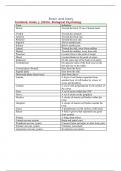
Term definition
Dorsal Toward the back top of human head
Ventral Toward the stomach
Anterior Toward the front end
Posterior Toward the rear end
Superior Above another part
Inferior Below another part
Lateral Toward the side, away from midline
Medial Toward the midline, away from side
Proximal Located close to the point of origin
Distal Located distant to the point of origin
Ipsilateral On the same side of the body (two parts)
Contralateral On opposite sides of the body (one on the
left and one on the right)
Coronal plane (frontal) Seen from the front
Sagittal plane Seen from the side
Horizontal plane (transverse) Seen from above
Lamina A layer of cell bodies separated from
another layer of cell bodies by a layer of
axons and dendrites
Column A set of cells perpendicular to the surface of
the cortex
Tract A set of axons within the CNS
Nerve A set of axons on the periphery
Nucleus A cluster of neuron cell bodies within the
CNS
Ganglion A cluster of neuron cell bodies outside the
CNS
Gyrus A protuberance on the surface of the brain
Sulcus A fold or groove that separated one gyrus
from another
Fissure A long, deep sulcus
Central nervous system Brain and spinal cord
Peripheral nervous system Connects brain and spine to other body parts
Somatic nervous system Voluntary movement
Autonomic nervous system Involuntary movement
,Textbook: Barnes, S., Pinel, J. (2018)
,
, LO: How does the central nervous system (specifically, the brain) work?
LO: What are the different areas in the brain? (brain anatomy)
LO: What are neurons?
LO: How does the brain send information to the rest of the body, and how
is information from the body send back to the brain?
The three major subdivisions of the brain (referred to with English
terms)
- hindbrain = posterior part of the brain
- medulla = enlarged extension of the spinal cord
- pons = bridge between left and right side of the brain
axons from each side cross to the opposite side of the spinal
cord so that the left hemisphere controls the muscles of the
right side of the body and vice versa
- cerebellum = balance and coordination
- midbrain = middle of the brain
- superior and inferior colliculus sensory processing (vision
and hearing)
- forebrain = two cerebral hemispheres
- receive sensory information from the contralateral side of
the body
- outer part = cerebral cortex
- limbic system: olfactory bulb, hypothalamus (eating,
drinking, temperature control, reproductive behaviors),
hippocampus, amygdala, and cingulate gyrus
The five smaller subdivisions (referred to with Latin terms)
- telencephalon
- diencephalon
- mesencephalon
- metencephalon
- myelencephalon
The division of the cerebral cortex into four types of lobes
- occipital lobe: visual information
- parietal lobe: somatosensory information
- temporal lobe: auditory information
- understanding spoken language, complex aspects of vision,
including perception of movement, recognition of faces
- emotional and motivational behaviors
- damage can lead to a set of behaviors known of the kluver-
bucy syndrome
- frontal lobe: fine movement
Gyri and sulci
- gyrus: protuberance
- sulci: folds
The thalamus
- with the hypothalamus, form the diencephalon
- sensory information processes and sent to the cerebral cortex (not
olfactory)
The hippocampus
Textbook: Kalat, J. (2019). Biological Psychology
Term definition
Dorsal Toward the back top of human head
Ventral Toward the stomach
Anterior Toward the front end
Posterior Toward the rear end
Superior Above another part
Inferior Below another part
Lateral Toward the side, away from midline
Medial Toward the midline, away from side
Proximal Located close to the point of origin
Distal Located distant to the point of origin
Ipsilateral On the same side of the body (two parts)
Contralateral On opposite sides of the body (one on the
left and one on the right)
Coronal plane (frontal) Seen from the front
Sagittal plane Seen from the side
Horizontal plane (transverse) Seen from above
Lamina A layer of cell bodies separated from
another layer of cell bodies by a layer of
axons and dendrites
Column A set of cells perpendicular to the surface of
the cortex
Tract A set of axons within the CNS
Nerve A set of axons on the periphery
Nucleus A cluster of neuron cell bodies within the
CNS
Ganglion A cluster of neuron cell bodies outside the
CNS
Gyrus A protuberance on the surface of the brain
Sulcus A fold or groove that separated one gyrus
from another
Fissure A long, deep sulcus
Central nervous system Brain and spinal cord
Peripheral nervous system Connects brain and spine to other body parts
Somatic nervous system Voluntary movement
Autonomic nervous system Involuntary movement
,Textbook: Barnes, S., Pinel, J. (2018)
,
, LO: How does the central nervous system (specifically, the brain) work?
LO: What are the different areas in the brain? (brain anatomy)
LO: What are neurons?
LO: How does the brain send information to the rest of the body, and how
is information from the body send back to the brain?
The three major subdivisions of the brain (referred to with English
terms)
- hindbrain = posterior part of the brain
- medulla = enlarged extension of the spinal cord
- pons = bridge between left and right side of the brain
axons from each side cross to the opposite side of the spinal
cord so that the left hemisphere controls the muscles of the
right side of the body and vice versa
- cerebellum = balance and coordination
- midbrain = middle of the brain
- superior and inferior colliculus sensory processing (vision
and hearing)
- forebrain = two cerebral hemispheres
- receive sensory information from the contralateral side of
the body
- outer part = cerebral cortex
- limbic system: olfactory bulb, hypothalamus (eating,
drinking, temperature control, reproductive behaviors),
hippocampus, amygdala, and cingulate gyrus
The five smaller subdivisions (referred to with Latin terms)
- telencephalon
- diencephalon
- mesencephalon
- metencephalon
- myelencephalon
The division of the cerebral cortex into four types of lobes
- occipital lobe: visual information
- parietal lobe: somatosensory information
- temporal lobe: auditory information
- understanding spoken language, complex aspects of vision,
including perception of movement, recognition of faces
- emotional and motivational behaviors
- damage can lead to a set of behaviors known of the kluver-
bucy syndrome
- frontal lobe: fine movement
Gyri and sulci
- gyrus: protuberance
- sulci: folds
The thalamus
- with the hypothalamus, form the diencephalon
- sensory information processes and sent to the cerebral cortex (not
olfactory)
The hippocampus


