

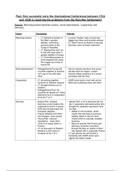
Plan: How successful were the International Conferences between 1924
and 1928 in resolving the problems from the Post-War Settlement?
Factors: Resolving tension between nations, world disarmament, cooperation and
Germany
Factor Successes Failures
Resolving tension • LT: Distinctive borders in • Locarno Treaties- task at hand was
the West = greater bigger than they could actually achieve
stability- confirming • LT: Gave France an illusion of security-
previous terms in the Germany have not been restrained
Treaty of Versailles
• LT: Signing they won’t go
to war with each other =
greater stability in Europe
• LT: Committing powers to
solve disputes and using
the League as a body to
insure this
World disarmament • Kellogg-Briand Pact got 62 • Hard to impose sanctions that would
countries together to promise actually have an impact- couldn’t
not to go to war with each impose military sanctions as it would
other contradict with the Pact
Cooperation • LT: all working together, • USSR were hard to work with as the
however for different reasons West had conflicting views with them
• LT: brought America out of
isolation
• Kellogg-Briand Pact- 62
countries all agreed to it. Most
distinctive form of cooperation
since the T of V
Germany • Dawes Plan: boosted - Dawes Plan: a lot of Germans did not
Germany economically (only like it, especially nationalist parties who
supposed to last for 5 years) - thought the reparation payments were
USA were brought back into too high
European disputes • Relied on US investors, which
• France withdrew from Ruhr means that Germany’s economic
and Cologne- more secure stability relied on the US stock
• Young Plan- reduced market which is naturally unstable
reparations - made them business
more of an equal nation in • Naive to assume that France and
Europe Germany would be reconciled
• LT: no discussion of Eastern through the plan as neither of them
Borders so left it open to fully agreed with it, especially France
revisions of the T of V - LT: got security but still formed a
friendship with USSR which went
against the West’s ideals
and 1928 in resolving the problems from the Post-War Settlement?
Factors: Resolving tension between nations, world disarmament, cooperation and
Germany
Factor Successes Failures
Resolving tension • LT: Distinctive borders in • Locarno Treaties- task at hand was
the West = greater bigger than they could actually achieve
stability- confirming • LT: Gave France an illusion of security-
previous terms in the Germany have not been restrained
Treaty of Versailles
• LT: Signing they won’t go
to war with each other =
greater stability in Europe
• LT: Committing powers to
solve disputes and using
the League as a body to
insure this
World disarmament • Kellogg-Briand Pact got 62 • Hard to impose sanctions that would
countries together to promise actually have an impact- couldn’t
not to go to war with each impose military sanctions as it would
other contradict with the Pact
Cooperation • LT: all working together, • USSR were hard to work with as the
however for different reasons West had conflicting views with them
• LT: brought America out of
isolation
• Kellogg-Briand Pact- 62
countries all agreed to it. Most
distinctive form of cooperation
since the T of V
Germany • Dawes Plan: boosted - Dawes Plan: a lot of Germans did not
Germany economically (only like it, especially nationalist parties who
supposed to last for 5 years) - thought the reparation payments were
USA were brought back into too high
European disputes • Relied on US investors, which
• France withdrew from Ruhr means that Germany’s economic
and Cologne- more secure stability relied on the US stock
• Young Plan- reduced market which is naturally unstable
reparations - made them business
more of an equal nation in • Naive to assume that France and
Europe Germany would be reconciled
• LT: no discussion of Eastern through the plan as neither of them
Borders so left it open to fully agreed with it, especially France
revisions of the T of V - LT: got security but still formed a
friendship with USSR which went
against the West’s ideals


