

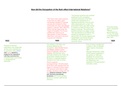
How did the Occupation of the Ruhr effect International Relations?
The German economy was severely
weakened by the occupation.
The French were under pressure Industrial production in the Ruhr
to pay their war debts, grew (which was responsible for a
increasingly impatient to German significant proportion of its iron and
excuses and invaded the Ruhr steel output) ground to a halt. The
(industrially rich area), with Belgian government had to pay relief money
support in January 1923. What the to workers on strike as long as the Extremist parties
French did was legal under the dispute continued. The government grew in popularity-
Treaty of Versailles. The French therefore printed more paper money. Weimar
justified their actions as an This was disastrous as inflation was government won
appropriation of what Germany already at a dangerous level. In 114 out 472 seats
owed them- took debt in the form spring 1923, the country experienced in the Reichstag in
of goods and materials. hyperinflation and money became May 1924.
worthless- sent the country into
1922 1923 economic chaos. 1924
The industry in the Ruhr was Price of bread rocketed from
Payment of German severely affected by the 4 marks in 1921 to 200,000
reparations was suspended occupation: about 60,000 French million marks in November
as they were experiencing and Belgian soldiers seized 1923.
an economic crisis. Britain control of factories, mines and Although Stresemann called
and France agreed to railways. With German army off the passive resistance in
postpone the reparations seriously limited by the Treaty, the the autumn of 1923 and
until they recovered but government ordered workers in stabilised the economy by
President Ebert was hoping the Ruhr to undertake passive introducing a new currency,
to renegotiate the resistance and went on strike. the Rentemark, the
payments.
French response: reputation of the government
uncompromising- 150,000 people had taken a blow.
of the Ruhr were expelled from the
region for refusing to follow orders,
132 Germans were killed in eight
months, including a seven year old
boy. Relations between France
and Germany dramatically
worsened; anti-French protests
became a common sight across
Germany.
The German economy was severely
weakened by the occupation.
The French were under pressure Industrial production in the Ruhr
to pay their war debts, grew (which was responsible for a
increasingly impatient to German significant proportion of its iron and
excuses and invaded the Ruhr steel output) ground to a halt. The
(industrially rich area), with Belgian government had to pay relief money
support in January 1923. What the to workers on strike as long as the Extremist parties
French did was legal under the dispute continued. The government grew in popularity-
Treaty of Versailles. The French therefore printed more paper money. Weimar
justified their actions as an This was disastrous as inflation was government won
appropriation of what Germany already at a dangerous level. In 114 out 472 seats
owed them- took debt in the form spring 1923, the country experienced in the Reichstag in
of goods and materials. hyperinflation and money became May 1924.
worthless- sent the country into
1922 1923 economic chaos. 1924
The industry in the Ruhr was Price of bread rocketed from
Payment of German severely affected by the 4 marks in 1921 to 200,000
reparations was suspended occupation: about 60,000 French million marks in November
as they were experiencing and Belgian soldiers seized 1923.
an economic crisis. Britain control of factories, mines and Although Stresemann called
and France agreed to railways. With German army off the passive resistance in
postpone the reparations seriously limited by the Treaty, the the autumn of 1923 and
until they recovered but government ordered workers in stabilised the economy by
President Ebert was hoping the Ruhr to undertake passive introducing a new currency,
to renegotiate the resistance and went on strike. the Rentemark, the
payments.
French response: reputation of the government
uncompromising- 150,000 people had taken a blow.
of the Ruhr were expelled from the
region for refusing to follow orders,
132 Germans were killed in eight
months, including a seven year old
boy. Relations between France
and Germany dramatically
worsened; anti-French protests
became a common sight across
Germany.


