

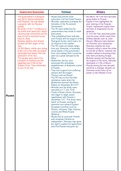
Social and Economic Political Military
• The government in Petrograd • Russia was still the most • By March 1917 the war had been
was left to Tsarina Alexandra autocratic of all the Great Powers. going badly for Russia.
and Rasputin. He was deeply • Nicholas’ abdication prompted the • Eastern Front highlighted the
unpopular with the Russian formation of the Provisional poor training of the Russian
people. Government. troops, inadequate supply lines
• By winter 1916-17 conditions on • The PG were limited by the and lack of imagination by the
the home front were poor; bread compromises they made to retain generals.
rationing was introduced and the their power. • In 1915 the Tsar assumed power
lack of fuel for factories forced • They established their authority over the army, which meant that
them to close. over Russia with the support of the military defeats such as Lake
• Russian soldiers and citizens Petrograd Soviet, which had a lot Naroch Offensive were blamed
focused all their anger on the of influence in the capital. on Nicholas’ poor leadership.
Tsar. • The PG could not simply resign • Nicholas ordered the local
• On 8th March, strikes and rioting from war. Kerensky, a moderate Cossack militia to down the strike
broke out in the cities as people social leader of the government on the 8th of March, however the
demanded first bread, then the from July realised that it would be soldiers balked at shooting cities
abdication of the Tsar . seen as a great betrayal by the who were protesting hunger.
• The people were tired of the Allies. • Mutinies spread and having lost
privations of wartime and the • Bolsheviks, led by Lenin the support of the army, Nicholas
appalling loss of life on the advocated the immediate abdicated on 15th of March.
Eastern Front. They demanded establishment of Bolshevik control • Russia leaving the war abruptly
an end to the war. in Russia. would be a strategic disaster as
• They won support from suffering Germany would focus all its
citizens with the slogan power on the Western Front
‘Peace,Land and Bread’.
• The PG was so thin that little
resistance came when the
Bolsheviks stormed the Winter
Palace on November 8th 1917.
• Nicholas and his family were
executed on 17 July 1918.
• Treaty of Brest-Litovsk; Germany
was eager to begin peace
Russia
negotiations with Russia in
December 1917. The terms were
harsh on Russia, ending its
dominion over several Eastern
European countries such as
Poland, Lithuania, Riga, Estonia,
Livonia and White Russia
(Belarus).
• Russia had to evacuate Finland
and recognise Ukraine as
independent. Germany was given
the right to exploit rich agricultural
land that Russia had given up.
• The government in Petrograd • Russia was still the most • By March 1917 the war had been
was left to Tsarina Alexandra autocratic of all the Great Powers. going badly for Russia.
and Rasputin. He was deeply • Nicholas’ abdication prompted the • Eastern Front highlighted the
unpopular with the Russian formation of the Provisional poor training of the Russian
people. Government. troops, inadequate supply lines
• By winter 1916-17 conditions on • The PG were limited by the and lack of imagination by the
the home front were poor; bread compromises they made to retain generals.
rationing was introduced and the their power. • In 1915 the Tsar assumed power
lack of fuel for factories forced • They established their authority over the army, which meant that
them to close. over Russia with the support of the military defeats such as Lake
• Russian soldiers and citizens Petrograd Soviet, which had a lot Naroch Offensive were blamed
focused all their anger on the of influence in the capital. on Nicholas’ poor leadership.
Tsar. • The PG could not simply resign • Nicholas ordered the local
• On 8th March, strikes and rioting from war. Kerensky, a moderate Cossack militia to down the strike
broke out in the cities as people social leader of the government on the 8th of March, however the
demanded first bread, then the from July realised that it would be soldiers balked at shooting cities
abdication of the Tsar . seen as a great betrayal by the who were protesting hunger.
• The people were tired of the Allies. • Mutinies spread and having lost
privations of wartime and the • Bolsheviks, led by Lenin the support of the army, Nicholas
appalling loss of life on the advocated the immediate abdicated on 15th of March.
Eastern Front. They demanded establishment of Bolshevik control • Russia leaving the war abruptly
an end to the war. in Russia. would be a strategic disaster as
• They won support from suffering Germany would focus all its
citizens with the slogan power on the Western Front
‘Peace,Land and Bread’.
• The PG was so thin that little
resistance came when the
Bolsheviks stormed the Winter
Palace on November 8th 1917.
• Nicholas and his family were
executed on 17 July 1918.
• Treaty of Brest-Litovsk; Germany
was eager to begin peace
Russia
negotiations with Russia in
December 1917. The terms were
harsh on Russia, ending its
dominion over several Eastern
European countries such as
Poland, Lithuania, Riga, Estonia,
Livonia and White Russia
(Belarus).
• Russia had to evacuate Finland
and recognise Ukraine as
independent. Germany was given
the right to exploit rich agricultural
land that Russia had given up.


