

Nrnp
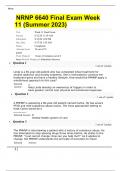
NRNP 6640 Final Exam Week
11 (Summer 2023)
Test Week 11 Final Exam
Started 8/12/20 11:39 AM
Submitted 8/12/20 1:02 PM
Due Date 8/17/20 1:59 AM
Status Completed
Attempt Score 74 out of 75
points
Time Elapsed 1 hour, 22 minutes out of 2
hours Results Displayed Submitted Answers
Question 1
1 out of 1 points
Linda is a 65-year-old patient who has completed initial treatment for
alcohol addiction and anxiety problems. She is motivated to continue her
treatment gains and have a healthy lifestyle. How would the PMHNP apply a
mindfulness approach to this case?
Selected A.
Answer: Help Linda develop an awareness of triggers in order to
have greater control over physical and emotional responses
Question 2
1 out of 1 points
A PMHNP is assessing a 60-year-old patient named Carlos. He has severe
PTSD and mild substance abuse issues. The most appropriate setting to
treat Carlos would be a
.
Selected Answer: D.
mental health system of care
Question 3
1 out of 1 points
The PMHNP is interviewing a patient with a history of substance abuse. He
has attempted to stop abusing drugs three times before. He states to the
PMHNP, “I just cannot change. How can you help me?!” As it applies to
change, the PMHNP understands the principle of evocation to mean:
Selected Answer:
1
,Nrnp
B. he patient already has everything needed and the PMHNP
T would like to help him facilitate his own inner coping.
Question 4
2
, Nrnp
1 out of 1 points
The PMHNP is assessing a 30-year-old client who reports feeling stressed
out due to his current employment situation. When asked about how he
manages this work- related stress, the patient says that exercise helps
him feel less anxious, so he often spends 2 or more hours at the gym each
night. After completing the patient assessment, the PMHNP has
determined that an existential psychotherapy approach may best benefit
this client. What is the PMHNP’s goal in employing this treatment
approach?
Selected Answer: B.
Help the patient be aware of his anxiety and
Question 5
1 out of 1 points
embrace it
The PMHNP initiates feeling-state therapy to help a 25-year-old patient
named Monique who has a compulsive urge to exercise. Using the Feeling-
State Addiction Protocol, what is an appropriate next step the PMHNP
should take after identifying the specific positive feeling linked with the
addictive behavior and its Positive Feeling Score level?
Selected C.
Answer: Locate and identify any physical sensations created by the
positive feelings
Question 6
1 out of 1 points
The PMHNP uses the Adult Attachment Interview (AAI) with a male patient
who reports having had a difficult time being separated from his parents
during his childhood. He explains that going to school or visiting his
relatives without his parents was troublesome. The PMHNP characterizes
the patient as unresolved/disorganized, according to his outcomes on the
AAI. What does the PMHNP anticipate from the patient?
Selected Answer: A.
He will have lapses in his memory of his childhood.
Question 7
0 out of 1 points
A PMHNP is using motivational interviewing (MI) with a 50-year-old patient
named Dave to commit to a healthy drug-free lifestyle. By using “change
talk,” the PMHNP hopes to help the patient build self-esteem and hope.
True or false: If Dave is resisting change, the PMHNP should challenge his
resistance in order for MI to be successful.
3
NRNP 6640 Final Exam Week
11 (Summer 2023)
Test Week 11 Final Exam
Started 8/12/20 11:39 AM
Submitted 8/12/20 1:02 PM
Due Date 8/17/20 1:59 AM
Status Completed
Attempt Score 74 out of 75
points
Time Elapsed 1 hour, 22 minutes out of 2
hours Results Displayed Submitted Answers
Question 1
1 out of 1 points
Linda is a 65-year-old patient who has completed initial treatment for
alcohol addiction and anxiety problems. She is motivated to continue her
treatment gains and have a healthy lifestyle. How would the PMHNP apply a
mindfulness approach to this case?
Selected A.
Answer: Help Linda develop an awareness of triggers in order to
have greater control over physical and emotional responses
Question 2
1 out of 1 points
A PMHNP is assessing a 60-year-old patient named Carlos. He has severe
PTSD and mild substance abuse issues. The most appropriate setting to
treat Carlos would be a
.
Selected Answer: D.
mental health system of care
Question 3
1 out of 1 points
The PMHNP is interviewing a patient with a history of substance abuse. He
has attempted to stop abusing drugs three times before. He states to the
PMHNP, “I just cannot change. How can you help me?!” As it applies to
change, the PMHNP understands the principle of evocation to mean:
Selected Answer:
1
,Nrnp
B. he patient already has everything needed and the PMHNP
T would like to help him facilitate his own inner coping.
Question 4
2
, Nrnp
1 out of 1 points
The PMHNP is assessing a 30-year-old client who reports feeling stressed
out due to his current employment situation. When asked about how he
manages this work- related stress, the patient says that exercise helps
him feel less anxious, so he often spends 2 or more hours at the gym each
night. After completing the patient assessment, the PMHNP has
determined that an existential psychotherapy approach may best benefit
this client. What is the PMHNP’s goal in employing this treatment
approach?
Selected Answer: B.
Help the patient be aware of his anxiety and
Question 5
1 out of 1 points
embrace it
The PMHNP initiates feeling-state therapy to help a 25-year-old patient
named Monique who has a compulsive urge to exercise. Using the Feeling-
State Addiction Protocol, what is an appropriate next step the PMHNP
should take after identifying the specific positive feeling linked with the
addictive behavior and its Positive Feeling Score level?
Selected C.
Answer: Locate and identify any physical sensations created by the
positive feelings
Question 6
1 out of 1 points
The PMHNP uses the Adult Attachment Interview (AAI) with a male patient
who reports having had a difficult time being separated from his parents
during his childhood. He explains that going to school or visiting his
relatives without his parents was troublesome. The PMHNP characterizes
the patient as unresolved/disorganized, according to his outcomes on the
AAI. What does the PMHNP anticipate from the patient?
Selected Answer: A.
He will have lapses in his memory of his childhood.
Question 7
0 out of 1 points
A PMHNP is using motivational interviewing (MI) with a 50-year-old patient
named Dave to commit to a healthy drug-free lifestyle. By using “change
talk,” the PMHNP hopes to help the patient build self-esteem and hope.
True or false: If Dave is resisting change, the PMHNP should challenge his
resistance in order for MI to be successful.
3


