NR599 Comprehensive Final Exam
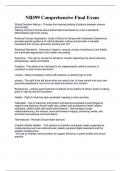
Ethical Decision Making - -Process that requires striking a balance between science and morality. -Making informed choices about ethical dilemmas based on a set of standards differentiating right from wrong. American Nurses Association- Code of Ethics for Nurses with Interpretive Statements. - provides specific guidance for ethical decision making and provides a valuable framework that can be used when working with HIT Bioethical Standards - Autonomy, freedom, veracity, privacy, beneficence, and fidelity are maximally appropriate to the health care setting. Autonomy - The right to choose for himself or herself; respecting the clients opinions, perspectives, values and beliefs. Freedom - The ability of an individual to act independently, without coercion or constraint in ones choice and action veracity - Being completely truthful with patients; a patients right to truth. privacy - The right to be left alone when you want to be, to have control over your own personal possessions, and not to be observed without your consent Beneficence - Actions performed that contribute to the welfare of others; Action of doing good or right by and for the patient. Fidelity - Right to what has been promised; keeping to one's promise. Telehealth - Use of electronic information and telecommunications technologies to support long-distance clinical health care, patient and professional health-related education, public health and health administration. Technologies include videoconferencing, the internet, store-and-forward imaging, streaming media, and terrestrial and wireless communications. Telemedicine - Remote clinical health services mHealth (Mobile Health) - -The practice of medicine and public health supported by mobile devices such as mobile phones, tablets, personal digital assistants and the wireless infrastructure. -The use of wireless communication to support efficiency in public health and clinical practice. Mobile Medical Applications (Apps) - -Accessories to a regulated medical device or are a software that transforms a mobile platform into a regulated medical device. -Facilitates mHealth Medical Devices - Any equipment, instrument, implant, material, or apparatus used for the diagnosis, treatment, or monitoring of patients. Rationale APP is NOT Considered Medical Devices - Apps that are not intended for use in the diagnosis of disease or other conditions, or in the cure, mitigation, treatment, or prevention of disease. FDA Oversight for Medical Devices - -Regulatory body that oversees mobile apps that are medical devices and whose functionality could pose a risk to a patient's safety if the mobile app were to not function as intended. -Also oversee the cybersecurity management of these devices as well as the hospital network security. (POC) Point of Care - Testing and diagnosis at the patient's side and can be conducted anywhere the patient is, such as the home, physician office, ambulance, or hospital bedside Privacy - Practice of maintaining the security and confidentiality of patient records. Confidentiality - The act of holding information in confidence, not to be released to unauthorized individuals. Cybersecurity - -Measures taken to protect a computer or computer system against unauthorized access or attack. -FDA is main regulatory agency
Written for
- Institution
-
Chamberlain College Of Nursing
Document information
- Uploaded on
- December 4, 2023
- Number of pages
- 7
- Written in
- 2023/2024
- Type
- Exam (elaborations)
- Contains
- Questions & answers
Subjects
-
nr599 comprehensive final exam

Also available in package deal