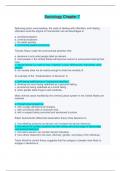
Sociology Chapter 7 - Questions and Answers
Sociology Chapter 7 - Questions and Answers Reducing prison overcrowding, the costs of dealing with offenders, and helping offenders avoid the stigma of incarceration are all advantages of a. societal protection. b. criminal recidivism. c. the death penalty. d. community-based corrections. Thomas Szasz made the controversial assertion that a. deviance is only what people label as deviant. b. most people in the United States will become insane for some period during their lives. c. mental illness is a myth so that "insanity" is only "differences" that bother other people. d. our society does not do nearly enough to treat the mentally ill. An example of the "medicalization of deviance" is a. theft being redefined as a "compulsive stealing." b. drinking too much being redefined as a personal failing. c. promiscuity being redefined as a moral failing. d. when people steal drugs to self-medicate. Most criminal cases handled by the criminal justice system in the United States are resolved a. through plea bargaining. b. with a judge dismissing all charges. c. with convictions after a courtroom trial. d. with a suspect being convicted and sentenced to prison. Edwin Sutherland's differential association theory links deviance to a. how labeling someone as deviant can increase the deviant behavior. b. the amount of contact a person has with others who encourage or discourage conventional behavior. c. how well a person can contain deviant impulses. d. how others respond to the race, ethnicity, gender, and class of the individual. Travis Hirschi's control theory suggests that the category of people most likely to engage in deviance is a. students enrolled in college. b. teenagers on sports teams with after-school jobs. c. youngsters who "hang out" waiting for something to happen. d. young people with respect for their parents. According to the social-conflict approach, what a society labels as deviant is based primarily on a. how often the act occurs. b. the moral foundation of the culture. c. how harmful the act is to the public as a whole. d. differences in power between various categories of people. Alexander Liazos speaks for the social-conflict approach when he states that a. powerless people are at the highest risk of being defined as deviant. b. deviance has both functions and dysfunctions. c. deviance exists only in the eye of the beholder. d. society should ignore victimless crime. Using a Marxist approach, Steven Spitzer claims that prime targets for deviant labeling include a. people who try to take the property of others. b. people who work hard but are poor. c. perpetrators of white-collar crime. d. people who have social power. Crime committed by persons of high social position during the course of their occupations is called a. victimless crime. b. white-collar crime. c. organized crime. d. street crime. Edwin Sutherland stated that white-collar crime a. almost always leads to a criminal conviction. b. provokes a strong response from the community. c. is usually resolved in a civil rather than a criminal court. d. rarely involves serious harm to the public as a whole. _________ _______ refers to the illegal actions of a corporation or people acting on its behalf.
École, étude et sujet
- Établissement
- Sociology
- Cours
- Sociology
Infos sur le Document
- Publié le
- 29 novembre 2023
- Nombre de pages
- 9
- Écrit en
- 2023/2024
- Type
- Examen
- Contenu
- Questions et réponses

Document également disponible en groupe