

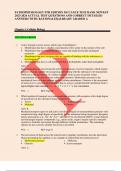
PATHOPHYSIOLOGY 9TH EDITION MCCANCE TEST BANK NEWEST ACTUAL TEST QUESTIONS AND CORRECT DETAILED ANSWERS WITH RATIONALES|ALREADY GRADED A Chapter 1: Cellular Biology
PATHOPHYSIOLOGY 9TH EDITION MCCANCE TEST BANK NEWEST ACTUAL TEST QUESTIONS AND CORRECT DETAILED ANSWERS WITH RATIONALES|ALREADY GRADED A Chapter 1: Cellular Biology MULTIPLE CHOICE 1. Active transport occurs across which type of membranes? a. Membranes that have a higher concentration of the solute on the outside of the cell b. Membranesthat are semipermeable to water and small electrically uncharged molecules c. Membranesthat have receptorsthat are capable of binding with the substances to be transported d. Membranes that have a cell membrane that is hydrophobic rather than hydrophilic ANS: C Some molecules are moved into the cell by mechanisms of active transport, which require receptorsthat are capable of recognizing and binding with the substance to be transported. Diffusion is the movement of a solute molecule from an area of greater solute concentration to an area of lesser solute concentration. Hydrostatic pressure is the mechanical force of water pushing against cellular membranes. Osmosis is the movement of water down a concentration gradient; that is, across a semipermeable membrane from a regionofhigherwater concentrati No Un RtoSI a Nl Go Tw Be .Cr Ow Mater concentration PTS: 1 REF: Page 28 2. Which method of transport usestransmembrane proteins with receptors with a high degree of specificity for the substance being transported? a. Active c. Transmembranous b. Mediated d. Passive ANS: B Mediated transport (passive and active) involves integral or transmembrane proteins with receptors having a high degree ofspecificity for the substance being transported. Inorganic anions and cations (e.g., Na+ , K+ , Ca++, chloride [Cl– ], bicarbonate [HCO3 – ]) and charged and uncharged organic compounds (e.g., amino acids, sugars) require specific transport systems to facilitate movement through different cellular membranes. The remaining options do not correctly identify the process described. PTS: 1 REF: Page 31 3. The movement of fluid across the arterial end of capillary membranes into the interstitial fluid surrounding the capillary is an example of which fluid movement process? a. Hydrostatic pressure c. Diffusion b. Osmosis d. Active transport ANS: A
Document information
- Uploaded on
- November 28, 2023
- Number of pages
- 506
- Written in
- 2023/2024
- Type
- Exam (elaborations)
- Contains
- Questions & answers


