AEMT Protocols Study Guide Questions with Complete Solutions
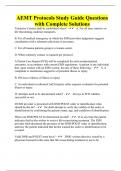
Telemetry Contact shall be established when? - A. For all time sensitive or life threatening condition transports. B. For all medical emergency in which the EMS providers judgement suggests consultation with a telemetry physician is necessary. C. For all trauma patients going to a trauma center. D. When telemetry contact is required per protocol. A Patient Care Report (PCR) will be completed for each incident/patient encounter, in accordance with current EMS regulations. A patient is any individual that, upon contact with an EMS system, has any of these following: - A. A complaint or mechanism suggestive of potential illness or injury B. Obvious evidence of illness or injury C. An individual or informed 2nd/3rd party caller requests evaluation for potential illness or injury. IV attempts need to be documented when? - Always in PCR whether successful or not. If EMS provider is presented with DNR/POLST order or identification what should he/she do? - He shall attempt to verify the validity of the order or identification by confirming the patients name, age, and condition of identification. When can DNR/POLST be determined invalid? - If at any time the patient indicates that he/she wishes to receive life-resuscitating treatment. The EMS provider shall document the presence of the DNR/POLST order or identification, and how the patient indicated that he/she wanted the order or identification to be revoked. Valid DNR and POLST must have? - DNR- written directive issued by a physician licensed in this state that life-resuscitating treatment is not to be administered to a qualified patient. The term also includes a valid do-not-resuscitate order issued under the laws of another state. POLST- valid form is signed physician that records the wishes of the patient and directs a healthcare provider regarding the provision of life-resuscitating treatment and life-sustaining treatment. INTER-FACILITY #1 Ambulance attendants should only transfer a patient whose therapy required during the transfer lies within the ambulance attendant's capabilities, unless capable personnel accompany the patient. - A. Ambulance attendants are authorized to administer or monitor all medications listed on the official drug inventory as appropriate for their level of licensure and as per protocol.
Schule, Studium & Fach
- Hochschule
- AEMT
- Kurs
- AEMT
Dokument Information
- Hochgeladen auf
- 28. november 2023
- Anzahl der Seiten
- 7
- geschrieben in
- 2023/2024
- Typ
- Prüfung
- Enthält
- Fragen & Antworten
Themen
- aemt protocols
- aemt
-
aemt protocols study guide questions
-
aemt protocols study guide

Ebenfalls erhältlich im paket-deal