

CCRN Test Bank
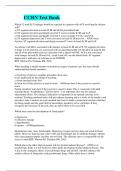
Which 12-lead ECG changes should be expected in a patient with ACS involving the inferior wall? a) ST segment elevation in leads II, III and all the precordial leads b) ST segment elevation and deeply inverted T waves in leads II, III and AvF c) ST segment elevation and deeply inverted T waves in leads V4-V6, I and aVL d) ST segment depression and T wave elevation in leads II, III and AvL - ANSCorrect Answer: ST segment elevation and deeply inverted T waves in leads II, III and AvF An inferior wall MI is associated with changes in leads II, III and aVF. ST segment elevation in leads V4-V6 and aVL are associated with an anterolateral MI. ST elevation in leads II, III, and all of the precordial leads are consistent with a lateral wall MI. ACS is not associated with changes in leads II, III and aVL. Leads I and aVL are the lateral leads. ST segment depression is indicative of ischemia or an NSTEMI. REF: Morton PG, Fontaine DK. 2018. When teaching a family member to perform an aspect of patient care, the nurse should understand that family members... a) learn best if shown a complex procedure all at once. b) are unaffected by the timing of teaching. c) learn unrelated tasks first. d) learn best if they perceive a need to learn. - ANSLearn best if they percieve a need to learn; Family members learn best if they perceive a need to learn. This is consistent with adult learning theory. Establishing a "need to know" is an important first step for optimal educational efforts. The timing of education is important for an optimal outcome to be realized. Teaching unrelated tasks will not enhance learning and is a waste of the family's and provider's time. Learners are goal-oriented and want to make a connection between what they are being taught and the goal (skill or knowledge) needed to solve a problem. If they recognize the relevance of the task, they are more likely to be successful Which may cause the development of fixed pupils? a) hyperoxia b) olfactory damage c) hypothermia d) opiates - ANSHypothermia; Hypothermia may cause fixed pupils. Hyperoxia (oxygen toxicity) does not result in fixed pupils. However, hypoxia may cause wide and fixed pupils due to midbrain damage. Opiates may cause pinpoint pupils, but they are not fixed. The olfactory nerve is responsible for the sense of smell.REF: Morton PG, Fontaine DK. 2018. Which places the older adult at greater risk for alcohol-induced disease? - ANSUse of psychotropic drugs is a risk factor for older adults developing alcohol-induced disease. This is due to the synergetic effects of psychotropic drugs and alcohol. Alcohol enhances the sedative effects of frequently used psychotropic drugs. Older adults have a slower
Document information
- Uploaded on
- November 27, 2023
- Number of pages
- 8
- Written in
- 2023/2024
- Type
- Exam (elaborations)
- Contains
- Questions & answers


