

Patho NSG 120 Exam Questions And Answers
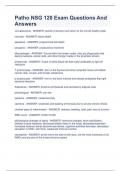
Patho NSG 120 Exam Questions And Answers convalescence - ANSWER- period of recovery and return to the normal healthy state necrosis - ANSWER- tissue death apoptosis - ANSWER- programmed cell death iatrogenic - ANSWER- produced by treatment Macrophages - ANSWER- Found within the lymph nodes, they are phagocytes that destroy bacteria, cancer cells, and other foreign matter in the lymphatic stream. lymphocyte - ANSWER- A type of white blood cell that make antibodies to fight off infections T lymphocytes - ANSWER- form in the thymus and other lymphatic tissue and attack cancer cells, viruses, and foreign substances b lymphocytes - ANSWER- form in the bone marrow and release antibodies that fight bacterial infections Adipokines - ANSWER- proteins synthesized and secreted by adipose cells physiological - ANSWER- can see systemic - ANSWER- inside the body cachexia - ANSWER- weakness and wasting of the body due to severe chronic illness cardinal signs of inflammation - ANSWER- redness, swelling, heat, pain, loss of function WBC count - ANSWER- 5,000-10,000 physiological changes of aging - ANSWER- hormone changes, bone calcification, skeletal muscle weakens, decreased elastic fibers in the lungs, decreased expiration, increased residual, bones become less dense, cognitive activities decrease, decreased sensation in CNS skin thins, weakened immune function neutrophils - ANSWER- arrive first to the site of cell injury, are the most numerous of all WBCs and are part of the innate immune system basophils - ANSWER- active in allergic responses, releasing their stores of inflammatory chemicals eosiniphils - ANSWER- active in larger parastic infections, allergic responses, and some cancers lymphocytes - ANSWER- B, T, and natural killer cells, identify and destroy foreign invaders, found in lymph and bloodd monocytes - ANSWER- largest WBC, differentiates into macrophages that clean up cellular debris in the inflammatory process exudate - ANSWER- a collection of interstitial fluid formed in the inflammed area serous (watery) exudate - ANSWER- primarily of fluid with small amounts of proteins and WBCs, occur in allergic reactions or burns fibrinous exudate - ANSWER- Thick, clotted exudate: indicates more advanced inflammation purulent exudate - ANSWER- thick, yellow-green, contains more leukocytes, cell debris, and microorganisms absess - ANSWER- localized collection of pus direct contact - ANSWER- touching/ sexual intercourse indirect contact - ANSWER- intermediary droplet transmission - ANSWER- airborne
Document information
- Uploaded on
- November 24, 2023
- Number of pages
- 4
- Written in
- 2023/2024
- Type
- Exam (elaborations)
- Contains
- Questions & answers


