100% satisfaction guarantee Immediately available after payment Both online and in PDF No strings attached 4.2 TrustPilot
logo-home
Exam (elaborations)

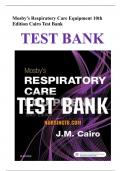
TEST BANK FOR MOSBY’S RESPIRATORY CARE EQUIPMENT 10TH EDITION BY CAIRO

Rating
-
Sold
-
Pages
352
Grade
A+
Uploaded on
23-11-2023
Written in
2023/2024

Mosby’s Respiratory Care Equipment 10th Edition Cairo Test Bank TEST BANK FOR MOSBY’S RESPIRATORY CARE EQUIPMENT 10TH EDITION BY CAIRO Chapter 01: Basic Physics for the Respiratory Therapist MULTIPLE CHOICE 1. Power is a measure of which of the following? a. Mechanical energy b. Gravitational potential energy c. The rate at which work is being performed d. The rate at which atoms and molecules move ANS: C Power is a measure of the rate at which work is being performed. The formula P = W/J, where W = watts and 1 watt is equal to 1 J/s, expresses this. Joules are the international standard for expressing energy and work. PTS: 1 REF: Page 8 2. When effort produces a change in the position of matter: a. work is performed. b. it is known as a joule. c. mechanical power is created. d. the law of the conservation of energy is being used. ANS: A Work is performed only when effort or outside forces produce a change in the position of matter. PTS: 1 REF: Page 8 3. The unit used to express the force of 1 newton (N) acting on a 1-kilogram (kg) object to move it 1 meter (m) is which of the following? a. Watt c. Kilowatt b. Joule d. Kinetic energy ANS: B One joule is equal to the force of 1 N acting on 1 kg. A watt is equivalent to 1 J/s. A kilowatt is simply 1000 W. Kinetic energy is energy an object possesses when it is in motion. PTS: 1 REF: Page 8 4. Power is expressed in which of the following units? a. Newtons c. Ohms b. Joules d. Watts ANS: D Power is a measure of the rate at which work is being performed. Energy and work are measured in joules. One joule is the force of 1 N acting on a 1-kg object to move it 1 m. Ohms is the resistance an electrical circuit possesses. PTS: 1 REF: Page 8 5. Four horsepower (hp) is equal to how many kilowatts (kW)? a. 5.36 c. 2984 b. 2.98 d. 186.5 ANS: B 1 hp = 0.746 kW. 1 hp/0.746 = 4 hp/X. X = 4 0.476 = 2.98 kW. PTS: 1 REF: Page 8 6. The energy that an object possesses when it is in motion is called: a. sound. c. thermal. b. kinetic. d. potential. ANS: B Kinetic energy is the energy an object possesses when it stays in motion. Potential energy is stored energy, and it exists in many forms such as thermal energy or sound waves. PTS: 1 REF: Page 9 7. If the velocity of an object is reduced by half, its kinetic energy will be which of the following? a. Reduced to one eighth c. Reduced twofold b. Increased twofold d. Not changed ANS: A Kinetic energy = (mass of object square of velocity it is traveling, or mv2 ) or KE = (V V). If the velocity is reduced by half, then KE = ( V V), or ( ) = reduction. PTS: 1 REF: Page 10 8. Energy that is stored in an object is called which of the following? a. Kinetic c. Chemical b. Potential d. Mechanical ANS: B Energy that is stored or possessed by an object because of its position is called potential energy. Mechanical energy can be divided into either kinetic energy or potential energy. Chemical potential energy often refers to the bonds in petroleum oils that, if broken, can be converted to kinetic energy. PTS: 1 REF: Page 10 9. The potential energy of a compressed spring is known as which of the following? a. Gravitational c. Inelastic b. Chemical d. Elastic ANS: D The potential energy stored in a compressed spring is called elastic potential energy. This energy is released when the spring is allowed to uncoil. Gravitational potential energy is the energy an object possesses if it is held above any surface, energy that the object’s weight gains as it falls. Chemical potential energy resides in the chemical bonds of the atoms that make up the object. Inelastic potential energy would not apply once the spring is compressed. PTS: 1 REF: Page 10 10. The energy stored in heating oil is known as which of the following? a. Elastic c. Chemical b. Atomic d. Gravitational ANS: C Petroleum reserves of coal, oil, and gas represent chemical potential energy by virtue of the chemical bond that must be broken to release energy. Heating oil potential energy has chemical-to-chemical bonds. Atomic energy involves two processes—fission (splitting atoms) and fusion (joining two atoms). PTS: 1 REF: Page 8 11. The kinetic theory holds that: a. all matter is composed of tiny particles. b. elements combine in fixed proportions to form molecules. c. the energy that an object gains as it falls is a result of gravity. d. atoms and molecules that make up matter are in constant motion. ANS: D Kinetic energy is the energy an object possesses while in motion. PTS: 1 REF: Page 9 12. Which is the correct order for increasing size? a. Atoms, molecules, mixtures, compounds, elements b. Atoms, elements, molecules, compounds, mixtures c. Elements, atoms, molecules, compounds, mixtures d. Atoms, elements, mixtures, molecules, compounds ANS: B All matter, whether in gas, liquid, or solid form, is made up of atoms that can combine to form elements; the elements can then combine to form molecules. Molecules can combine to form compounds. Combining compounds makes a mixture. PTS: 1 REF: Page 10 13. Atoms and molecules arranged in an orderly fashion are called: a. Solids c. Crystalline b. Mixtures d. Amorphous ANS: C Crystalline solids are highly organized structures whose atoms and molecules are arranged in a lattice configuration. Amorphous solids have atoms and molecules that are less rigidly arranged. PTS: 1 REF: Page 10 14. The most potential energy is contained by which state of matter? a. Gases c. Liquids b. Solids d. Mixtures ANS: B Of all states of matter, solids contain the most potential energy; solids are followed by liquids and then gases. PTS: 1 REF: Page 11 15. Which of the following are amorphous solids? 1. Iron 2. Glass 3. Plastic 4. Margarine a. 1 c. 2 and 4 b. 1 and 3 d. 2, 3, and 4 ANS: D Glass and margarine are always considered amorphous solids. Plastic usually shows flexibility, which implies that it has amorphous features, so it should be considered amorphous. Iron, however, has well-organized atoms in a crystalline arrangement. PTS: 1 REF: Page 10 16. Supercooled liquids are also known as which of the following? a. Elements c. Crystalline solids b. Compounds d. Amorphous solids ANS: D Amorphous solids are sometimes called supercooled liquids. Elements and compounds alone can combine to form either crystalline or amorphous solids. PTS: 1 REF: Page 10 17. The least amount of kinetic energy is possessed by which one of the following? a. Air c. Water b. Iron d. Plastic ANS: B Of the three states of matter, solids possess the least amount of kinetic energy. The bonds holding their atoms together limit the mobility of the particles that make up the solid. PTS: 1 REF: Page 11 18. Incompressible substances that are able to maintain their volume and shape are called: a. gases. c. liquids. b. solids. d. compounds. ANS: B Solids are characterized as incompressible substances that can maintain their volume and shape. Gases and liquids do not maintain their volume and shape as well as solids do. PTS: 1 REF: Page 11 19. The weakest cohesive forces between constituent particles are present in which of the following? a. Water c. Hydrogen b. Plastic d. Liquid oxygen ANS: C Gases have extremely weak or no cohesive forces between their atoms. Hydrogen is the only gas among the four choices. PTS: 1 REF: Page 11 20. A cylinder of compressed gas contains 1500 psig at 70° F; the cylinder is heated to 120° F. Which of the following effects will occur as a result of the temperature change? 1. There will be increased kinetic activity in the contents of the cylinder 2. The volume of gas in the cylinder will increase 3. The pressure indicated on the pressure gauge will increase. a. 1 only c. 1 and 3 b. 1 and 2 d. 2 and 3 ANS: C The increased temperature will increase the kinetic activity of the molecules which make up the gas. Charles law states that pressure and temperature are directly proportional. An increase in temperature will increase the pressure. PTS: 1 REF: Page 6 21. The temperature at which a solid converts to a liquid is the point. a. freezing c. boiling b. melting d. critical ANS: B This is the definition of melting point. Freezing is the change of a substance from a liquid to a solid. Melting is the change from a solid to a liquid. The temperature at which a liquid converts to a gaseous state is the boiling point. The critical point is used to describe the critical temperature and critical pressure of a substance. PTS: 1 REF: Page 13 22. Which of the following statements are true concerning the latent heat of fusion? 1. It is also called evaporation. 2. It is expressed in calories per gram. 3. It will cause a complete change of state. 4. It is expressed in grams per degree Celsius. a. 1 and 2 c. 2 and 3 b. 1 and 3 d. 2, 3, and 4 ANS: C Latent heat of fusion is the amount of heat, in calories, that must be added to cause a complete change of state. Evaporation is change from liquid to gas. Latent heat is expressed as calories per gram. Evaporation is the passive change of state over time, with no addition of heat. PTS: 1 REF: Page 13 23. The process whereby a solid directly becomes a gas is known as: a. latent heat. c. evaporation. b. sublimation. d. condensation. ANS: B The direct change of state from solid to gas is called sublimation. Evaporation involves change from liquid to gas. Latent heat involves a change of state in matter of any form. PTS: 1 REF: Page 15 24. Which two of the following are ways to enhance the process of evaporation? 1. Decrease the temperature of the liquid 2. Increase the temperature of the liquid 3. Decrease atmospheric pressure 4. Increase atmospheric pressure a. 1 and 3 c. 2 and 3 b. 1 and 4 d. 2 and 4 ANS: B Either decreasing the temperature or increasing the atmospheric pressure will decrease the evaporation rate. PTS: 1 REF: Page 16 25. How much pressure must be applied to maintain equilibrium between liquid and gaseous oxygen at its critical temperature? a. 1 atm c. 43.9 atm b. 37 atm d. 49.7 atm ANS: D When the atmospheric pressure is maintained at 49.7 atm, at a temperature of –119° C (oxygen’s critical temperature), oxygen maintains an equal balance between its liquid and gaseous states. PTS: 1 REF: Page 18 26. The point at which the vapor pressure of a liquid equals atmospheric pressure is known as which of the following? a. Critical temperature c. Boiling point b. Vapor pressure d. Latent heat ANS: C The boiling point is the temperature at which the vapor pressure of a liquid equals atmospheric pressure. Critical temperature is the temperature above which gases cannot convert back to liquid. Critical pressure is the amount of pressure applied at the critical temperature to maintain balance between the liquid and gas phases. PTS: 1 REF: Page 19 27. The temperature above which gas molecules cannot be converted back to a liquid, no matter how much pressure is exerted, is known as which of the following? a. Critical temperature c. Boiling point b. Critical point d. Latent heat ANS: A This is the definition of critical temperature. PTS: 1 REF: Page 19 28. The boiling point of liquid oxygen is which of the following? a. –119° C c. –183° C b. 182° F d. 49.7° C ANS: C This is the boiling point of liquid oxygen. PTS: 1 REF: Page 14 29. Which two of the following are considered vapors? 1. Carbon dioxide 2. Nitrogen 3. Oxygen 4. Water a. 1 and 3 c. 2 and 3 b. 1 and 4 d. 2 and 4 ANS: B A vapor is the gaseous form of any substance that can exist as a solid or a liquid at ordinary temperature and pressure. Water and dry ice (CO2) can exist as a liquid or a solid at room temperature; N2 and O2 cannot. PTS: 1 REF: Page 16 30. How many degrees Fahrenheit is 200° K? a. –99.4° F c. 32° F b. –58.3° F d. 0° F ANS: A Use the formula in Box 1-3 to calculate this conversion. PTS: 1 REF: Page 24 31. Absolute zero is which of the following? a. 0° K b. The freezing point of water c. Routinely measured in Fahrenheit d. The temperature at which all molecular motion stops ANS: A On the Kelvin scale, 0° K is absolute zero. PTS: 1 REF: Page 24 32. 20° C equals how many Kelvin? a. 32° K c. 253° K b. 68° K d. 293° K ANS: D See Figure 1-3 in the textbook. PTS: 1 REF: Page 24 33. How many degrees Celsius is 373° K? a. 32° C c. 273° C b. 100° C d. 341° C ANS: B See Box 1-3. PTS: 1 REF: Page 24 34. How many degrees Fahrenheit is 100° K? a. –331° F c. –173° F b. –279° F d. 212° F ANS: B See Box 1-3. PTS: 1 REF: Page 24 35. How many degrees Fahrenheit is 425° K? a. 152° F c. 306° F b. 274° F d. 698° F ANS: C See Box 1-3. PTS: 1 REF: Page 24 36. Which two of the following temperatures are not equal? 1. 15° C = 288° K 2. 98.6° C = 32° F 3. 20° F = –6.7° C 4. 100° C = 273° K a. 2 and 4 b. 1 and 3 c. 3 and 4 d. 1 and 2 ANS: A See Box 1-3. PTS: 1 REF: Page 24 37. How many degrees Celsius is 101° F? a. 24° C c. 38.3° C b. 145° C d. 56.1° C ANS: C See Box 1-3. PTS: 1 REF: Page 24 38. How many degrees Kelvin is 25° F? a. 298° K c. 269° K b. 277° K d. 266° K ANS: C See Box 1-3. PTS: 1 REF: Page 24 39. How many millimeters of mercury is 25 cm H2O? a. 2.45 c. 188 b. 18.4 d. 34 ANS: B See Box 1-4. PTS: 1 REF: Page 27 40. How many kilopascals are equal to 15 mm Hg? a. 2 b. 11 c. 153 d. 1.47 ANS: A See Box 1-4. PTS: 1 REF: Page 27 41. A reduction in the force of gravity will cause the atmospheric pressure to: a. shift. c. decrease. b. increase. d. remain constant. ANS: C Atmospheric pressure is highest at sea level. An increase in altitude will cause atmospheric pressure to decrease, which leads to a decrease in the force of gravity. PTS: 1 REF: Page 24 42. What are the two opposing forces in a mercury barometer? a. The weight of the mercury column and the force of the gas molecules b. The weight of the mercury column and the spring tension c. The spring tension and the gas pressure d. The gravity and the gas pressure ANS: A In a mercury barometer the weight of a column of mercury must equilibrate with the force of the gas molecules. PTS: 1 REF: Page 28 43. The effects of buoyancy are best explained by: a. Archimedes principle. c. Dalton’slaw. b. Bernoulli principle. d. Boyle’s law. ANS: A Buoyancy occurs when an object is submerged in water. The object feels lighter than it is above water. The Bernoulli principle, Dalton’s law, and Boyle’s law relate to how gases or fluids vary with changes in pressure, volume, or temperature.

Show more Read less
Institution
Mosby’s Respiratory Care Equipment 10th Edition Ca
Course
Mosby’s Respiratory Care Equipment 10th Edition Ca


Whoops! We can’t load your doc right now. Try again or contact support.

Written for

Institution
Mosby’s Respiratory Care Equipment 10th Edition Ca
Course
Mosby’s Respiratory Care Equipment 10th Edition Ca

Document information

Uploaded on
November 23, 2023
Number of pages
352
Written in
2023/2024
Type
Exam (elaborations)
Contains
Questions & answers

Subjects

  • test bank for mosbys

Content preview

Mosby’s Respiratory Care Equipment 10th
Edition Cairo Test Bank

,TEST BANK FOR MOSBY’S RESPIRATORY CARE EQUIPMENT 10TH EDITION BY CAIRO

,Chapter 01: Basic Physics for the Respiratory Therapist


MULTIPLE CHOICE

1. Power is a measure of which of the following?
a. Mechanical energy
b. Gravitational potential energy
c. The rate at which work is being performed
d. The rate at which atoms and molecules move
ANS: C
Power is a measure of the rate at which work is being performed. The formula P = W/J, where
W = watts and 1 watt is equal to 1 J/s, expresses this. Joules are the international standard for
expressing energy and work.

PTS: 1 REF: Page 8

2. When effort produces a change in the position of matter:
a. work is performed.
b. it is known as a joule.
c. mechanical power is created.
d. the law of the conservation of energy is being used.
ANS: A
Work is performed only when effort or outside forces produce a change in the position of
matter.

PTS: 1 REF: Page 8

3. The unit used to express the force of 1 newton (N) acting on a 1-kilogram (kg) object to move
it 1 meter (m) is which of the following?
a. Watt c. Kilowatt
b. Joule d. Kinetic energy

ANS: B
One joule is equal to the force of 1 N acting on 1 kg. A watt is equivalent to 1 J/s. A kilowatt is
simply 1000 W. Kinetic energy is energy an object possesses when it is in motion.

PTS: 1 REF: Page 8

4. Power is expressed in which of the following units?
a. Newtons c. Ohms
b. Joules d. Watts

ANS: D
Power is a measure of the rate at which work is being performed. Energy and work are
measured in joules. One joule is the force of 1 N acting on a 1-kg object to move it 1 m. Ohms
is the resistance an electrical circuit possesses.

PTS: 1 REF: Page 8

, 5. Four horsepower (hp) is equal to how many kilowatts (kW)?
a. 5.36 c. 2984
b. 2.98 d. 186.5

ANS: B
1 hp = 0.746 kW.
1 hp/0.746 = 4 hp/X.
X = 4 0.476 = 2.98 kW.

PTS: 1 REF: Page 8

6. The energy that an object possesses when it is in motion is called:
a. sound. c. thermal.
b. kinetic. d. potential.

ANS: B
Kinetic energy is the energy an object possesses when it stays in motion. Potential energy is
stored energy, and it exists in many forms such as thermal energy or sound waves.

PTS: 1 REF: Page 9

7. If the velocity of an object is reduced by half, its kinetic energy will be which of the
following?
a. Reduced to one eighth c. Reduced twofold
b. Increased twofold d. Not changed
ANS: A
Kinetic energy = (mass of object square of velocity it is traveling, or mv2) or KE = (V
V). If the velocity is reduced by half, then KE = ( V V), or ( )= reduction.

PTS: 1 REF: Page 10

8. Energy that is stored in an object is called which of the following?
a. Kinetic c. Chemical
b. Potential d. Mechanical

ANS: B
Energy that is stored or possessed by an object because of its position is called potential
energy. Mechanical energy can be divided into either kinetic energy or potential energy.
Chemical potential energy often refers to the bonds in petroleum oils that, if broken, can be
converted to kinetic energy.

PTS: 1 REF: Page 10

9. The potential energy of a compressed spring is known as which of the following?
a. Gravitational c. Inelastic
b. Chemical d. Elastic
ANS: D

Get to know the seller

Seller avatar
Reputation scores are based on the amount of documents a seller has sold for a fee and the reviews they have received for those documents. There are three levels: Bronze, Silver and Gold. The better the reputation, the more your can rely on the quality of the sellers work.
TUTORWILLIAM NURSING
View profile
Follow You need to be logged in order to follow users or courses
Sold
130
Member since
2 year
Number of followers
55
Documents
2915
Last sold
6 hours ago
TUTOR WILLIAM

4.8

72 reviews

5
64
4
4
3
1
2
1
1
2

Recently viewed by you

Why students choose Stuvia

Created by fellow students, verified by reviews

Quality you can trust: written by students who passed their tests and reviewed by others who've used these notes.

Didn't get what you expected? Choose another document

No worries! You can instantly pick a different document that better fits what you're looking for.

Pay as you like, start learning right away

No subscription, no commitments. Pay the way you're used to via credit card and download your PDF document instantly.

Student with book image

“Bought, downloaded, and aced it. It really can be that simple.”

Alisha Student

Frequently asked questions