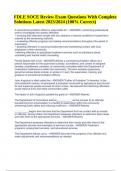
FDLE SOCE Review Exam Questions With Answers Latest 2023/2024 (100% Solved)
FDLE SOCE Review Exam Questions With Answers Latest 2023/2024 (100% Solved). A correctional probation officer is responsible for: - ANSWER-• performing professional work to investigate and assess offenders • ensuring that offenders comply with any statutory or special conditions of supervision ordered by the sentencing authority • evaluating offender progress and making recommendations throughout the period of supervision • assisting offenders in securing employment and maintaining contact with local employers in their community • referring offenders to specialized treatment services such as substance abuse counseling and mental health counseling Florida Statute 943.10(3) - ANSWER-defines a correctional probation officer as a person responsible for the supervised custody, surveillance, and control of assigned inmates, probationers, parolees, or community controlees within the Department of Corrections' institutions or within the community. The term includes supervisory personnel whose duties include, in whole or in part, the supervision, training, and guidance of correctional probation officers. John Augustus is often called the - ANSWER-"Father of Probation" in America. In the mid-nineteenth century, he pioneered a probation movement by agreeing to pay the bail for and supervise people accused of minor crimes. He believed that reforming offenders would improve lives and make communities safer. The ideals of John Augustus parallel the goals of - ANSWER-Reentry The Department of Corrections defines___________ as the process of an offender transitioning from incarceration in a facility to supervision within the community enhancing public safety and reducing recidivism. - ANSWER-Reentry __________ begins from the time that the Department first has contact with an inmate or offender. During intake, the Department assesses offenders to determine their needs and refer them to the appropriate services. - ANSWER-Reentry The Department assesses offenders to determine their needs and refer them to the appropriate services and examples of services include: - ANSWER-Treatment programs, employment services, and educational services. The Department follows up to: - ANSWER-document the progress of an offender and make adjustments and recommendations as needed. FDLE SOCE Review Exam Questions With Complete Solutions Latest 2023/2024 (100% Correct) The reentry process continues: - ANSWER-throughout an offender's incarceration and/or period of supervision. The reentry process is crucial to - ANSWER-breaking barriers and reducing recidivism. Research shows that offenders may have a difficult time finding employment, which can cause them to___________ . The goal is to make every effort to reduce the likelihood that an offender will return to the correctional system. - ANSWER-Reoffend Primary Responsibilities of Probation Officers Florida Statute 943.10(3) - ANSWERdefines a correctional probation officer as a person responsible for the supervised custody, surveillance, and control of assigned inmates, probationers, parolees, or community controlees within the Department of Corrections' institutions or within the community. The term includes supervisory personnel whose duties include, in whole or in part, the supervision, training, and guidance of correctional probation officers. (Pg. 7) A correctional probation officer is responsible for: - ANSWER-• performing professional work to investigate and assess offenders • ensuring that offenders comply with any statutory or special conditions of supervision ordered by the sentencing authority • evaluating offender progress and making recommendations throughout the period of supervision • assisting offenders in securing employment and maintaining contact with local employers in their community • referring offenders to specialized treatment services such as substance abuse counseling and mental health counseling • collecting monies such as restitution, court costs, and other related payments • maintaining an awareness of offenders' daily activities and providing direction as needed • managing cases of all assigned offenders (Pg. 7) _________ perform fieldwork as necessary or required, making regular visits to the residences and places of employment of offenders under supervision. ________also conduct random drug tests on offenders and follow up with needed action. - ANSWERProbation Officers (Page 8) ________ job focuses on helping offenders; however, ensuring compliance with supervision orders and reporting noncompliance with the sentencing authority may place you in harm's way. When necessary, officers file Violation of Probation (VOP) reports to the court or Florida Commission on Offender Review (FCOR) and arrest offenders. Officers also represent the Department at court hearings or conditional release/parole hearings. - ANSWER-Probation Officers (Page 8) Leadership in Supervision To be an effective probation officer, you need to be a - ANSWER-Good leader (Page 8) Many of the offenders you will supervise on a daily basis have had: - ANSWER-Very little positive reinforcement or role models in their lives. (Page 8) Refers to the structure, functions, and decision-making processes of those agencies that deal with the management and control of crime and criminal offenders. The three main components of the criminal justice system are law enforcement, the court system, and corrections. - ANSWER-Criminal Justice (Page 11) This division investigates possible criminal activities related to the insurance industries (life, health, title, worker's compensation). Florida - ANSWER-Division of Insurance Fraud (Page 13) Works with the Department of Homeland Security to protect the nation's leaders and the financial (Counterfeit Money) and critical infrastructure of the United States. - ANSWERU.S. Secret Service (Page 14) The court system in the United States includes - ANSWER-Local, county, state, and federal courts Are the highest courts in the U.S. and generally take precedence over the state courts. - ANSWER-The federal courts (Page 15) Means the types of cases in which the court can make decisions. - ANSWERJurisdiction (Page 15) Only hear cases that are violations of federal laws, including constitutional violations. - ANSWER-Federal courts (Page 15) Only hear cases involving violations of state law. - ANSWER-State courts (Page 15) Courts of limited jurisdiction only decide - ANSWER-a limited set of case types. (Page 15) A formal decision made by the court, an obligation made by the ruling of a court - ANSWER-Judgment (Page 15) Defines a legal relationship between persons in a court proceeding, it requires someone to do or refrain from doing something, examples include, restraining order, warrant, divorce decree, summons, etc. - ANSWER-Court order (Page 15) A court order that requires someone to do or to refrain from doing something - ANSWER-Injunction (Page 15) A court order that authorizes an officer to conduct a search or seizure, or make an arrest - ANSWER-Warrant (Page 15) The state court system in Florida has four levels: - ANSWER-Florida County Courts Florida Circuit Courts Florida District Courts of Appeal (DCA) Florida Supreme Court (Page 16 & 17) Florida has how many County Courts? - ANSWER-67 County Courts (Page 15) How many Circuit courts does Florida have? - ANSWER-20 Circuit Courts (Page 16) Florida County Courts: The 67 county courts have limited jurisdiction and handle the following legal issues: - ANSWER-• minor criminal offenses (misdemeanors), which provide a maximum sentence of one year or less in the county jail • county and municipal ordinance violations, including traffic infractions (some counties use hearing officers for these cases) • civil cases involving amounts of $15,000 or less and small claims disputes (less than $5,000) • the issuance of search and arrest warrants within the county • injunction (domestic, sexual, dating, and repeat violence and stalking) is a court order that requires someone to refrain from doing specific acts (Page 16) __________ is the highest court in the United States and the chief authority in the judicial branch—one of three branches of the U.S. federal government. - ANSWERSupreme Court of the United States (Page 16 & 17) __________hears appeals from the decisions of lower federal courts and state supreme courts, and it resolves issues of constitutional and federal law. It stands as the ultimate authority in constitutional interpretation, changed only by a constitutional amendment. - ANSWER-The Supreme Court (Page 16 & 17) _________most important responsibility is to decide cases that raise questions of constitutional interpretation. The court decides if a law or government action violates the Constitution. This power, known as judicial review, enables the court to invalidate both federal and state laws when they conflict with its interpretation of the Constitution. - ANSWER-The Supreme Court (Page 16 & 17) ________ is responsible for the supervision of all four institutional regions and operational management of all correctional facilities - ANSWER-Office of Institutions (Page 17 & 18) The Office of Institutions is responsible for the supervision of all four institutional regions and operational management of all correctional facilities to include: - ANSWER-• auditing security at facilities; maintaining accreditation standards • special operations (Correction Emergency Response Teams (CERT), Rapid Response Teams, Crisis Negotiation Teams) • membership on the State Emergency Response Team (SERT) • tracking incident reports • maintaining records on all inmates incarcerated • assisting law enforcement in their investigations • monitoring and interpreting court orders • establishing security standards for all facilities • maintaining the inmate transportation system • conducting training programs on security issues, classification, records, sentence structure, and court orders as well as other related areas • establishing policy and direction for all classification and records functions from reception to release (Page 17 & 18) is a court-ordered term of community supervision under specified conditions for a specific period of time that cannot exceed the maximum sentence for the offense. - ANSWER-Probation _________ is a post-prison supervision program where eligible inmates (offenses committed prior to October 1, 1983) have the terms and conditions of parole set by the Florida Commission on Offender Review. The Florida Department of Corrections provides parole supervision. __________ is a conditional extension of the limits of confinement after an offender has served part of his sentence. The period of __________cannot exceed the balance of the sentence. - ANSWER-Parole (Page 18) is a form of intensive supervised house arrest in the community that includes surveillance on weekends and holidays. - ANSWER-Community Control (Page 18) is a person placed on supervision by the Court or the Florida Commission on Offender Review. The offender can transfer from another state or supervised based on a pre-trial agreement. - ANSWER-Community Supervision Offender (Page 18) An__________ is an agreement between the Florida Department of Corrections and any corrections department outside of Florida, to supervise offenders on probation or parole in accordance with Florida's policy and procedures for community corrections. - ANSWER-Interstate compact (Page 18) The __________orders offenders sentenced to community corrections where an offender must complete specific conditions during the period of supervision. - ANSWERSentencing Authority (Page 18) The two sentencing authorities in Florida are: - ANSWER-The county or state courts and the Florida Commission on Offender Review (FCOR) (Page 18) Is a quasi-judicial body independent from the Florida Department of Corrections. - ANSWER-Florida Commission on Offender Review (FCOR) (Page 18) The legislature charges the _________ to determine conditions of supervision for specific offenders, including those on parole and conditional release. - ANSWER-FCOR (Page 18) FCOR - ANSWER-____________sets the conditions of supervision for these offenders, rather than a judge. (Page 18) In Florida,__________ mirrors the geographical organization of the states attorney's circuits. - ANSWER-The Office of Community Corrections (Page 21) Recognize the differences in officer ranks across criminal justice disciplines: Law Enforcement/Correctional Institution Organizational Structure (military hierarchy) - ANSWER-Chief/Warden (Page 22) __________ is the order of authority within an organization. It provides the links of authority and responsibility that join one level of an organization to another. Most organizations use the ______________ as a means of communicating and making decisions. A Circuit Administrator or Deputy Circuit Administrator cannot answer every question that all subordinates might have. - ANSWER-Chain of command (Page 23) ____________is the failure to follow orders from superiors in the chain of command and is a very serious offense. An officer refusing to follow an order must be certain of the law involved and may be subject to charges of _____________ if he or she is wrong. Under certain limited circumstances, the Department has the legal authority to vary from its own policies; even if that order appears to constitute a violation of policy, you must follow the order. If the order was improper, responsibility will rest with the supervisor who issued the order, not the subordinate who followed the order. - ANSWERInsubordination (Page 23) ___________is a term for information that flows down from the chief executive officer through the supervision levels to the lowest levels of the organization. The information that flows up from the lowest levels to the highest is equally important. - ANSWERVertical communication (Page 23) __________ is a term for information that flows across the same level of employees or officers within the chain of command. - ANSWER-Lateral communication (Page 23) Whether it is the Secretary, Regional Director, or Circuit Administrator, the consequences of everything that happens within the Department ultimately rests on one person. To manage an organization effectively, the person in command needs to assign decision-making authority to those under his or her command. This granting of power by the person with authority to another person is a - ANSWER-Delegation of authority (Page 24) _____________oversees the certification, employment, training, and conduct of Florida law enforcement, correctional, and correctional probation officers during quarterly meetings. The Commission's mission is "to ensure that the citizens of the state of Florida are served by the most qualified, well-trained, competent, and ethical criminal justice officers in the nation." - ANSWER-The Criminal Justice Standards and Training Commission (Page 25) Explains the Commission's duties - ANSWER-943.12, F.S. (Page 25) Section 943.12, F.S. explains the Commission's duties as follows: - ANSWER-• certify officers who complete a Florida Basic Recruit Training Program or who are diversely qualified through experience and training and who meet minimum employment standards • develop, maintain, and administer the State Officer Certification Examination for criminal justice officers (((((PLEASE SEE PAGE 25 TO LEARN ADDITIONAL BULLET POINTS, JUST IN CASE THE ADDITIONAL BULLET POINTS MAY BE AN ANSWER CHOICE))))) Section 943.13, F.S., sets the minimum requirements and standards for employment as a criminal justice officer. A person must: - ANSWER-• have a good moral character (((((PLEASE SEE PAGE 26 TO LEARN ADDITIONAL BULLET POINTS, JUST IN CASE THE ADDITIONAL BULLET POINTS MAY BE AN ANSWER CHOICE))))) Sets the minimum requirements and standards for employment as a criminal justice officer. - ANSWER-943.13, F.S., (Page 26) In addition to certifying criminal justice officers,__________ has the authority under the Florida Statutes (F.S.) and the Florida Administrative Code (F.A.C.) to impose discipline on an officer's certification if the officer fails to maintain the required standards of conduct. - ANSWER-The Criminal Justice Standards and Training Commission (CJSTC) (Page 29) The CJSTC may take action against an officer's certification, based on the Florida Statues and the F.A.C., if the officer does any of the following: - ANSWER-• pleads nolo contendere, pleads guilty, or is found guilty of any felony • pleads nolo contendere, pleads guilty, or is found guilty of a misdemeanor involving perjury or false statement • fails to maintain good moral character • commits any act constituting a felony offense, regardless of criminal prosecution • tests positive for controlled substances by a urine or blood test • found guilty of excessive use of force under color of authority • engages in sexual harassment involving physical contact or misuse of official position • misuses the official position • engages in sex while on duty • has an unprofessional relationship with an inmate, detainee, probationer, parolee, or community controlee • has written or oral communication that is intended to facilitate conduct which is prohibited by Commission rule • engages in any physical contact not required in the performance of official duties that is normally associated with the demonstration of affection or sexual misconduct • makes false statements during the employment process • commits conduct that subverts or attempts to subvert the SOCE process • commits conduct that subverts or attempts to subvert the CJSTC-approved training examination process or an employing agency's promotional examination process (Page 29 & 30) Penalties for Violations Following an established set of penalty guidelines, the Commission may impose discipline on an officer. The penalties include written reprimand, probation, suspension, or revocation of certification. When the CJSTC revokes an officer's certification in accordance with - ANSWER-s. 943.1395(6), F.S., the officer can no longer work as a certified probation officer in the state of Florida. (Page 30) Penalties for Violations While these guidelines are specific to certified officers, it is important to remember that the CJSTC and the academy expect recruits to adhere to the standards of conduct during basic recruit training. - ANSWER-Violations may result in the denial of officer certification. (Page 30) provides certain protections for law enforcement, correctional, and correctional probation officers, whenever an officer "is under investigation and subject to interrogation by members of his or her agency for any reason that could lead to disciplinary action, suspension, demotion, or dismissal..." - ANSWER-112.532, F.S. (Page 30) Section 112.532, F.S. provides certain protections for law enforcement, correctional, and correctional probation officers, whenever an officer "is under investigation and subject to interrogation by members of his or her agency for any reason that could lead to disciplinary action, suspension, demotion, or dismissal..." These protections include: - ANSWER-• conducting the interrogation at the office of the command (Page 30) _________ is behavior that demonstrates good character, marked by pride in self and career. Examples of these characteristics include service, integrity, respect, quality, fairness, honesty, courage, compassion, moral/ethical leadership, trustworthiness, and common sense. Ethics, personal values, and professionalism are essential, intertwined elements in a probation officer's personal and professional life. - ANSWERProfessionalism (Page 34) is a standard of conduct based on moral duties and virtues derived from the principles of right and wrong. Ethics indicates how a person should behave. - ANSWER-Ethics (Page 34) are principles, standards, or qualities considered worthwhile or desirable. They are core beliefs or desires that guide or motivate a person's attitudes and actions. - ANSWERValues (Page 34) is principled, value-based decision making, practiced daily for personal or professional reasons. Ethical behavior includes treating the public, offenders under your supervision, office visitors, and colleagues courteously with dignity, fairness, and impartiality. Abide by all federal, state, and municipal criminal laws, as well as those governing the conduct of state employees, and all laws and regulations protecting an individual's civil and legal rights. Respect confidential and privileged information, as well as avoid conflicts of interest by neither accepting nor granting favors. - ANSWER-Ethical behavior (Page 34) as promising, offering, or giving any public servant money or benefits intended to influence a decision, action, or inaction related to the performance of a public duty. - ANSWER-Bribery (Page 35) is a false statement that a person makes under oath and does not believe to be true. Criminal violations differ depending on the situation in which an individual commits perjury. In official proceedings—for example, testifying in court or giving a deposition— perjury is a felony. - ANSWER-Perjury (Page 35) Misuse of Position of Authority
Document information
- Uploaded on
- November 23, 2023
- Number of pages
- 140
- Written in
- 2023/2024
- Type
- Exam (elaborations)
- Contains
- Questions & answers