

NR 509 MIDTERM EXAM REVIEW
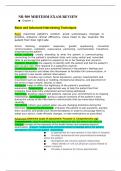
NR 509 MIDTERM EXAM REVIEW ● Chapter 1 Basic and Advanced Interviewing Techniques Basic maximize patient's comfort, avoid unnecessary changes in position, enhance clinical efficiency, move head to toe, examine the patient from their right side Active listening, empathic responses, guided questioning, nonverbal communication, validation, reassurance, partnering, summarization, transitions, empowering the patient Active Listening- closely attending to what the patient is communicating, connecting to the patient’s emotional state and using verbal and nonverbal skills to encourage the patient to expand on his or her feelings and concerns. Empathic Responses-the capacity to identify with the patient and feel the patient’s pain as your own, then respond in a supportive manner. Guided Questioning- show your sustained interest in the patient’s feelings and deepest disclosures and allows the interviewer to facilitate full communication, in the patient’s own words, without interruption. Non-verbal- includes eye contact, facial expression, posture, head position and movement such as shaking or nodding, interpersonal distance, and placement of the arms or legs-crossed, neutral, or open. Validation- helps to affirm the legitimacy of the patient’s emotional experience. Reassurance- an appropriate way to help the patient feel that problems have been fully understood and are being addressed. Partnering- building rapport with patients, express your commitment to an ongoing relationship. Summarization- giving a capsule summary of the patient’s story during the course of the interview to communicate that you have been listening carefully. Transitions- inform your patient when you are changing directions during the interview. Empowering the Patient- empower the patient to ask questions, express their concerns, and probe your recommendations in order to encourage them to adopt your advice, make lifestyle changes, or take medications as prescribed. Advanced: Determine scope of assessment: Focused vs. Comprehensive: pg5 Comprehensive: Used for patients you are seeing for the first time in the office or hospital. Includes all the elements of the health history and complete physical examination. A source fundamental and personalized knowledge about the patient, strengthens the clinician-patient relationship. ● Is appropriate for new patients in the office or hospital ● Provides fundamental and personalized knowledge about the patient ● Strengthens the clinician–patient relationship ● Helps identify or rule out physical causes related to patient concerns ● Provides a baseline for future assessments ● Creates a platform for health promotion through education and counseling ● Develops proficiency in the essential skills of physical examination Flexible Focused or problem-oriented assessment: For patients you know well returning for routine care, or those with specific “urgent care” concerns like sore throat or knee pain. You will adjust the scope of your history and physical examination to the situation at hand, keeping several factors in mind: the magnitude and severity of the patient’s problems; the need for thoroughness; the clinical setting—inpatient or outpatient, primary or subspecialty care; and the time available. ● Is appropriate for established patients, especially during routine or urgent care visits ● Addresses focused concerns or symptoms ● Assesses symptoms restricted to a specific body system ● Applies examination methods relevant to assessing the concern or problem as thoroughly and carefully as possible Tangential lighting: JVD, thyroid gland, and apical impulse of heart. Components of the Health History Jenna/Ashley Initial information Identifying data and source of the history; reliability Identifying data- age, gender, occupation, marital status Source of history- usually patient. Can be: a family member or friend, letter of referral, or clinical record. Reliability- Varies according to the patient’s memory, trust, and mood. Chief Complaint Chief Complaint- Make every attempt to quote the patient’s own words. Present Illness Complete, clear and chronological description of the problem prompting the patient visit Onset, setting in which it occurred, manifestations and any treatments Should include 7 attributes of a symptom: ● Location ● Quality ● Quantity or severity ● Timing, onset, duration, frequency ● Setting in which it occurs ● Aggravating or relieving factors ● Associated manifestations -Differential diagnosis is derived from the “pertinent positives” and “pertinent negatives” when doing Review of Systems that are relevant to the chief complaint. A list of potential causes for the patients problems. -Present illness should reveal patient’s responses to his or her symptoms and what effect this has on their life. -Each symptom needs its own paragraph and a full description. -Medication should be documented, name, dose, route, and frequency. Home remedies, non- prescriptions drugs, vitamins, minerals or herbal supplements, oral contraceptives, or borrowed medications. -Allergies-foods, insects, or environmental, including specific reaction Tobacco use, including the type. If someone has quit, note for how long -Alcohol and drug use should always be investigated and is often pertinent to the Presenting Illness. Past history -Childhood Illness: measles, rubella, mumps, whooping cough, chickenpox, rheumatic fever, scarlet fever, and polio. Also include any chronic childhood illness -Adult illnesses: Provide information in each of the 4 areas: ● Medical: diabetes, hypertension, hepatitis, asthma and HIV; hospitalizations; number and gender of sexual partners; and risk taking sexual practices. ● Surgical: dates, indications, and types of operations ● Obstetric/gynecologic: Obstetric history, menstrual history, methods of contraception, and sexual function. ● Psychiatric: Illness and time frame, diagnoses, hospitalizations, and treatments. -Health Maintenance: Find out if they are up to date on immunizations and screening tests. Review Tb tests, pap smears, mammograms, stool tests for occult blood, colonoscopy, cholesterol levels etc.. Family history Outlines or diagrams age and health, or age and cause of death, of siblings, parents, and grandparents Documents presence or absence of specific illnesses in family, such as hypertension, coronary artery disease, elevated cholesterol levels, stroke, diabetes, thyroid or renal disease, arthritis, tuberculosis, asthma or lung disease, headache, seizure disorder, mental illness, suicide, substance abuse, and allergies, and symptoms reported by patient. Ask about history of breast, ovarian, colon, or prostate cancer Ask about Genetically transmitted diseases Personal or social history Describes educational level, occupation, family of origin, current household, personal interests, and lifestyle
Document information
- Uploaded on
- November 22, 2023
- Number of pages
- 73
- Written in
- 2023/2024
- Type
- Exam (elaborations)
- Contains
- Questions & answers


