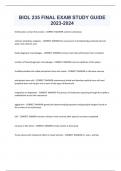
Biol 235 Final Exam Study Guide
BIOL 235 FINAL EXAM STUDY GUIDE Erythrocytes contain the enzyme - CORRECT ANSWER-carbonic anhydrase carbonic anhydrase catalyzes - CORRECT ANSWER-the conversion of metabolically produced C)2 and water into carbonic acid fixed phagocytic macrophages - CORRECT ANSWER-remove most old erythrocytes from circulation Location of fixed phagocytic macrophages - CORRECT ANSWER-narrow capillaries of the spleen Undifferentiated cells called pluripotent stem cells reside - CORRECT ANSWER-in the bone marrow pluripotent stem cells - CORRECT ANSWER-continuously divide and develop myeloid stem cells and lymphoid stem cells to give rise to each of the types of blood cells emigration or diapedesis - CORRECT ANSWER-The process of leukocytes squeezing through the capillary endothelium to exit the vasculature agglutinins - CORRECT ANSWER-genetically-determined glycoprotein and glycolipid antigens found on the surface of an erythrocyte ESV - CORRECT ANSWER-volume of blood in the ventricle after ejection has been completed Increase in ESV when - CORRECT ANSWER-stroke volume is decreased Three cations with important effect on heart function - CORRECT ANSWER-K+, Ca2+, and Na+ Increased blood levels of NA+ - CORRECT ANSWER-blocks Ca2+ inflow and decreases force of contraction Excess in K+ - CORRECT ANSWER-blocks generation of action potentials pharynx - CORRECT ANSWER-serves as a sound resonating chamber, contains tonsils, directs air flow inferiorly larynx - CORRECT ANSWER-passes air form pharynx into windpipe, site of sound production paranasal sinuses - CORRECT ANSWER-resonates sound, not part of the pharynx fauces - CORRECT ANSWER-opening from oral cavity into pharynx tertiary bronchus - CORRECT ANSWER-carries air to a segment of a lung terminal bronchiole - CORRECT ANSWER-carries air directly into a respiratory bronchiole pleural membranes - CORRECT ANSWER-surround the lungs surfactant - CORRECT ANSWER-reduces surface tension at sites of gas exchange alveoli - CORRECT ANSWER-actual sites of gas exchange eupnea - CORRECT ANSWER-normal, quiet breathing costal breathing - CORRECT ANSWER-shallow breathing using just the external intercostal muscles compliance - CORRECT ANSWER-amount of effort required to expand the lungs and chest wall inspiratory capacity - CORRECT ANSWER-tidal volume + inspiratory reserve volume, usually about 3600 mL in males vital capacity - CORRECT ANSWER-tidal volume + inspiratory reserve volume + expiratory reserve volume; usually about 4800 mL in males functional residual capacity - CORRECT ANSWER-residual volume + expiratory reserve volume; usually about 2400 mL in males Henry's law - CORRECT ANSWER-states that the amount of gas that will dissolve in a liquid is proportional to the partial pressure of that gas and its solubility Bohr effect - CORRECT ANSWER-when pH decreases, O2 saturation of hemoglobin decreases Dalton's law - CORRECT ANSWER-each gas in a mixture of gases exerts its own partial pressure medulla oblongata - CORRECT ANSWER-sets basic rhythm of breathing pons - CORRECT ANSWER-includes the pontine respiratory group Blood is - CORRECT ANSWER-a connective tissue that consists of blood plasma (liquid) plus formed elements (red blood cells, white blood cells, and platelets) Whole blood - CORRECT ANSWER-blood plasma and formed elements Blood plasma - CORRECT ANSWER-proteins, water, other solutes Blood plasma proteins - CORRECT ANSWER-albumins (54%), globulins (36%), fibrinogens (7%) Formed elements - CORRECT ANSWER-red blood cells, white blood cells, platelets Blood cell production - CORRECT ANSWER-hemopoesis, mainly occurs in red bone marrow after birth Reticulocyte - CORRECT ANSWER-from proerythrocyte, ejects nucleus Average lifespan of an erythrocyte - CORRECT ANSWER-120 days Rate of RBC formation by red blood cells - CORRECT ANSWER-equals the rate of RBC destruction by macrophages Emigration or diapedesis is - CORRECT ANSWER-the process by which phagocytic cells leave blood vessels WBCs use to destroy pathogens - CORRECT ANSWER-lysozyme, defensins, and certain anions Neutrophils - CORRECT ANSWER-are usually the first and most numerous responders to an infection Macrophages - CORRECT ANSWER-react more slowly to an infection than neutrophils do Pluripotent stem cells are derived from - CORRECT ANSWER-mesenchyme Megakaryoblasts - CORRECT ANSWER-platelet precursor cells, develop into megakaryocytes Platelet - CORRECT ANSWER-fragment of megakaryocyte that is enclosed by a piece of plasma membrane Platelet plug - CORRECT ANSWER-can stop blood loss completely if the hole in a blood vessel is small enough Hemostasis - CORRECT ANSWER-sequence of responses that stops bleeding, vascular spasm, platelet plug formation, blood clotting Blood clot - CORRECT ANSWER-gel that contains formed elements of the blood entangled in fibrin threads In blood clotting - CORRECT ANSWER-coagulation factors are activated in sequence, resulting in a cascade of reactions that includes positive feedback cycles Extrinsic pathway of blood clotting - CORRECT ANSWER-fewer steps, thromboplastic leaks into the blood from cells outside (extrinsic to) blood vessels and initiates the formation of prothrombinase Intrinsic pathway of blood clotting - CORRECT ANSWER-more complex, occurs more slowly, activators are in direct contact with blood or contained within (intrinsic to) the blood. Outside tissue damage is not needed. clotting pathway - CORRECT ANSWER-Prothrombinase - prothrombin - thrombin - soluble fibrinogen - insoluble fibrin - threads of clot Common pathway - CORRECT ANSWER-formation of prothrombinase marks the beginning of the____ In an incompatible blood transfusion - CORRECT ANSWER-antibodies in the recipient's plasma bind to the antigens on the donated RBCs which causes agglutination (clumping) Antibodies in your plasma don't react with - CORRECT ANSWER-antigens on your red blood cells HDN - CORRECT ANSWER-occurs when maternal anti-Rh antibodies cross the placenta and cause hemolysis of fetal RBC ABO blood typing - CORRECT ANSWER-blood is mixed with anti-A and anti-B serum The heart is located in - CORRECT ANSWER-the mediastinum
Document information
- Uploaded on
- November 20, 2023
- Number of pages
- 42
- Written in
- 2023/2024
- Type
- Exam (elaborations)
- Contains
- Questions & answers