Applied Calculus I Practice Final Exam – Solution Notes
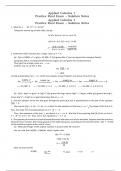
1. Solve for x: 10 · 32x = 3 · (1.12)x Taking the natural log of both sides, we get ln 10 + 2x ln 3 = ln 3 + x ln 1.12 x(2 ln 3 − ln 1.12) = ln 3 − ln 10 x = ln 3 − ln 10 = ln(3/10) 2 ln 3 − ln 1.12 ln(9/1.12) 2. Determine which function has a larger value as x → ∞: (a). f (x) = 0.0005 · x3 or g(x) = 52, 000 · 2x f (x) grows like x3 (we can ignore the constant factor). g(x) grows like 2x, and exponential function (again, we can ignore the constant factor). Thus, g(x) has a larger value as x . Another way to say this is that lim f (x) = 0, x→∞ g(x) so that g dominates f as x → ∞, which we compute using l’Hopital’s rule (since it has form ∞ ): lim 0.0005 x3 x = lim 0.0005 3x2 x = lim 0.0005 6x x = lim 0.0005 6 x = 0. x→∞ 52, 000 · 2 x→∞ 52, 000 · 2 ln 2 x→∞ 52, 000 · 2 ln 2 ln 2 x→∞ 52, 000 · 2 ln 2 ln 2 ln 2 (b). f (x) = log x7 or g(x) = 6 · log2 x2 f (x) grows like log x (since log x7 = 7 log x), while g(x) grows like log2 x (since log2 x2 = 2 log2 x), so g(x) dominates f (x) as x → ∞. 3. Find the equation of the line that goes through the point (8,3) and is perpendicular to the plot of the equation 2x+1 = 2. y−1 We rewrite 2x+1 = 2: 2y − 2 = 2x + 1, so that it is the equation of the line y = x + 3 . The slope of this line is 1; y−1 thus, the slope of a line perpendicular to it is 2 −1 = −1. Thus, the equation of the line, L, we desire is y = −x + b. We find b by requiring that (8,3) lies on line L: 3 = −8 + b, so b = 11. Thus, line L has equation y = −x + 11. 4. The quantity of moisture in a loaf of bread decreases with time as it sits on the table. Suppose that the moisture, M (t), at time t minutes after being placed on the table decreases according to the function M (t) = Qe−kt. If 10% of the moisture is gone at the end of 1 hour, (a). What percentage of the original moisture is present after 30 minutes? We are told that M (60) = (.9)M (0), which implies that Qe−60k = (.9)Q −60k = ln(.9) k = − ln(.9) 60 Now, we want to find M (30) Qe−30k − ln(.9) −30 1 ln(.9) 1/2 M (0) · 100 = Q · 100 = 100e 60 = 100e 2 = 100(.9) (b). How long will it take until the moisture is reduced to 60% of its original quantity? Thus, we want t so that −kt = ln(0.6), i.e., ln(0.6) ln(0.6) ln(0.6)
Document information
- Uploaded on
- November 18, 2023
- Number of pages
- 10
- Written in
- 2023/2024
- Type
- Exam (elaborations)
- Contains
- Questions & answers