

LECTURE 1 +ART.
Q1. For each of the following statements indicate whether it applies to white matter (wm) or gray matter
(gm).
1. Connections between brain areas
2. Consists of neuronal cell bodies
3. Surface of cerebral cortex and cerebellum 4. Is myelinated
5. In subcortical structures
Answer: WM: 1,4 and GM: 2,3,5
Q2. Functional Magnetic Resonance imaging (fMRI) technique is based on which of the following
signals?
• electroencephalography (EEG)
• Rapid eye movement (REM)
• Blood-oxygen level dependent (BOLD) • Magnetoencephalography (MEG)
Answer: BOLD
Q3. What is the advantage of functional Magnetic Resonance Imaging (fMRI) compared to EEG?
Answer: Participants do not need to wash their hair after participating in the study
Q4. Who has more brain cells?
• an 11 year old
• Adult
Answer: an 11 year old
Q5. With age, there are changes in brain function ut no changes in brain structure. Correct or incorrect
Answer:incorrct
Q6. What is the global pattern of structural brain development?
Answer; from back to front
Q7. What happens with gray matter during adolescence?
Answer: it decreases
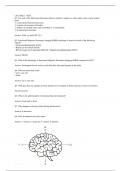
Q8. Geef de nummers de juiste naam:
Answer: 1=dorsal, 2= posterior, 3=ventral, 4=anterior
, Q9. What are the three different nodes that develop in our brain, from first to develop through last one to
develop.
Answer:
1. Detection node: early maturation
2. Affective node; maturation in early adolescence
3. Cognition/ regulation node: maturation in late adolescence
Q10. What is the detection node?
Answer:
The detection node are brain regions involved with perceptual processing
• Face perception
• Facial expressions/ emotions
• Biological motion
• Other sensory modes
Q11. What is the affective node?
Answer:
The affective node are brain regions involved with emotional response
• positive (& negative) emotional arousal -> amygdala
• Negative emotions (like disgust) -> insula
• Reward -> nucleas accumbens / (ventral) striatum
Q12. What is the cognition/ regulation node?
Answer:
The cognition/ regulation node are brain regions involved with regulation and monitoring of perception
and affection
• self-referential processing, self reflection, mentalizing -> medial prefrontal cortex
• Behavioral control, working memory -> dorsal lateral prefontale cortex
• Monitoring of affective state/ action -> anterior cingulate cortex
Q13. What are methods to examine brain development?
- How do these work? What are advantages/disadvantagous?
Answer:
• fMRI: measures brain function by measuring blood flow. It is non-invasive and high spatial
resolution. However, it has a low temporal resolution and the BOLD signal is not an absolute measure but
a relative measure
• EEG: has a high temporal resolution but low spatial resolution. Collecting of data over long
periods of time is easier with EEG.
Q14. Why is it important to include an experimental as well as a control condition in an fMRI study?
Answer:
The BOLD signals are not an absolute measure of brain activation but relative.
Q15. What developmental period is referred to as “adolescence”?
Q1. For each of the following statements indicate whether it applies to white matter (wm) or gray matter
(gm).
1. Connections between brain areas
2. Consists of neuronal cell bodies
3. Surface of cerebral cortex and cerebellum 4. Is myelinated
5. In subcortical structures
Answer: WM: 1,4 and GM: 2,3,5
Q2. Functional Magnetic Resonance imaging (fMRI) technique is based on which of the following
signals?
• electroencephalography (EEG)
• Rapid eye movement (REM)
• Blood-oxygen level dependent (BOLD) • Magnetoencephalography (MEG)
Answer: BOLD
Q3. What is the advantage of functional Magnetic Resonance Imaging (fMRI) compared to EEG?
Answer: Participants do not need to wash their hair after participating in the study
Q4. Who has more brain cells?
• an 11 year old
• Adult
Answer: an 11 year old
Q5. With age, there are changes in brain function ut no changes in brain structure. Correct or incorrect
Answer:incorrct
Q6. What is the global pattern of structural brain development?
Answer; from back to front
Q7. What happens with gray matter during adolescence?
Answer: it decreases
Q8. Geef de nummers de juiste naam:
Answer: 1=dorsal, 2= posterior, 3=ventral, 4=anterior
, Q9. What are the three different nodes that develop in our brain, from first to develop through last one to
develop.
Answer:
1. Detection node: early maturation
2. Affective node; maturation in early adolescence
3. Cognition/ regulation node: maturation in late adolescence
Q10. What is the detection node?
Answer:
The detection node are brain regions involved with perceptual processing
• Face perception
• Facial expressions/ emotions
• Biological motion
• Other sensory modes
Q11. What is the affective node?
Answer:
The affective node are brain regions involved with emotional response
• positive (& negative) emotional arousal -> amygdala
• Negative emotions (like disgust) -> insula
• Reward -> nucleas accumbens / (ventral) striatum
Q12. What is the cognition/ regulation node?
Answer:
The cognition/ regulation node are brain regions involved with regulation and monitoring of perception
and affection
• self-referential processing, self reflection, mentalizing -> medial prefrontal cortex
• Behavioral control, working memory -> dorsal lateral prefontale cortex
• Monitoring of affective state/ action -> anterior cingulate cortex
Q13. What are methods to examine brain development?
- How do these work? What are advantages/disadvantagous?
Answer:
• fMRI: measures brain function by measuring blood flow. It is non-invasive and high spatial
resolution. However, it has a low temporal resolution and the BOLD signal is not an absolute measure but
a relative measure
• EEG: has a high temporal resolution but low spatial resolution. Collecting of data over long
periods of time is easier with EEG.
Q14. Why is it important to include an experimental as well as a control condition in an fMRI study?
Answer:
The BOLD signals are not an absolute measure of brain activation but relative.
Q15. What developmental period is referred to as “adolescence”?


