

NR 347 Week 6 Checkpoint Quiz
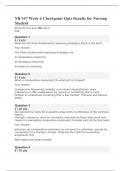
NR 347 Week 6 Checkpoint Quiz Results for Nursing Student Score for this quiz: 82 out of 100 What are the three fundamental reasoning strategies listed in the text? Your Answer: The three fundamental reasoning strategies are 1) comparative reasoning 2) ideological reasoning 3) empirical reasoning What is comparative reasoning? On what skill is it based? Your Answer: Comparative Reasoning "enables us to make interpretations, draw inferences or offer explanations by relying on something that is more familiar to understand something that is less familiar" (Facione and Gittens, 2016) We learned four tests for evaluating arguments: truthfulness of the premises, logical strength, relevance, and non-circularity. How well do these tests work with respect to evaluating comparative reasoning? Consider each of the four tests. Your Answer: when we use comparative reasoning, we interpret an unfamiliar concept by comparing it to a familiar concept. Using the four tests for evaluating arguments, this More depth and detail needed Briefly explain how we can determine if one comparison is more comprehensive than another. Your Answer: There are four tests we can apply to a comparison to determine if it is comprehensive or not. The four tests are 1) Are all premises true? 2) Are there counterexamples and how difficult is it to imagine them? 3) Are the premises relevant to the truth of the conclusion? 4) Does the truth of any premise depend on the truth of the conclusion? (Criteria are found at p. 247) Familiarity, Simplicity, Comprehensiveness, Productivity, Testability According to the text, the basic question to ask when evaluating a comparison between two objects or ideas or events is “Are they alike enough in the important ways or not?” (p. 248). What are those “important ways” that determine the credibility of conclusions based on similarities? Your Answer: "The more pervasive the essential similarities are, the more relevant the comparison is, and therefore the more credibility a conclusion based on those similarities will have" (Facione and Gittens, 2016). We analyze the familiarity, simplicity, comprehensiveness, productivity, and testability of inferences to determine if the conclusions are credible. In your own words, define empirical reasoning. Your Answer: Empirical reasoning is when an individual uses their own personal experiences and premises that they hold to be true and use their own experiences to support their argument. What are the three defining characteristics of empirical reasoning? Your Answer: 1) Empirical reasoning is inductive 2) Empirical reasoning is self-corrective 3) Empirical reasoning is open to independent verification What is meant by “the null hypothesis”? Your Answer: "An empirically testable hypothesis that two phenomena are entirely unrelated except perhaps by random chance is known as the null hypothesis" (Facione and Gittens, 2016) What is the purpose of empirical reasoning? Your Answer: empirical reasoning is used to determine if a hypothesis can be disconfirmed. We use bottom-up thinking to disprove or support a hypothesis
Document information
- Uploaded on
- November 10, 2023
- Number of pages
- 6
- Written in
- 2023/2024
- Type
- Exam (elaborations)
- Contains
- Questions & answers


