Dunphy Primary Care
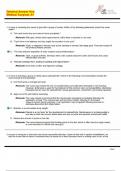
Nausea is difficult to discern in a young child. What question might you ask to determine if a child has nausea? 1. "Are you sick to your tummy?" 2. "Are you hungry?" 3. "Are you eating the way you normally eat?" 4. "Are you nauseous?" "Are you hungry?" Zena just had a hemorrhoidectomy. You know she has not understood your teaching when she tells you she will: 1. Take a sitz bath after each bowel movement for 1 to 2 weeks after surgery. 2. Drink at least 2000 mL of fluids per day. 3. Decrease her dietary fiber for 1 month. 4. Take stool softeners as prescribed. Decrease her dietary fiber for 1 month. You haven't studied these terms yet! Select these 158 Susan, age 59, has no specific complaints when she comes in for her annual examination. She does, however, have type 2 diabetes mellitus (DM), slight hypertension, dyslipidemia, and central obesity. How would you diagnose her? 1. As a healthy adult with several problems. 2. As having a glycemic event. 3. As having metabolic syndrome. 4. As having multiple organ dysfunction. As having metabolic syndrome. Simon, age 72, states that he is worried because he has a bowel movement only every third day. You respond: 1. "You should have two to three stools per day." 2. "You should defecate once a day." 3. "You should have at least three stools per week." 4. "There is no such thing as a 'normal' pattern of defecation." "There is no such thing as a 'normal' pattern of defecation." Matt, age 26, recently returned from a camping trip and has gastroenteritis. He says that he has been eating only canned food. Which of the following pathogens do you suspect? 1. Campylobacter jejuni. 2. Clostridium botulinum. 3. Clostridium perfringens. 4. Staphylococcus. Clostridium botulinum. Timothy, age 68, complains of an abrupt change in his defecation pattern. You evaluate him for: 1. Constipation. 2. Colorectal cancer. 3. Irritable bowel syndrome. 4. Acute appendicitis. Colorectal cancer. Martina, age 34, has AIDS and currently suffers from diarrhea. You suspect she has which protozoal infection of the bowel? 1. Giardiasis. 2. Amebiasis. 3. Cryptosporidiosis. 4. Escherichia coli. Cryptosporidiosis Anson tells you he thinks his antacids are causing his diarrhea. You respond: 1. "Antacids contain fructose, which may not be totally absorbed, resulting in fluid being drawn into the bowel." 2. "Antacids contain sorbitol or mannitol, which are sugars that aren't absorbed and can cause fluid to be drawn into the bowel." 3. "Antacids contain caffeine, which decreases bowel transit time." 4. "Antacids may contain magnesium, which decreases bowel transit time and may contain poorly absorbed salts that draw fluid into the bowel." "Antacids may contain magnesium, which decreases bowel transit time and may contain poorly absorbed salts that draw fluid into the bowel." Tina has a chronic hepatitis C infection. She asks you how to prevent its transmission. You respond: 1. "Do not donate blood until one year after diagnosis." 2. "Abstain from sex altogether." 3. "There is no possibility of transmission through razors or toothbrushes." 4. "Abstain from sex during your period." "Abstain from sex during your period." Marcie just returned from Central America with traveler's diarrhea. Which is the best treatment? 1. Metronidazole (Flagyl). 2. Supportive care. 3. Quinolone antibiotics. 4. Gastric lavage. Supportive care. Rose, a client with gastroesophageal reflux disease (GERD), has many other concurrent conditions. In teaching Rose about medications to avoid, what do you recommend she refrain from using? 1. Antibiotics. 2. Nonsteroidal anti-inflammatory drugs (NSAIDs). 3. Oral contraceptives. 4. Antifungals. Nonsteroidal anti-inflammatory drugs (NSAIDs). Lucy, age 49, has pain in both the left and right lower quadrants. What might you suspect? 1. A gastric ulcer. 2. Gastritis. 3. Pelvic inflammatory disease. 4. Pancreatitis. Pelvic inflammatory disease. Rose has gastroesophageal reflux disease (GERD). You know she misunderstands your teaching when she tells you she will: 1. Avoid coffee, alcohol, chocolate, peppermint, and spicy foods. 2. Eat smaller meals. 3. Have a snack before retiring so that the esophagus and stomach are not empty at bedtime. 4. Stop smoking. Have a snack before retiring so that the esophagus and stomach are not empty at bedtime. Marty, age 52, notices a bulge in his midline every time he rises from bed in the morning. You tell him that it is a ventral hernia, also known as an: 1. Inguinal hernia. 2. Epigastric hernia. 3. Umbilical hernia. 4. Incisional hernia. Epigastric hernia. You elicit costovertebral angle tenderness in Gordon, age 29. Which condition do you suspect? 1. Cirrhosis. 2. Inflammation of the kidney. 3. Inflammation of the spleen. 4. Peritonitis. Inflammation of the kidney. Marvin, a known alcoholic with cirrhosis, is frequently admitted for coagulopathies and occasionally receives blood transfusions. His wife asks you why he has bleeding problems. How do you respond? 1. "Occasionally he accumulates blood in the gut." 2. "There is an interruption of the normal clotting mechanism." 3. "Long-term alcohol abuse has made his vessels very friable." 4. "His bone marrow has been affected." "There is an interruption of the normal clotting mechanism." Shelby has recently been diagnosed with pancreatitis. Of the following objective findings that can result from the pancreatic inflammatory process, which is known as Grey Turner sign? 1. Left-sided pleural effusion. 2. Bluish discoloration over the flanks. 3. Bluish discoloration around the umbilicus. 4. Jaundice. Bluish discoloration over the flanks. Bobby, age 6, has constant periumbilical pain shifting to the right lower quadrant, vomiting, a small volume of diarrhea, absence of headache, a mild elevation of the white blood cell count COTINUED
Geschreven voor
- Instelling
- Dunphy Primary Care.
- Vak
- Dunphy Primary Care.
Documentinformatie
- Geüpload op
- 4 november 2023
- Aantal pagina's
- 40
- Geschreven in
- 2023/2024
- Type
- Tentamen (uitwerkingen)
- Bevat
- Vragen en antwoorden
Onderwerpen
- the
-
nausea is difficult to discern in a young child w
-
zena just had a hemorrhoidectomy you know she has
-
susan age 59 has no specific complaints when she
-
as having metabolic syndrome simon age 72 state