
Attachment- https://www.illuminatepublishing.com/product-category/psychology
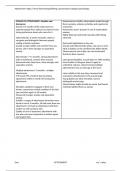
STAGES OF ATTACHMENT- Schaffer and Good external validity, observations made through
Emmerson their everyday, ordinary activities and reported to
Asocial: 0-3 months of life, baby learns to researcher.
separate people from objects, but doesn’t have Researcher wasn’t present in case it made babies
strong preference about who cares for it anxious
Highly likely pp’s behaved naturally whilst being
Indiscriminate- 6 weeks-7months, starts to observed
recognise and distinguish between people,
smiling at family members Real world application in day care
Usually accept cuddles and comfort from any Asocial and indiscriminate phase, day care is more
person, don’t show stranger or separation ideal as babies can be comforted by skilled adults
anxiety Means parents use of day care can be planned
thanks to their research
Discriminate- 7-11 months, strong attachment
with an individual, content when around, Lacks generalisability, as took place in 1960 working
distressed when they leave, show stranger and class families in Glasgow, doesn’t apply to
separation anxiety collectivist cultures, where forming multiple
attachments from an early age is the norm
Multiple attachment- 9 months+, multiple
attachments Lacks validity in the way they measured and
S+E found 29% of infants had secondary assessed in attachments in the asocial stage
attachment within 1 month of forming first Young babies are fairly immobile, hard to
attachment distinguish anxiety sign
Means babies might actually be social, but flawed
60 babies studied in Glasgow in their own methods labelled them as asocial
homes, researchers visited monthly for the first
year and then again at 18 months.
Measured stranger anxiety and separation
anxiety
Schaffer’s stages of attachment formation were
found to occur. 8 months, 50 had more than one
attachment; rest had no attachment with their
mother or with someone else
Quality of care is important, attachment with
one who was most responsive to infants signal,
not longest time
Zara ATTACHMENT a/a* notes.
, Attachment- https://www.illuminatepublishing.com/product-category/psychology
Strange situation- Ainsworth, observe key Good predictive validity of babies later
attachments behaviours as a means of development, type B tend to have better
assessing the quality of a baby’s attachment to outcomes than others later in adulthood, and
cg better achievement in school. Ward- better
Used a controlled observation and conditions, mental health
with two way mirrors and cameras Measures meaningful development
106 infants, aged 9-18mnths
Behaviours used to judge attachments Good inter-rater reliability
1. Mother and child enter Bick et al, tested this for a team of trained
2. exploration and secure base observers, 94% agreement on attachment
encouraged to explore types
3. stranger anxiety stranger comes in Due to controlled conditions
4. separation anxiety cg leaves baby and Doesn’t depend on subjective judgement
stranger together- cg returns, stranger
leaves Culture bound
5. response to reunion – reunited with Developed in Britain and US
baby Doesn’t apply to collectivists
Hard to know what it is measuring outside
Identified 3 types of attachment Europe and US
Type A- insecure avoidant
Explore freely but do not seek proximity or Soloman and Main- reductionist, 4th type-
show secure base disorganised
Little to no separation anxiety and little stranger
anxiety
Little effort upon reunion to make contact
15%
(70%)Type B- secure
Explore happily, show proximity seeking and
secure base
Moderate separation and stranger anxiety
Accept comfort in reunion
Type C- insecure resistant
Seek greater proximity and explore less
High levels of stranger and separation distress
Resist comfort upon reunion
15%
Zara ATTACHMENT a/a* notes.


