
Memory-https://www.illuminatepublishing.com/product-category/psychology
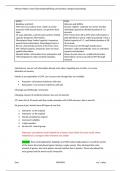
WMM MSM
Baddeley and Hitch Atkinson and Shiffrin
STM was not a unitary store, rather an active Sensory register- coded by our senses and has
processor with several stores, can perform dual unlimited capacity but limited duration of 1-2
tasks. seconds.
CE- pays attention, controls slave system, limited STM- Moves from SR to STM when information is
capacity temporary information. paid attention to and is coded acoustically. It has a
Phonological loop- limited capacity, temporary limited capacity of 5-7, and limited duration of 18-
speech bases information. Phonological store is 30 seconds.
the ear, and articular process is the inner voice. STM moves to LTM through maintenance
VSS- limited capacity, temporary store of visual rehearsal, coded semantically, have an unlimited
spatial information capacity and duration.
Episodic buffer- information from subsystems and Moves to each store in a unidirectional order.
LTM integrated to make complete episodes. Information can be accessed by STM through
retrieval
Interference- two pc’s of information disrupt each other, forgetting one or both, or in some
distortion of memory
Mainly as an explanation of LTM, can’t access even though they are available
Proactive- old memory interferes with new
Retroactive- new memory interferes with old
McGeogh and McDonald- retroactive
Changing amount of similarity between two sets of material
PP’s learn list of 10 words until they could remember with 100% accuracy, then a new list
Six group of pp’s had to learn diff types of new lists
1. Synonyms- to the original
2. Antonyms- to the original
3. Worlds unrelated to original
4. Consonant syllables
5. 3 digit numbers
6. No new list- control group
When pp’s are asked to recall original list of words, most similar list worst recall, shows
interference is strongest when memories are similar
Strength- Real world application, Baddeley and Hitch asked rugby players to recall the names
of the teams they had played against during a rugby season. They all played the same
amount of games, but some players missed matches due to injuries. Those who played the
most games had the worst recall, retroactive
Zara MEMORY a/a* notes.
, Memory-https://www.illuminatepublishing.com/product-category/psychology
Limitations- Lab based, although there is control of variables between time learning and
recalling and control over confounding shows link between interference and forgetting
Use artificial material, and unrealistic, lacks ecological validity- in everyday life we learn
something and recall it much later such as revising for exams
Interference may cause some forgetting, but unusual, and the variables that the conditions
of the lab become are rare. Interference though revising for similar subjects happens in
everyday life but not often. There are better explanations such as retrieval failure.
Tulving and Psotka found that interference and info lost is temporary and can be overcome
by using cues
Pp’s given 5 word lists organised into categories’, recall was 70% with one word list but fell
when more was added, when told the name of categories again rose to 70%
Interference effects are actually due to an absence of cues, suggesting interference theory is
simplistic
Outline and evaluate interference as an explanation of forgetting
One explanation of forgetting is interference which is when two pieces of information disrupt each
other causing an individual to forget one or both pieces of information and in some a distortion in
memory. Interference is an explanation of forgetting of long-term memory, when information is
available cannot be accessed and there are two types of interference: proactive interference when
an old memory interferes with a new one, and retroactive interference is when a new memory
interferes with an old one. Research of retroactive interference was conducted by McGeough and
McDonald who changed the amount of similarity between two sets of material. Participants were
asked to learn a list of 10 words, and remember them with 100% accuracy, then learn a new list. The
participants were put into 6 groups each with a different type of new list to learn, and the groups
were as followed: synonyms (like the original list (, antonyms (opposites to the original lists), words
unrelated to the original list, consonant syllables, three digits numbers and a control group with no
new list, who just rested. McGeough and McDonald found that participants, who were asked to
recall the original list of words in the synonyms group, had the worst accuracy in recall, justifying
that interference is strongest when memories are similar.
There is supporting evidence conducted by Baddeley and Hitch who studied rugby players, who were
asked to recall the names of previous teams they had played during that season- all players played
the same number of matches, except for those who missed out and were exempt due to injury. They
found that rugby players, who had played more recent games, struggled to recall the name of the
teams earlier on in the season, proving that retroactive inference has real life application.
However, there are limitations of the interference theory as an explanation for forgetting as studies
for this are conducted in the laboratory, and although there is a control of variables between leaning
Zara MEMORY a/a* notes.


