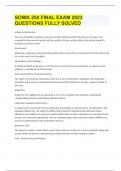
SOWK 250 FINAL EXAM 2023 QUESTIONS FULLY SOLVED
reciprocal interaction Two-way interaction between a person and the external world: the person acts upon and responds to the external world, and the quality of those actions affects the external world's reactions (and vice versa) Assessment Gathering, analyzing, and synthesizing information to provide a concise picture of the client and his or her needs and strengths Secondary or Host Settings A setting in which social work is not the only or not the primary profession, as when a social worker is a member of a clinical team. basic social history or personal history The client's functioning, interactions with his or her environment, problems and challenges, strengths and resources, developmental needs and life transitions, and key systems related to the case. Diagnoses A label or term applied to an individual or his or her situation that provides a shorthand categorization based on specifically defined criteria. Culturally competent assessment An approach to assessment that incorporates knowledge of cultural norms, acculturation, and language differences; the ability to differentiate between individual and culturally linked attributes; the initiative to seek out needed information so that evaluations are not biased and services are culturally appropriate; and an understanding of the ways that cultural differences may reveal themselves in the assessment process. goodness of fit The degree to which a client feels a part of the culture in which he or she is situated, taking into account both the person's predominant cultural identity and the majority culture. brief, solution-focused therapy A therapy model based the assumptions that making small changes can lead to larger changes, that focusing on the present can help the client tap into unused capacities and generate creative alternatives, and that paying attention to solutions is more relevant than focusing on problems. enactment Technique used to observe interactions between spouses or partners, family members, or group members by having them reenact an event during a session. symbolic interactions A form of enactment that uses some type of expressive or play therapy such as dolls or games. Client self-monitoring An approach to assessment in which clients track symptoms on logs or in journals, write descriptions, and record feelings, behaviors, and thoughts associated with particular times, events, symptoms, or difficulties collateral contacts Sources of assessment data such as relatives, friends, teachers, physicians, child care providers, and others who possess essential insights about relevant aspects of a client's life. Assessment instruments Written assessment tools such as intelligence tests, personality tests, and other screening instruments. activities of daily living Common activities carried out during the day, such as meal preparation or brushing one's teeth. presenting problem The reason a person is seeking help. Problem for Work The problem that the social worker and client ultimately focus on in therapy. antecedents Events that precede problematic behavior. ABC model Detecting patterns and targeting interventions by analyzing the Antecedents of problematic behavior, describing the Behavior in specific terms, and assessing the Consequences or effects of the behavior. meaning attributions Meanings people place on events, which influence how they respond to those events. precipitating events Events that immediately precede a decision to seek help. formal systems Institutional support systems such as schools, medical clinics, mentors, or home health aides. natural or informal systems Personal support systems such as neighbors, family, or friends. developmental assessment Understanding a child's history and current situation by means of information provided by a parent or other caregiver about the circumstances of the child's delivery, birth, and infancy; achievement of developmental milestones; family description and atmosphere; interests; significant life transitions; presenting problem, including its history; and school history. genogram A visual picture of a client's family, usually in the form of a family tree, identifying information about each person in order to obtain a comprehensive understanding of the family situation. Instrumental ADLs (IADLs) A client's ability to perform more intricate activities of daily living (ADLs), such as managing money, taking medicine properly, completing housework, shopping, and preparing meals. form of assessment that is most helpful in understanding the history and life experiences of a child? Developmental assessment Describe assessment a synthesis of relevant information and a tentative hypothesis In assessment, A-B-C refers to antecedent-behavior-consequence "Enactment" provides what type of data for assessment? Direct observation The reasons why it is important to explore clients' emotional reactions to their problems include all of the following EXCEPT emotional reactions can block hidden motives that underlie problem behaviors Which of the following questions does NOT address the meaning clients ascribe to problems? What happened after he told you that you would be fired? You have just begun working with an elderly woman. You want to better assess her ability to perform tasks associated with her daily living. Which of the following assessments is most appropriate? Functional assessment The authors suggest all of the following guidelines for practitioners who are culturally different than their clients EXCEPT use slang and other colloquial terms to demonstrate familiarity with the culture "You've done a good job of describing situations where you feel anxious being in crowds. Can you describe a situation when you aren't feeling anxious in crowds?" This is an example of seeking exceptions Asking a client to rate how much they feel commitment to solving their problem is an example of scaling motivation Comorbidity Simultaneous presence of more than one condition, such as alcohol and other drug abuse problems co-occurring with a variety of health and mental health problems. Reality testing Assessing whether a person is properly oriented to time, place, person, and situation; can reach appropriate conclusions about cause-and-effect relationships; can perceive external events and discern the intentions of others with reasonable accuracy; and can differentiate his or her own thoughts and feelings from those of others. Mild distortions Poor reality testing, such as stereotypical perceptions, that may cause some difficulties in interpersonal relationships. Moderate distortions Poor reality testing, often involving marked misinterpretations of the motives of others, that may severely impair interpersonal relationships. extreme distortions Extremely poor reality testing in which individuals have delusions or false beliefs—for example, that others plan to harm them when they do not. delusions False beliefs, not grounded in reality. auditory hallucinations hearing voices visual hallucinations A dysfunction in reality testing of psychotic proportions in which a client sees things that are not there. looseness of association or derailment Major thought disorder in which successive thoughts are highly fragmented and disconnected from one another. flight of ideas A form of derailment in which the client's response seems to "take off" based on a particular word or thought, unrelated to logical progression or the original point of the communication. cognitive flexibility Being receptive to new ideas, able to analyze many facets of problematic situations, highly adaptable, and hence capable of successful problem solving. Negative cognitive sets A pattern of cognitive inflexibility that involves thinking in absolute terms and may include biases and stereotypes that impede relationship building or cooperation with members of certain groups or individuals. Cognitive dissonance Inconsistency between a person's values and behaviors, which may produce tension, confusion, and distress. self-concept Convictions, beliefs, and ideas about the self. Intellectual disability Lower-than-average intelligence, typically diagnosed in infancy or childhood. Schizophrenia A psychotic disorder that causes marked impairment in social, educational, and occupational functioning. positive symptoms (of schizophrenia) Delusions, hallucinations, disorganized thinking and/or speech, and grossly disorganized or abnormal behavior. Negative symptoms (of schizophrenia) Flattened affect, restricted speech, and limited initiation of goal-directed behavior. avolition Limited initiation of goal-directed behavior. Major neurocognitive disorder (NCD) Significant cognitive decline from one's previous level of performance in one or more cognitive domains of sufficient severity to affect daily functioning. emotional constriction Appearing unexpressive and withholding in relationships, out of touch with one's emotions. emotional excesses Losing control and reacting intensely to even mild provocations. anhedonia The absence of pleasure in previously enjoyable activities; inability to feel joy or to express many pleasurable emotions. affect Emotionality. Emotional blunting A muffled or apathetic response to material that would typically evoke a stronger response. bipolar disorder The presence of manic episodes (mania) with intervening periods of depression. manic episodes A period of abnormally and persistently elevated, expansive, or irritable mood, including inflated self-esteem, extreme talkativeness, racing thoughts, distractibility, and agitation sufficient to cause marked impairment in job performance or relationships, or to necessitate hospitalization to protect self or others from harm. Major depressive disorder Recurrent episodes of depressed mood, with painful emotions commonly related to anxiety, mental anguish, an extreme sense of guilt, and restlessness. dysphoria Painful emotions. learned helplessness A passive resignation that one's life is out of one's hands. determination stage Stage at which the client is committed to action and works with the clinician to develop a plan for change. maintenance stage Stage at which the client takes steps to avoid problem recurrence. Physical environment stability and adequacy of one's physical surroundings and whether the environment fosters or jeopardizes one's health and safety. Social support systems Systems that fill a variety of needs to improve a client's quality of life. spirituality The human search for transcendence, meaning, and connectedness beyond the self. religion A socially sanctioned institution based on spiritual practices and beliefs. spiritual assessment Attempting to understand the client's belief system and resources.
Written for
- Institution
-
Calvin College
- Course
- Unknown
Document information
- Uploaded on
- October 29, 2023
- Number of pages
- 21
- Written in
- 2023/2024
- Type
- Exam (elaborations)
- Contains
- Questions & answers
Subjects

Also available in package deal