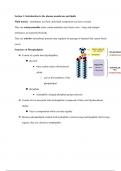
Section 1: Introduction to the plasma membrane and lipids
Fluid mosaic - membranes are fluid, individual components can move around
They are semi-permeable (only certain materials may freely cross – large and charged
substances are typically blocked)
They are selective (membrane proteins may regulate the passage of material that cannot freely
cross)
Structure of Phospholipids:
➔ Consist of a polar head (hydrophilic)
◆ glycerol
● three carbon chain with hydroxyl
group
○ acts as the backbone of the
phospholipid
◆ phosphate
● hydrophilic charged phosphate group molecule
➔ Consist of two non-polar tails (hydrophobic) composed of fatty acid (hydrocarbon)
chains.
◆ Vary in composition which can alter rigidity
➔ Because phospholipids contain both hydrophilic (water-loving) and lipophilic (fat-loving)
regions, they are classed as amphipathic.
, Polar Phospholipid Head groups:
PI=cytosolic leaflet
Charged Phospholipid Head Groups:
, PS= negatively & cytosolic leaflet, PE= positive & cytosolic leaflet, PC= positive &
exoplasmic leaflet
Cholesterol:
➔ Hydrophobic
➔ Has a hydroxyl group on one of its rings
◆ This ring will interact with the surface of the membrane
◆ The rest of the rings will interact with the lipid part of the membrane
Interacts with the fatty acid tails of phospholipids to moderate the properties of the
membrane:
➔ Cholesterol functions to immobilize the outer surface of the membrane, reducing fluidity
➔ It makes the membrane less permeable to very small water-soluble molecules that would
otherwise freely cross
➔ It functions to separate phospholipid tails and so
prevent crystallization of the membrane
Fluid mosaic - membranes are fluid, individual components can move around
They are semi-permeable (only certain materials may freely cross – large and charged
substances are typically blocked)
They are selective (membrane proteins may regulate the passage of material that cannot freely
cross)
Structure of Phospholipids:
➔ Consist of a polar head (hydrophilic)
◆ glycerol
● three carbon chain with hydroxyl
group
○ acts as the backbone of the
phospholipid
◆ phosphate
● hydrophilic charged phosphate group molecule
➔ Consist of two non-polar tails (hydrophobic) composed of fatty acid (hydrocarbon)
chains.
◆ Vary in composition which can alter rigidity
➔ Because phospholipids contain both hydrophilic (water-loving) and lipophilic (fat-loving)
regions, they are classed as amphipathic.
, Polar Phospholipid Head groups:
PI=cytosolic leaflet
Charged Phospholipid Head Groups:
, PS= negatively & cytosolic leaflet, PE= positive & cytosolic leaflet, PC= positive &
exoplasmic leaflet
Cholesterol:
➔ Hydrophobic
➔ Has a hydroxyl group on one of its rings
◆ This ring will interact with the surface of the membrane
◆ The rest of the rings will interact with the lipid part of the membrane
Interacts with the fatty acid tails of phospholipids to moderate the properties of the
membrane:
➔ Cholesterol functions to immobilize the outer surface of the membrane, reducing fluidity
➔ It makes the membrane less permeable to very small water-soluble molecules that would
otherwise freely cross
➔ It functions to separate phospholipid tails and so
prevent crystallization of the membrane