AQA Chemistry A-Level - Electrode Potentials and Cells QP
Q1.
This question is about electrode potentials and electrochemical cells.
(a) State the meaning of the term electrochemical series.
___________________________________________________________
___________________________________________________________
(1)
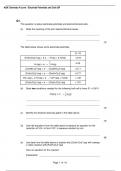
The table below shows some electrode potentials.
Eo / V
[Fe(H2O)6]2+(aq) + 2 e– → Fe(s) + 6 H2O(l) –0.44
H+(aq) + e– → H2(g) 0.00
[Co(NH3)6]3+(aq) + e– → [Co(NH3)6]2+(aq) +0.11
[Fe(H2O)6]3+(aq) + e– → [Fe(H2O)6]2+(aq) +0.77
VO2+(aq) + 2 H+(aq) + e– → VO2+(aq) + H2O(l) +1.00
[Co(H2O)6]3+(aq) + e– → [Co(H2O)6]2+(aq) +1.81
(b) State two conditions needed for the following half-cell to have Eo = 0.00 V
___________________________________________________________
___________________________________________________________
(1)
(c) Identify the weakest reducing agent in the table above.
___________________________________________________________
(1)
(d) Use half-equations from the table above to deduce an equation for the
reduction of VO2+ to form VO2+ in aqueous solution by iron.
___________________________________________________________
(2)
(e) Use data from the table above to explain why [Co(H2O)6]3+(aq) will undergo
a redox reaction with [Fe(H2O)6]2+(aq)
Give an equation for this reaction.
Explanation _________________________________________________
Page 1 of 16
,AQA Chemistry A-Level - Electrode Potentials and Cells QP
___________________________________________________________
___________________________________________________________
Equation
___________________________________________________________
(2)
(f) Suggest why the two cobalt(III) complex ions in the table above have
different electrode potentials.
___________________________________________________________
___________________________________________________________
___________________________________________________________
(1)
(Total 8 marks)
Q2.
This question is about the development of lithium cells.
The value of Eo for lithium suggests that a lithium cell could have a large EMF.
The table below shows some electrode potential data.
Eo / V
Li+(aq) + e– → Li(s) –3.04
2 H2O(l) + 2 e– → H2(g) + 2 OH–(aq) –0.83
I2(s) + e– → I–(aq) +0.54
(a) Use data in the table above to explain why an aqueous electrolyte is not
used for a lithium cell.
___________________________________________________________
___________________________________________________________
___________________________________________________________
(2)
(b) In the 1970s lithium-iodine cells became a common power source for heart
pacemakers. Lithium iodide is the final product of the cell reaction.
Use the data in the table above to calculate the cell EMF of a standard
lithium-iodine cell.
___________________________________________________________
(1)
Page 2 of 16
, AQA Chemistry A-Level - Electrode Potentials and Cells QP
(c) An EMF value for a commercial lithium-iodine cell is 2.80 V
Suggest why this value is different from the value calculated in part (b).
___________________________________________________________
___________________________________________________________
(1)
(d) In some lithium cells, lithium perchlorate (LiClO4) is used as the electrolyte.
Deduce the oxidation state of chlorine in LiClO4
___________________________________________________________
(1)
In other lithium cells, lithium cobalt oxide electrodes and lithium electrodes are
used.
(e) Give an equation for the reaction that occurs at the positive lithium cobalt
oxide electrode.
___________________________________________________________
(1)
(f) Give an equation for the reaction that occurs at the negative lithium
electrode.
___________________________________________________________
(1)
(Total 7 marks)
Q3.
This question is about a glucose–oxygen fuel cell.
When the cell operates, the glucose (C6H12O6) molecules react with water at the
negative electrode to form carbon dioxide and hydrogen ions.
Oxygen gas reacts with hydrogen ions to form water at the positive electrode.
(a) Deduce the half-equation for the reaction at the negative electrode.
___________________________________________________________
(1)
(b) Deduce the half-equation for the reaction at the positive electrode.
___________________________________________________________
(1)
Page 3 of 16