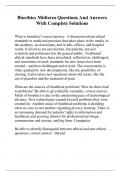
Bioethics Midterm Questions And Answers With Complete Solutions
What is bioethics? correct answer: A discussion about ethical standards in medicinal practices that takes place in the media, in the academy, in classrooms, and in labs, offices, and hospital wards. It involves not just doctors, but patients, not just scientists and politicians but the general public. Traditional ethical standards have been articulated, reflected on, challenged, and sometimes revised; standards for new issues have been created - and then challenged and revised. The conversation is often sparked by new developments, like the possibility of cloning. It also raises new questions about old issues, like the use of placebos and the treatment of pain. What are the sources of bioethical problems? How do these lead to problems? Be able to give/identify examples. correct answer: Much of bioethics is due to the unrelenting pace of technological advance. New technologies expand beyond problems they were created for. Another cause of bioethical problems is deciding what we owe to one another regarding privacy, honesty. There is an increasing demand for patients' rights to information and healthcare and growing distrust for professional privilege, consumerism and sexism, and big farm. Companies. Be able to identify/distinguish between ethical and non-ethical questions. correct answer: Should Utilitarianism is a consequentialist theory, what is consequentialism? correct answer: The class of normative ethical theories holding that the consequences of one's conduct are the ultimate basis for any judgment about the rightness or wrongness of that conduct. What is the greatest happiness principle? Be able to apply it to the resolve of cases. correct answer: The ethical principle that an action is right in so far as it promotes the greatest happiness of the greatest number of those affected. What are the benefits/advantages of utilitarianism as a moral theory? What are the main objections to utilitarianism? correct answer: Utilitarianism is good because it focuses on benefitting the most amount of people and it is impartial and creates a sense of equality. Some objections: 1. Happiness is the greatest good. (Critics say it leaves out other goods like health, friendship, creativity, intellectual attainment, etc.) 2. Requires us to calculate the probable consequences of every action, which is impossible. 3. For nonconsequentialists it is significant whether an outcome was done, or done by me. (killing/letting die) 4. Sometimes goes against our basic moral intuitions (killing one for the sake of others) Usually when we talk about utilitarianism, we are referring to act-utilitarianism. What is the difference between act-utilitarianism and rule-utilitarianism? How does rule-utilitarianism resolve (some of) the major problems with act-utilitarianism? correct answer: Action is right as it conforms to a rule that leads to the greatest good, or that "the rightness or wrongness of a particular action is a function of the correctness of the rule of which it is an instance." Be able to distinguish Kant's deontological theory from other theories of ethics. correct answer: The normative ethical position that judges the morality of an action based on the action's adherence to a rule or rules. It is sometimes described as "duty" or "obligation" or "rule"-based ethics, because rules "bind you to your duty." What sets human beings apart from other animals, according to Kant? Why is this important for understanding Kant's moral theory? correct answer: Humans are rational beings and therefore have special moral standing because of their ability to act on the basis of reason and to conform their behavior to the moral law. How do we make decisions about whether an action is consistent with duty and, therefore, morally permissible? What role does the categorical imperative play in this process? correct answer: "Can I, as a rational agent, consistently will that everyone in a similar situation should act this way?" What is the difference between the universalization test (Formula of Universal Law) and the respect for persons test (Formula of Humanity)? Can you think of any cases where an action would be permissible according to one, but not the other? correct answer: The first formulation (Formula of Universal Law) of the moral imperative "requires that the maxims be chosen as though they should hold as universal laws of nature" . This formulation in principle has as its supreme law the creed "Always act according to that maxim whose universality as a law you can at the same time will" and is the "only condition under which a will can never come into conflict with itself [....]" The second formulation (or Formula of the End in Itself) holds that "the rational being, as by its nature an end and thus as an end in itself, must serve in every maxim as the condition restricting all merely relative and arbitrary ends". The principle dictates that you "[a]ct with reference to every rational being (whether yourself or another) so that it is an end in itself in your maxim", meaning that the rational being is "the basis of all maxims of action" and "must be treated never as a mere means but as the supreme limiting condition in the use of all means, i.e., as an end at the same time" What is autonomy, according to Kant? How does this differ from standard views of autonomy in the bioethical literature? correct answer: The idea of freedom as autonomy thus goes beyond the merely 'negative' sense of being free from influences on our conduct originating outside of ourselves. It contains first and foremost the idea of laws made and laid down by oneself, and, in virtue of this, laws that have decisive authority over oneself. What is the basic moral precept/rule of natural law theory? correct answer: Refers to the use of reason to analyze human nature — both social and personal — and deduce binding rules of moral behavior from it. Natural law is often contrasted with the positive law of a given political community, society, or state. In legal theory, on the other hand, the interpretation of positive law requires some reference to natural law. On this understanding of natural law, natural law can be invoked to criticize judicial decisions about what the law says but not to criticize the best interpretation of the law itself. Some scholars use natural law synonymously with natural justice or natural right (Latin ius naturale), while others distinguish between natural law and natural right. What is the doctrine of double-effect? (Be able to reproduce the version from lecture, which is slightly different from the reading.) Be able to apply in the resolution of cases. correct answer: Often invoked to explain the permissibility of an action that causes a serious harm, such as the death of a human being, as a side effect of promoting some good end. Be able to distinguish virtue ethics from utilitarianism and Kant's deontology. correct answer: Deontology is the normative ethical position that judges the morality of an action based on the action's adherence to a rule or rules. It is sometimes described as "duty" or "obligation" or "rule"-based ethics, because rules "bind you to your duty." Utilitarianism is a theory in normative ethics holding that the proper course of action is the one that maximizes utility, usually defined as maximizing total benefit and reducing suffering or the negatives. Virtue Ethics emphasizes the role of one's character and the virtues that one's character embodies for determining or evaluating ethical behavior. What is eudaimonia? How is it different from the standard view of happiness? correct answer: A Greek word commonly translated as happiness or welfare; however, "human flourishing" has been proposed as a more accurate translation. How does one become virtuous, according to Aristotle? correct answer: By acting like a virtuous person. What roles do the virtues play in Aristotle's ethical theory? correct answer: The virtues represent the excellent states of our emotional and intellectual faculties. The authors mention a number of nonmoral considerations that play a role in decision-making. What are these nonmoral considerations? What does it mean to say that they are nonmoral? correct answer: Some nonmoral considerations are that of pursuing a significant personal goal or defining relationship. Also feels. What is the four principles approach to bioethics? How is it different from the other views we have considered thus far? correct answer: Respect for Autonomy,Beneficence, Non-Maleficence, Justice What is the principle of autonomy? Why does autonomy matter in bioethical decision-making? correct answer: Respecting the decision-making capacities of autonomous persons; enabling individuals to make reasoned informed choices. What is the principle of beneficence? What is the importance of this principle in bioethical decision-making? correct answer: This considers the balancing of benefits of treatment against the risks and costs; the healthcare professional should act in a way that benefits the patient What is the principle of nonmaleficence? What is the importance of this principle in bioethical decision-making? correct answer: Avoiding the causation of harm; the healthcare professional should not harm the patient. All treatment involves some harm, even if minimal, but the harm should not be disproportionate to the benefits of treatment. What is the principle of justice? In what ways is justice relevant in bioethical cases? correct answer: Distributing benefits, risks and costs fairly; the notion that patients in similar positions should be treated in a similar manner. What are the three main objections to the four principles approach? (You should be able to explain these, not simply name them.) correct answer: These are on the other computer too, i just didn't explain the objections. What is casuistry? How does the casuistical method work? correct answer: The use of clever but unsound reasoning, especially in relation to moral questions What is autonomy? correct answer: a concept found in moral, political, and bioethical philosophy. Within these contexts, it is the capacity of a rational individual to make an informed, un-coerced decision. What are the requirements for a person to be autonomous? correct answer: ... What is the difference between a negative obligation and positive obligation? correct answer: Positive obligations denote a State's obligation to engage in an activity to secure the effective enjoyment of a fundamental right, as opposed to the classical negative obligation to merely abstain from human rights violations. What are the elements of autonomy and informed consent? Be able to briefly describe each. correct answer: ... What are the two cases we identified in which it seems permissible for a health care provider to intentionally withhold information from a patient? correct answer: ... What is paternalism? How is paternalism a problem for the principle of beneficence? correct answer: The policy or practice on the part of people in positions of authority of restricting the freedom and responsibilities of those subordinate to them in the subordinates' supposed best interest. What is the four box method? How can it be used to evaluate clinical cases? correct answer: Medical Indications: What is the patient's medical problem? Is the problem acute? Chronic? Critical? Reversible? Emergent? Terminal? What are the goals of treatment? In what circumstances are medical treatments not indicated? What are the probabilities of success of various treatment options? In sum, how can this patient be benefited by medical and nursing care, and how can harm be avoided? Patient Preferences: Has the patient been informed of benefits and risks, understood this information, and given consent? Is the patient mentally capable and legally competent, and is there evidence of incapacity? If mentally capable, what preferences about treatment is the patient stating? If incapacitated, has the patient expressed prior preferences? Who is the appropriate surrogate to make decisions for the incapacitated patient? Is the patient unwilling or unable to cooperate with medical treatment? If so, why? Quality of Life: What are the prospects, with or without treatment, for a return to normal life, and what physical, mental, and social deficits might the patient experience even if treatment succeeds? On what grounds can anyone judge that some quality of life would be undesirable for a patient who cannot make or express such a judgment? Are there biases that might prejudice the provider's evaluation of the patient's quality of life? What ethical issues arise concerning improving or enhancing a patient's quality of life? Do quality-of-life assessments raise any questions regarding changes in treatment plans, such as forgoing life-sustaining treatment? What are plans and rationale to forgo life-sustaining treatment? What is the legal and ethical status of suicide? Contextual Features: Are there professional, interprofessional, or business interests that might create conflicts of interest in the clinical treatment of patients? Are there parties other than clinicians and patients, such as family members, who have an interest in clinical decisions? What are the limits imposed on patient confidentiality by the legitimate interests of third parties? Are there financial factors that create conflicts of interest in clinical decisions? Are there problems of allocation of scarce health resources that might affect clinical decisions? Are there religious issues that might affect clinical decisions? What are the legal issues that might affect clinical decisions? Are there considerations of clinical research and education that might affect clinical decisions? Are there issues of public health and safety that affect clinical decisions? Are there conflicts of interest within institutions or organizations (e.g. hospitals) that may affect clinical decisions and patient welfare? Be able to identify ways that the questions in the four boxes line up with questions/issues from the four principles approach. correct answer: Medical Indications: The Principles of Beneficience and Non-Malficience. Patient Preferences: The Principle of Respect for Autonomy Quality of Life: The Principles of Beneficience, Non-Malficience, and Respect for Autonomy. Contextual Features: The Principles of Justice and Fairness How is cultural relativism (as a description about the way the world is) different from a moral theory based on cultural relativism? correct answer: ... What is the cultural differences argument? correct answer: ... Rachels and Rachels identify three (problematic) consequences of cultural relativism. Be able to describe and give examples of each. correct answer: ... How do Rachels and Rachels support the claim that there is less moral disagreement than there seems to be? correct answer: ... What is intersectionality? correct answer: The study of intersections between forms or systems of oppression, domination or discrimination. What is cultural humility? How does/should it change our approach to multicultural issues? correct answer: Ability to maintain an interpersonal stance that is other-oriented (or open to the other) in relation to aspects of cultural identity that are most important to the person. How does Mentzel support his claim that people in the United States have a "realistic moral right to accessible basic health care"? (Hint: There are 5 steps in his argument.) correct answer: Hospitals in the united states are legally prohibited from turning away the uninsured for emergency care. People already have universal access to emergency care. in such a context, allowing insurance to remain voluntary condones unfair free riding by some who go without insurance. it is also gallingly inefficient. the only feasible way to alleviate the unfairness and inefficiency is to mandate insurance. a mandate that everyone insure is unfair insurance is affordable. affordability requires two things: for virtually everyone, restrictions on the behavior of insurers and, for many people, subsidies it is unfair to insurers, and self-defeating in relation to reducing the ranks of the uninsured, to bar insurers from using preexisting condition exclusions, waiting periods, and risk-rated premiums unless insurance is made mandatory. justice between well and ill requires that they share most of the financial burdens of illness and insurance What kind of right is the right to health care? How is it different from something like the right to vote? What does it mean to say that the right to health care is a positive right? correct answer: It is a positive right in that it requires that the government gives a service to someone Are there limits on the right to health care? How does Mentzel address this issue? correct answer: Comparative effectiveness and cost, expensive end of life care, life support for patients in persistent vegetative states, In which areas does the US rank low (among the 13 most economically advanced countries)? correct answer: -low birth weight -neonatal mortality -life expectancy at age 1 -life expectancy at age 15 '' at age 40 '' at age 65 Kawachi addresses three myths about the U.S.'s poor health performance. What are these three myths and how does Kawachi respond to each? correct answer: Poor health = Bad genes, Poor people behaving badly, Lack of access to healthcare What does Kawachi conclude is the main contributing factor in the U.S.'s poor health performance? How does this factor contribute to poor health? correct answer: Economic inequality What is the argument from collective social protection? Be able to summarize and explain the argument. correct answer: ... What is the argument from return on investment? Be able to summarize and explain the argument. correct answer: ... What are the four components of class? How is class related to health and health care? correct answer: ... How do the authors respond to the argument that a market in living organ donation (for kidneys) would preclude genuine consent on the part of vendors? correct answer: ... Erin and Harris sketch the requirements of an ethical market in human organs. What conditions would have to be met in order for such a market to be ethical? correct answer: safeguards against wrongful exploitation such as a singly purchaser system within a confined marketplace Why is commodification a problem for organ markets? correct answer: it would lead to further objectification of the human body How does Pogge support the claim that foreigners' medical conditions have greater moral weight than those of individuals who live in our own nation? correct answer: ... What is the "reasoned ideal" argument? How do Erin and Harris respond? correct answer: ... In what ways have the economic and social institutions of wealthier nations contributed world poverty, according to Pogge? correct answer: ... Pogge lists six ways one might impact the medical conditions of another. Which of these six does he think is important for understanding responsibility? Why are these important? correct answer: officially mandated, legally authorized, forseeably and avoidably engender, legally prohibited but barely deterred, avoidably leaving unmitigated the effects of a natural defect, avoidably leaving the unmitigated effects of a self-caused defect What is the main problem that Dwyer is addressing? Who are the people that he is talking about? correct answer: these pre-pubescent countries are spending money educating health care workers and then they are =ditching them. In what ways might a society justifiably restrict health care professional? What makes these restrictions justifiable? correct answer: ... What are the three features of a just society that Dwyer discusses? How do they relate to the problem he is addressing? correct answer: ... What possible solutions does Dwyer offer? correct answer: requiring substantial social commitments from people who are educated as healthcare professionals How does Risse address Pogge's argument? correct answer: she argues that his premise, that the global order harms the poor, is not true and that, in fact, it has helped with the considerable improvements in human well being that have occurred over the last 200 years What are the benchmarks for harm that Risse presents? correct answer: ...
Geschreven voor
- Instelling
- Bioethics
- Vak
- Bioethics
Documentinformatie
- Geüpload op
- 21 oktober 2023
- Aantal pagina's
- 15
- Geschreven in
- 2023/2024
- Type
- Tentamen (uitwerkingen)
- Bevat
- Vragen en antwoorden
Onderwerpen
-
bioethics midterm questions and answers with compl

Ook beschikbaar in voordeelbundel