Cross Cultural & Global Mental Health – Lecture notes
Lecture 1: Introduction into cross-cultural and global mental health
Global mental health: an evolving field of research and practice that aims to alleviate mental
suffering through the prevention, care, and treatment of mental and substance use disorders,
and to promote and sustain the mental health of individuals and communities around the
world.
Past 10 years there has been a high quality of research.
Mental disorders across the globe: WHO-World Mental Health (WMH) Surveys is a face-to-
face administration of survey including Composite diagnostic interview (CIDI) in 17 countries
(more dan 85 thousand respondents).
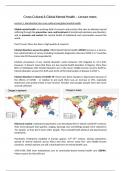
Lifetime prevalence of any mental disorders varies between 12% (Nigeria) to 47.4 (US).
However, it doesn’t mean that there are less mental health disorders in Nigeria. More than
80% of individuals with mental disorders are in the lower middle-income country (LMIC’s).
Mental disorders account for 8.8% and 16.6% of the total burden of disease in LMIC’’s.
Mental disorders in times of COVID-19: there have been changes in depression because of
the effects of COVID – in relation to pre-covid there was an increase in 25%, especially
depression and anxiety (most in low income). Females and younger people were also more
severely affected.
Historical context: Institutional psychiatric care developed first in Islamic world (8th century).
They were pleasant (nice garden, singing, dancing), but somethings people were chained to
‘fix’ people, so they don’t harm other people. They included both physical and psychosocial
treatments.
Psychiatric institutions establish in Europe approx. 12th-15th century. During colonialism,
spread of mental asylums across Africa and Asia. Across many low- and middle-income
countries, mental asylums are still a dominant form of mental health care.
1950-1960: Shift from institutional care to community-based mental health care (CBMH).
Many reasons for this shift are:
, Increased belief in efficacy of CBMH
Disadvantages of institutionalization (abusive conditions, negative effects).
Costs of institutionalization
Discovery of antipsychotics (chlorpromazine, 1954) (live home instead of institution)
Appreciation of human rights if individual with mental health disorders.
There were two kinds of approaches: the Emic vs. the Etic approaches: Emic approach (social
anthropologists and cultural psychiatrics): human experience is shaped by culture and there
are no such thing as universal psychiatric syndromes. Etic approach (clinicians and
epidemiologist): core symptoms of psychopathology are product of universal biological or
psychological processes.
From 1970s there was an integration of emic and etic approaches to interdisciplinary cross-
cultural psychiatry approach. From 2000s there’re epidemiological studies across diverse
populations and in LMIC’s. After 2005: Large Randomized Controlled Trials (RCT’s).
Research methods in global mental health care: mixed methods research – includes
qualitative and quantitative approaches.
Application with global mental health? Test intervention and prevalence are reasons for
quantitative research. Qualitative research is generally used for understanding views and
perceptions. It offers visions to different problems and helps in developing concepts or
theories for potential quantitative research.
WHO’s 5 phase model for new intervention testing. This is at 2 sites, because it’s usual to
conduct 2 independent studies in 2 different countries. In phase 1, you can start with
translating and then qualitative research
(start with big sample) – see what kind of
problems there are adapt
intervention. small RCT. In phase 2:
see if you need to change it. If there is an
effect (even if it is small), continue with
the steps. In phase 3: Interview and find
out what went well and what went wrong
related to the intervention (you go back).
In phase 4: look at effect. You can use
hundreds of people pre assessment
then post assessments for the problems. In the last phase (5): How did it landed and what you
Lecture 1: Introduction into cross-cultural and global mental health
Global mental health: an evolving field of research and practice that aims to alleviate mental
suffering through the prevention, care, and treatment of mental and substance use disorders,
and to promote and sustain the mental health of individuals and communities around the
world.
Past 10 years there has been a high quality of research.
Mental disorders across the globe: WHO-World Mental Health (WMH) Surveys is a face-to-
face administration of survey including Composite diagnostic interview (CIDI) in 17 countries
(more dan 85 thousand respondents).
Lifetime prevalence of any mental disorders varies between 12% (Nigeria) to 47.4 (US).
However, it doesn’t mean that there are less mental health disorders in Nigeria. More than
80% of individuals with mental disorders are in the lower middle-income country (LMIC’s).
Mental disorders account for 8.8% and 16.6% of the total burden of disease in LMIC’’s.
Mental disorders in times of COVID-19: there have been changes in depression because of
the effects of COVID – in relation to pre-covid there was an increase in 25%, especially
depression and anxiety (most in low income). Females and younger people were also more
severely affected.
Historical context: Institutional psychiatric care developed first in Islamic world (8th century).
They were pleasant (nice garden, singing, dancing), but somethings people were chained to
‘fix’ people, so they don’t harm other people. They included both physical and psychosocial
treatments.
Psychiatric institutions establish in Europe approx. 12th-15th century. During colonialism,
spread of mental asylums across Africa and Asia. Across many low- and middle-income
countries, mental asylums are still a dominant form of mental health care.
1950-1960: Shift from institutional care to community-based mental health care (CBMH).
Many reasons for this shift are:
, Increased belief in efficacy of CBMH
Disadvantages of institutionalization (abusive conditions, negative effects).
Costs of institutionalization
Discovery of antipsychotics (chlorpromazine, 1954) (live home instead of institution)
Appreciation of human rights if individual with mental health disorders.
There were two kinds of approaches: the Emic vs. the Etic approaches: Emic approach (social
anthropologists and cultural psychiatrics): human experience is shaped by culture and there
are no such thing as universal psychiatric syndromes. Etic approach (clinicians and
epidemiologist): core symptoms of psychopathology are product of universal biological or
psychological processes.
From 1970s there was an integration of emic and etic approaches to interdisciplinary cross-
cultural psychiatry approach. From 2000s there’re epidemiological studies across diverse
populations and in LMIC’s. After 2005: Large Randomized Controlled Trials (RCT’s).
Research methods in global mental health care: mixed methods research – includes
qualitative and quantitative approaches.
Application with global mental health? Test intervention and prevalence are reasons for
quantitative research. Qualitative research is generally used for understanding views and
perceptions. It offers visions to different problems and helps in developing concepts or
theories for potential quantitative research.
WHO’s 5 phase model for new intervention testing. This is at 2 sites, because it’s usual to
conduct 2 independent studies in 2 different countries. In phase 1, you can start with
translating and then qualitative research
(start with big sample) – see what kind of
problems there are adapt
intervention. small RCT. In phase 2:
see if you need to change it. If there is an
effect (even if it is small), continue with
the steps. In phase 3: Interview and find
out what went well and what went wrong
related to the intervention (you go back).
In phase 4: look at effect. You can use
hundreds of people pre assessment
then post assessments for the problems. In the last phase (5): How did it landed and what you