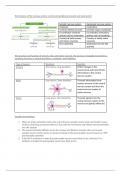
The divisions of the nervous system: central and peripheral (somatic and autonomic):
Somatic nervous system Autonomic nervous system
Voluntary Involuntary
Controls skeletal muscles Controls organs and glands
Co-ordinates voluntary Co-ordinates involuntary
actions such as movement actions such as breathing
Consists of both sensory Consists of solely motor
and motor neurones neurones
Not subdivided Subdivided into the SNS
and PNS
The structure and function of sensory, relay and motor neurons. The process of synaptic transmission,
including reference to neurotransmitters, excitation, and inhibition:
Type of neuron Structure Function
Sensory Short axons, long dendrites Detect changes in the
environment and transmit this
information to the central
nervous system
Relay Short axons, short dendrites Transmit information from
sensory neurons to the central
nervous system and from the
central nervous system to
motor neurons
Motor Long axons, short dendrites Transmit signals from the
central nervous system to the
muscles and glands (effectors)
Synaptic transmission:
1. When an action potential reaches the end of the pre-synaptic neuron (axon terminal) it causes
vesicles containing neurotransmitters to fuse with the membrane and release neurotransmitters
into the synapse
2. The neurotransmitter diffuses across the synapse and binds to receptor sites on the post-
synaptic neuron which causes an electrical change in the post-synaptic neuron known as a PSP
(postsynaptic potential)
3. If the PSP is excitatory it make the postsynaptic neuron more likely to fire, whereas if it’s
inhibitory it makes the postsynaptic neuron less likely to fire
, 4. These impulses are summed in a process called summation and causes the postsynaptic neuron
to either fire or not
5. The neurotransmitter is then taken back into the presynaptic neuron in reuptake, or the
neurotransmitter is broken down in degradation by enzymes
The function of the endocrine system: glands and hormones:
Endocrine system – A network of glands in the body which manufacture and secrete hormones which
regulate bodily functions
Endocrine gland – A group of cells within the endocrine system which produce and secrete hormones
Hormones – Chemical messengers that travel through the bloodstream to target sites throughout the
body
Regulated by negative feedback – The secretion of a hormone directly reduces the change which
activated the secretion of the hormone in the first place
Difference Nervous system Endocrine system
Effectors Muscles or glands Target cells in specific tissues
Speed of response Rapid Slow
Communication Electrical Chemical
Target cells Specific General
Transport Synaptic transmission Bloodstream – in blood plasma
Pituitary gland:
FSH (follicle-stimulating hormone): Stimulates the growth and
development of ovarian follicles in the female and sperm production in
the male
LH (luteinizing hormone): Stimulates ovulation in the female and the
production of testosterone in the male
Testes:
Testosterone: Responsible for the development of male secondary
sexual characteristics and maintaining muscle mass and bone density
Ovaries:
Oestrogen: Responsible for the development of female secondary
sexual characteristics and regulating the menstrual cycle
Progesterone: Helps to maintain pregnancy and regulate the menstrual
cycle
Adrenal glands:
Cortisol: Helps to regulate metabolism and the body's stress response
Noradrenaline: Increases heart rate and blood pressure in response to
stress
Adrenaline: Increases heart rate and blood pressure in response to
stress
Somatic nervous system Autonomic nervous system
Voluntary Involuntary
Controls skeletal muscles Controls organs and glands
Co-ordinates voluntary Co-ordinates involuntary
actions such as movement actions such as breathing
Consists of both sensory Consists of solely motor
and motor neurones neurones
Not subdivided Subdivided into the SNS
and PNS
The structure and function of sensory, relay and motor neurons. The process of synaptic transmission,
including reference to neurotransmitters, excitation, and inhibition:
Type of neuron Structure Function
Sensory Short axons, long dendrites Detect changes in the
environment and transmit this
information to the central
nervous system
Relay Short axons, short dendrites Transmit information from
sensory neurons to the central
nervous system and from the
central nervous system to
motor neurons
Motor Long axons, short dendrites Transmit signals from the
central nervous system to the
muscles and glands (effectors)
Synaptic transmission:
1. When an action potential reaches the end of the pre-synaptic neuron (axon terminal) it causes
vesicles containing neurotransmitters to fuse with the membrane and release neurotransmitters
into the synapse
2. The neurotransmitter diffuses across the synapse and binds to receptor sites on the post-
synaptic neuron which causes an electrical change in the post-synaptic neuron known as a PSP
(postsynaptic potential)
3. If the PSP is excitatory it make the postsynaptic neuron more likely to fire, whereas if it’s
inhibitory it makes the postsynaptic neuron less likely to fire
, 4. These impulses are summed in a process called summation and causes the postsynaptic neuron
to either fire or not
5. The neurotransmitter is then taken back into the presynaptic neuron in reuptake, or the
neurotransmitter is broken down in degradation by enzymes
The function of the endocrine system: glands and hormones:
Endocrine system – A network of glands in the body which manufacture and secrete hormones which
regulate bodily functions
Endocrine gland – A group of cells within the endocrine system which produce and secrete hormones
Hormones – Chemical messengers that travel through the bloodstream to target sites throughout the
body
Regulated by negative feedback – The secretion of a hormone directly reduces the change which
activated the secretion of the hormone in the first place
Difference Nervous system Endocrine system
Effectors Muscles or glands Target cells in specific tissues
Speed of response Rapid Slow
Communication Electrical Chemical
Target cells Specific General
Transport Synaptic transmission Bloodstream – in blood plasma
Pituitary gland:
FSH (follicle-stimulating hormone): Stimulates the growth and
development of ovarian follicles in the female and sperm production in
the male
LH (luteinizing hormone): Stimulates ovulation in the female and the
production of testosterone in the male
Testes:
Testosterone: Responsible for the development of male secondary
sexual characteristics and maintaining muscle mass and bone density
Ovaries:
Oestrogen: Responsible for the development of female secondary
sexual characteristics and regulating the menstrual cycle
Progesterone: Helps to maintain pregnancy and regulate the menstrual
cycle
Adrenal glands:
Cortisol: Helps to regulate metabolism and the body's stress response
Noradrenaline: Increases heart rate and blood pressure in response to
stress
Adrenaline: Increases heart rate and blood pressure in response to
stress