TOPIC 14: COORDINATION AND RESPONSE
14.1 NERVOUS SYSTEM IN HUMANS
-The human nervous system consists of the:
→central nervous system (CNS) – the brain and the spinal cord
→peripheral nervous system (PNS) – all of the nerves in the body
-It allows us to make sense of our surroundings and respond to them and to coordinate and regulate body functions
-Information is sent through the nervous system as nerve impulses – electrical signals that pass along nerve cells known as
neurones.
-A bundle of neurones is known as a nerve
Types of Neurone
-There are three main types of neurone: SENSORY, RELAY AND MOTOR
→Sensory neurones carry impulses from sense organs to the CNS (brain or
spinal cord)
→Relay neurones are found inside the CNS and connect sensory and motor
neurones
→Motor neurones carry impulses from the CNS to effectors (muscles or
glands)
-Neurones have a long fibre (axon)
-This means that less time is wasted transferring the impulse from one cell to
another
-The axon is insulated by a fatty sheath with small uninsulated sections along it
(called nodes)
-This means that the electrical impulse does not travel down the whole axon,
but jumps from one node to the next
-Their cell body contains many extensions called dendrites
-This means they can connect to many other neurones and receive impulses
from them, forming a network for easy communication.
NERVE:
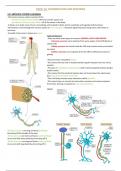
-Sensory neurones are long and have a cell body
branching off the middle of the axon.
-Relay neurones are short and have a small cell body
at one end with many dendrites branching off it
-Motor neurones are long and have a large cell body
at one end with long dendrites branching off it.
, Voluntary & Involuntary Responses
→Voluntary response: one where you make a conscious decision to carry out a particular action therefore it starts with your
brain
-voluntary responses often take longer as we consider what the response might be before doing it.
→Involuntary (or reflex) response: does not involve the brain as the coordinator of the reaction and you are not aware you have
completed it until after you have carried it out
-Involuntary actions are usually ones which are essential to basic survival and are rapid.
The Reflex Arc
-An involuntary (or reflex) response does not involve the brain as the coordinator of the reaction and you are not aware you
have completed it until after you have carried it out.
-This is an automatic and rapid response to a stimulus such as touching something sharp or hot.
-As it does not involve the brain, a reflex response is quicker than any other type of nervous response
-This helps to minimise the damage to the body
1) The pin (the stimulus) is detected by a pain/pressure/touch
receptor in the skin
2) Sensory neurone sends electrical impulses to the spinal cord
(the coordinator)
3) Electrical impulse is passed on to relay neurone in the spinal
cord
4) Relay neurone connects to motor neurone and passes the
impulse on
5) Motor neurone carries impulse to a muscle in the leg (the
effector)
6) The muscle will contract and pull the foot up and away from the
sharp object (the
response).
The Synapse
→Synapse: the junction between two neurones.
How an Impulse is Passed Across a Synapse?
-Neurones never touch each other
-The junctions (gaps) in between them are called synapses
-The electrical impulse travels along the first axon
-This triggers the nerve-ending of the presynaptic neurone to release chemical messengers called neurotransmitters from
vesicles which fuse with the presynaptic membrane
-The neurotransmitters diffuse across the synaptic gap and bind with receptor molecules on the membrane of the second
neurone (known as the post synaptic membrane)
-This stimulates the second neurone to generate an electrical impulse that travels down the second axon
14.1 NERVOUS SYSTEM IN HUMANS
-The human nervous system consists of the:
→central nervous system (CNS) – the brain and the spinal cord
→peripheral nervous system (PNS) – all of the nerves in the body
-It allows us to make sense of our surroundings and respond to them and to coordinate and regulate body functions
-Information is sent through the nervous system as nerve impulses – electrical signals that pass along nerve cells known as
neurones.
-A bundle of neurones is known as a nerve
Types of Neurone
-There are three main types of neurone: SENSORY, RELAY AND MOTOR
→Sensory neurones carry impulses from sense organs to the CNS (brain or
spinal cord)
→Relay neurones are found inside the CNS and connect sensory and motor
neurones
→Motor neurones carry impulses from the CNS to effectors (muscles or
glands)
-Neurones have a long fibre (axon)
-This means that less time is wasted transferring the impulse from one cell to
another
-The axon is insulated by a fatty sheath with small uninsulated sections along it
(called nodes)
-This means that the electrical impulse does not travel down the whole axon,
but jumps from one node to the next
-Their cell body contains many extensions called dendrites
-This means they can connect to many other neurones and receive impulses
from them, forming a network for easy communication.
NERVE:
-Sensory neurones are long and have a cell body
branching off the middle of the axon.
-Relay neurones are short and have a small cell body
at one end with many dendrites branching off it
-Motor neurones are long and have a large cell body
at one end with long dendrites branching off it.
, Voluntary & Involuntary Responses
→Voluntary response: one where you make a conscious decision to carry out a particular action therefore it starts with your
brain
-voluntary responses often take longer as we consider what the response might be before doing it.
→Involuntary (or reflex) response: does not involve the brain as the coordinator of the reaction and you are not aware you have
completed it until after you have carried it out
-Involuntary actions are usually ones which are essential to basic survival and are rapid.
The Reflex Arc
-An involuntary (or reflex) response does not involve the brain as the coordinator of the reaction and you are not aware you
have completed it until after you have carried it out.
-This is an automatic and rapid response to a stimulus such as touching something sharp or hot.
-As it does not involve the brain, a reflex response is quicker than any other type of nervous response
-This helps to minimise the damage to the body
1) The pin (the stimulus) is detected by a pain/pressure/touch
receptor in the skin
2) Sensory neurone sends electrical impulses to the spinal cord
(the coordinator)
3) Electrical impulse is passed on to relay neurone in the spinal
cord
4) Relay neurone connects to motor neurone and passes the
impulse on
5) Motor neurone carries impulse to a muscle in the leg (the
effector)
6) The muscle will contract and pull the foot up and away from the
sharp object (the
response).
The Synapse
→Synapse: the junction between two neurones.
How an Impulse is Passed Across a Synapse?
-Neurones never touch each other
-The junctions (gaps) in between them are called synapses
-The electrical impulse travels along the first axon
-This triggers the nerve-ending of the presynaptic neurone to release chemical messengers called neurotransmitters from
vesicles which fuse with the presynaptic membrane
-The neurotransmitters diffuse across the synaptic gap and bind with receptor molecules on the membrane of the second
neurone (known as the post synaptic membrane)
-This stimulates the second neurone to generate an electrical impulse that travels down the second axon