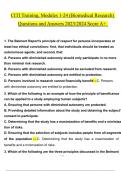
CITI Training, Modules 1-24 Questions and Answers 2023/2024 | 100% Correct
The Belmont Report's principle of respect for persons incorporates at least two ethical convictions: first, that individuals should be treated as autonomous agents, and second, that: A. Persons with diminished autonomy should only participate in no more than minimal risk research. B. Persons with diminished autonomy should be excluded from research. C. Persons with diminished autonomy are entitled to protection. D. Persons involved in research cannot financially benefit>>C. Persons with diminished autonomy are entitled to protection. 2. Which of the following is an example of how the principle of beneficence can be applied to a study employing human subjects? A. Ensuring that persons with diminished autonomy are protected. B. Providing detailed information about the study and obtaining the subject's consent to participate. C. Determining that the study has a maximization of benefits and a minimization of risks. D. Ensuring that the selection of subjects includes people from all segments of the population >>C. Determining that the study has a maximization of benefits and a minimization of risks. 3. Which of the following are the three principles discussed in the Belmont 2 / 36 Report? A. IRB Review, Federal Regulations, Declaration of Helsinki B. Privacy, Confidentiality, Equitable Selection of Subjects C. Informed Consent, Institutional Assurance, Researcher Responsibility D. Respect for Persons, Beneficence, Justice: D. Respect for Persons, Beneficence, Justice 4. When an IRB is reviewing a research study and they are considering if a potential subject population is vulnerable, they should consider: A. Are there adequate resources to conduct the study? B. Is there a power differential between researchers and subjects? C. Has the researcher completed required training? D. Are the research procedures greater than minimal risk of harm?: B. Is there a power differential between researchers and subjects? 5. Which is an example of a situation where deferential vulnerability might be a factor? A. An army medical officer recruiting subjects among lower ranks B. A college professor recruiting among their students C. A physician recruiting patients to be subjects 3 / 36 D. An employer recruiting among persons who directly report to them: C. A physician recruiting patients to be subjects 6. In considering NBAC's analytic approach, an otherwise competent person who is acutely ill might be considered at especially high risk of harm for: A. Economic vulnerability B. Situational cognitive vulnerability C. Capacity-related cognitive vulnerability D. Communicative vulnerability: B. Situational cognitive vulnerability 7. Identify the following groups that are protected in the federal regulations (45 CFR 46), specifically in Subparts B, C, and D with additional protections: A. Pregnant women, prisoners, and mentally disabled B. Children, prisoners, and terminally ill C. Prisoners, children, and elderly D. Pregnant women, prisoners, children: D. Pregnant women, prisoners, children 8. The NBAC looks at characteristics individuals might have that would prevent them from being able to provide voluntary informed consent. The traits may be thought of as falling into six broad areas: cognitive or communicative, institutional, deferential, medical, economic, and social. Prospective research subjects who are not able to comprehend information, deliberate, and make decisions about participation in a proposed research study have a: A. Institutional vulnerability B. Cognitive or communicative vulnerability C. Physical vulnerability 4 / 36 D. Economic or social vulnerability: B. Cognitive or communicative vulnerability 9. The use of prisoners in research is a concern under the Belmont principle of Justice because: A. Prisoners are less educated that the general population and have difficulty understanding research B. Prisoners may not be used to conduct research that only benefits the larger society C. Prisoners are not a representative sample of the general population D. Prisoners are not free to say no: B. Prisoners may not be used to conduct research that only benefits the larger society 10. Which of the following is included in the Nuremberg Code: A. Additional protection for vulnerable subjects B. Equitable selection of subjects 5 / 36 C. Confidentiality of data D. Voluntary consent: D. Voluntary consent 11. Which of the following brought increased public attention to the problems with the IRB system? A. 1983 Presidential Commission Report B. HHS Inspector General Report of 1998 C. "Shut Downs" by OHRP D. Death of Research Subject (Jesse Gelsinger): D. Death of Research Subject (Jesse Gelsinger) 12. Informed consent is considered an application of which Belmont principle? A. Non-maleficence B. Justice C. Beneficence D. Respect for Persons: D. Respect for Persons 13. The National Research Act of 1974 A. Required that all federal agencies have the same regulations governing human subjects research. B. Identified guidelines to ensure the ethical conduct of research. C. Established the National Commission. D. Identified the basic ethical principles of human subjects research>>C. Established the National Commission. 14. A subject in a clinical research trial experiences a serious, unanticipated adverse drug experience. How should the investigator proceed, with respect 6 / 36 to the IRB, after the discovery of the adverse event occurrence? A. Report the adverse drug experience in a timely manner, in keeping with the IRB's policies and procedures, using the forms or the mechanism provided by the IRB. B. Report the adverse drug experience as part of the continuing review report. C. Do not report the adverse drug experience to the IRB since it is a common adverse experience. D. Report the adverse drug experience to the IRB only if there are several other occurrences>>A. Report the adverse drug experience in a timely manner, in keeping with the IRB's policies and procedures, using the forms or the mechanism provided by the IRB. 15. How long is an investigator required to keep consent documents, IRB correspondence, and research records? 7 / 36 A. As long as the investigator is at that institution B. For a minimum of three years after completion of the study C. Until data analysis is complete D. Until the study is closed: B. For a minimum of three years after completion of the study 16. According to federal regulations, which of the following best describes when expedited review of a new, proposed study may be used by the IRB? A. The study is required for a student research project B. The study includes only research subjects that are healthy volunteers. C. The study does not require informed consent or survey instruments. D. The study involves no more than minimal risk and meets one of the allowable categories of expedited review specified in federal regulations: D. The study involves no more than minimal risk and meets one of the allowable categories of expedited review specified in federal regulations 17. Amendments involving changes to IRB-approved protocols do NOT need prior IRB approval if: A. They only involve changes to the consent form. B. The changes must be immediately implemented for the health and well-being of the subject. C. They are eligible for review using expedited procedures. D. The investigator keeps careful records of all changes and includes them in the final report>>B. The changes must be immediately implemented for the health and well-being of the subject. 18. IRB continuing review of a greater than minimal risk approved protocol 8 / 36 that is currently enrolling subjects must: A. Include copies of all signed consent forms. B. Occur at least annually. C. Be conducted by an expedited review. D. Occur only when the level of risk changes>>B. Occur at least annually. 19. A general requirement for the informed consent form is that it may not include any exculpatory language. Exculpatory language is that which waives or appears to waive any of the subject's legal rights or releases or appears to release those conducting the research from liability for negligence. Which of the following statements in a consent form is an example of exculpatory language? A. In the event of any injury you may have related to this research, you will be given medical treatment. B. Your participation in this research is voluntary. If you choose not to 9 / 36 participate, or change your mind later, your decision will not affect your relationship with your doctor or your right to health care or other services that you may be eligible for. C. The investigator may stop you from participating in this research without your consent if you experience side effects that make your condition worse. If you become ill during the research, you may have to drop out. D. I waive any possibility of compensation for injuries that I may receive as a result of participation in this research >>D. I waive any possibility of compen- sation for injuries that I may receive as a result of participation in this research. 20. An investigator is confronted with a life-threatening situation that necessitates using a test article in a human subject who is unable to provide informed consent and there is no time to obtain consent from the individual's LAR and no alternative method or recognized therapy is available. Under the FDA regulations for using test articles, which of the following describes the best course of action for the investigator: A. Submit a research protocol to the IRB and justify an expedited review approval of the consent document so test article can be used immediately. B. Use the test article without obtaining consent from the subject or the LAR then notify the IRB. C. The investigator and an independent physician agree that the situation necessitates the use of the test article. An exception or waiver for informed consent can be made under these circumstances. The IRB will be notified later. D. Do not use the test article until either the subject or the subject's LAR can 10 / 36 give consent>>C. The investigator and an independent physician agree that the situation necessitates the use of the test article. An exception or waiver for informed consent can be made under these circumstances. The IRB will be notified later. 21. An elderly gentleman, whose wife is his legally authorized representative (LAR) since his strokes several years ago, was recently diagnosed with lung cancer. He is eligible for a clinical trial using a new investigational drug that aims to treat lung cancer. He is able to express interest, shows a basic understanding of the nature of the trial, and gives his assent to participation. The subject's wife is out of town on a business trip. Which of the following is the most appropriate action to take for the investigator? A. Send a copy of the informed consent via facsimile to the subject's wife. After she has had the opportunity to speak to the investigator, she can sign the informed consent and fax it back. B. Exclude the man from the study. 11 / 36 C. Consult a colleague about his opinion. If the colleague agrees, enroll the man without a signed consent. D. The investigator can go ahead and enroll the man without a signed consent>>A. Send a copy of the informed consent via facsimile to the subject's wife. After she has had the opportunity to speak to the investigator, she can sign the informed consent and fax it back. 22. The purpose of informed consent is: A. To provide a potential subject with appropriate information in an appropriate manner and allow that person to make an informed decision about participation in research. B. To obtain a signature from a study subject in order to protect the investigator, the study staff and the institution. C. To obtain a signature from a study subject in order to document his or her agreement to participate in research. D. To document the investigator's participation in the consent process>>A. To provide a potential subject with appropriate information in an appropriate manner and allow that person to make an informed decision about participation in research. 23. A 46-year-old man is currently enrolled in a Phase 2 study of a drug for severe diabetic neuropathy. While the study is on-going, a new drug becomes commercially available that may have equal or greater benefit to the subject. The investigator should do which of the following? A. Do not tell the subject about the new drug because physicians have the right to try out new treatments with their patients. B. Withhold this new information to avoid confusing the subject with other 12 / 36 treatment options or alternatives. C. Give the subject comprehensive information about the new drug, including its side effects. Discuss the pros and cons of both the investigational drug and the commercially available drug and then allow the subject to decide whether to withdraw from the research to take the new drug. D. Tell the subject about the new drug but discourage him from switching treatments until the study is completed>>C. Give the subject comprehensive information about the new drug, including its side effects. Discuss the pros and cons of both the investigational drug and the commercially available drug and then allow the subject to decide whether to withdraw from the research to take the new drug. 24. A researcher is conducting a written survey about people's attitudes toward walking as an exercise option at the local shopping mall that supports a walking program. The survey is anonymous (without codes, names, or 13 / 36 other information) and subjects may complete the survey and place it in a box at the shopping mall exits. Which of the following is the most important issue that the researcher addressed in planning the research? A. Possibility of emotional distress for subjects from the questions themselves B. Data analysis from a large sample size C. Confidentiality of the individual subject's responses D. Recruitment of subjects to ensure varied characteristics of the sample size: C. Confidentiality of the individual subject's responses 25. A researcher wants to invite therapists to participate in small focus groups to discuss their perceptions regarding "troubled" adolescent girls and the relationships they have with their parents. Specific clients of the therapists will not be discussed. Which of the following will be the most important issue for the researcher to consider when planning the research? A. Amount of compensation for the subject's (therapist's) time B. Emotional distress from discussing the topic C. Recruiting strategies to ensure quick enrollment and completion of the research D. Breach of confidentiality from the focus group subjects (therapists): D. Breach of confidentiality from the focus group subjects (therapists) 26. Which of the following most accurately describes the risks associated with SBR? A. Less predictable, more variable, and less treatable than physical harms B. More likely to be treatable by researchers than physical harms C. Less serious and more frequent than physical harms 14 / 36 D. Shorter in duration and less frequent than physical harms: A. Less predictable, more variable, and less treatable than physical harms 27. Which of the following is considered a SBR data collection method? A. Blood draws B. Interviews C. Hearing/audiological screenings D. Physical exams: B. Interviews
Written for
- Institution
- CITI
- Course
- CITI
Document information
- Uploaded on
- October 17, 2023
- Number of pages
- 71
- Written in
- 2023/2024
- Type
- Exam (elaborations)
- Contains
- Questions & answers
Subjects
- citi
- biomedical research
- latest upated 2023
- 2024
- verified solutions
-
citi training modules 1 24
-
citi training modules 1 24 questions and answers

Also available in package deal