
COLLEGE OF SOUTHERN NEVADA MATH 120 - FUNDAMENTALS OF COLLEGE MATHEMATICS LATEST 2023/2024 LECTURE NOTES TO ACCOMPANY THE BOOK.
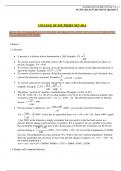
COLLEGE OF SOUTHERN NEVADA MATH 120 - FUNDAMENTALS OF COLLEGE MATHEMATICS LATEST 2023/2024 LECTURE NOTES TO ACCOMPANY THE BOOK. Chapter 1 1.2 Percents • A percent is a fraction whose denominator is 100. Example: 5% 5 . 100 • To convert a percent to a decimal, remove the % sign and move the decimal point two places to the left. Example: 5% 0.05 . • To convert a decimal to a percent, move the decimal point two places to the right and attach the % sign to the number. Example: 0.275 27.5% • To convert a fraction to a percent, divide the numerator by the denominator to get a decimal, then convert the decimal to a percent. Example: 5 16 0.3125 31.25% . • To convert a percent to a fraction, change the % sign to 100 in the denominator, then reduce or simplify. Example: 12.5% 12.5 125 1 . 100 1000 8 • The phrase “percent of” signifies a multiplication. Examples: (a) 8% of 30 = 8% 30 0.08 30 2.4 . (b) 6% of what number is 24? If we let x be the unknown number, then we need to solve the equation 6%x 24 , i.e., 0.06 x 24 . Divide both sides by 0.06 we find the answer x 24 400 . 0.06 • Percent change is defined as % new old 100% , you can also write the formula as old % new old 1100%. It also has an equivalent form new old old %. Since 100% equals 1, the 100% in the formula is simply a reminder that you need to write the final answer as a percent. Percent change can be positive or negative. If it is negative, the new number is less than the old number. Examples: (a) Last week a dozen eggs cost $2.00, this week they cost $2.30, the 2.30 2.00 percent change is 2.00 100% 0.15 100% 15% . (b) A city had a population of 30,000 last year. The population has since declined 15%. What is the city’s current population? Solution: Since the population has declined, we know the percent change is negative, i.e., % 15% . So the current population is new old old % 30000 30000 (15%) 30000 4500 25500. 1.3 Simple and Compound Interests • Simple interest formula I PRT , where I is the amount of interest, P the principal, R the interest rate, and T the amount of time. Even though the formula is very simple (no pun intended), you need to remember that the units for R and T must match. Normally R is given as annual rate, then T must be given as number of years. But if R is given as a daily rate, then T must be given as the number of days. Examples: (a) What is the amount of interest if the principal is $500, the annual rate is 18%, and the time is 3 years? Solution: Follow the formula, I PRT 500 0.18 3 270 . (b) If the interest amount is $30 on a loan of $1,000 after one month, what is the annual rate of the loan? Solution: Here we are to find the annual rate, but time is given in months, so we first need to convert one month to years. Since there are 12 months in a year, one month = 1/12 of a year. So I PRT becomes 30 1000 R 1 12 . Multiply both sides of the equation by 12 we get R 0.36 . So is the answer 0.36%? No, we need to move the decimal point two places to the right to convert a decimal to a percent, the rate is 36%: 0.36 = 36%. nt • Compound interest formula A r , where A = balance (interest and principal combined), n P = principal, r = annual rate, t = time measured in years, and n = number of times interest is compounded per year. Examples: (1) Invest $500 at annual rate 6% with interest compounded monthly. What is the balance after 3 years? Solution: Here
Document information
- Uploaded on
- October 17, 2023
- Number of pages
- 29
- Written in
- 2023/2024
- Type
- Class notes
- Professor(s)
- Professor wong
- Contains
- All classes


