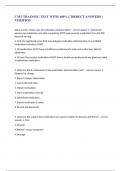
CMT Training Test | 45 Questions with 100% Correct Answers | Verified | Latest Update
What are the 4 basic rules of medication administration? - correct answer 1. Unlicensed persons can administer only after completing MTTP and receiving medication from the MD board of nursing. 2. Only the registered nurse (RN) may delegate medication administration to a certified medication technician (CMT) 3. All medications MUST have a healthcare professional's order and a pharmacy label to administer. 4. All over-the-counter medications MUST have a healthcare professional and pharmacy label to administer medication. 2. What are the 8 components of the medication administration cycle? - correct answer 1. Observe for change. 2. Report change/ observation. 3. Assist with HCP visits. 4. Obtain medication. 5. Store medication correctly. 6. Administer medication. 7. Ensure medication is taken. 8. Record and document. 3. What are the reasons that medications are used in relation to diseases and illness? - correct answer 1. Cure 2. Prevent 3. Relieve/ reduce symptoms 4. Manage 4. What type of things can we do to ensure personal rights, privacy, and dignity? - correct answer Address individual(s) by name, do not hang signs on wall, do not have individuals line-up to receive medications (one-person at-a-time), Involve individuals/ guardian in decision making process regarding treatment plans. True or False? The individual has the right to refuse treatment and/or services - correct answer True True or False? Self-administration medications may be used as a substitute for programming - correct answer True 10. Who consults with/ assists with the visit to the health care professional? - correct answer CMT (Certified Metication Technician) 11. Who obtains the medication from the pharmacy? - correct answer CMT (Certified Medication Technician) 12. Who is responsible for storing the medication correctly? - correct answer CMT (Certified Medication Technician) 13. Who administers medications and performs treatments? - correct answer CMT (Certified Medication Technician) 14. Who completes the documentation on medication administration forms? - correct answer CMT (Certified Medication Technician) Desired effect of medication - correct answer Medication does what it's supposed to do. Unwanted/ adverse side effect of medication - correct answer Something unexpected happened. No apparent effect of medication - correct answer Medication does not appear to be working. 4. What are important things to remember about drug interactions? - correct answer 1. The greater the number of drug taken, the greater the possibility of drug interactions. 2. Know your individual's baseline. Who is responsible for observing and reporting possible effects of medication? - correct answer CMT (Certified Medical Technician) 6. Define objective symptom - correct answer Something you can see or measure. 7. Define subjective symptom - correct answer Something you cannot see or measure. Chemical/ generic - correct answer Is the actual chemical name of the medication. Brand name - correct answer Given by the manufacturer. Name 3 important things to remember about the pharmacy - correct answer • All medications should come from the same pharmacy. • A pharmacist is a valuable member of the team. • A pharmacist is an excellent resource for information about drug interactions, and side effects. List factors which influence a person's response to medication - correct answer Age Weight Gender Health status Physical condition The most common routes of medication administration are - correct answer Oral Topical What are some forms of medication? - correct answer Tablets, drops, caplets, liquids, ointments, patches, suppositories. What is a suspension medication? - correct answer Liquid The inability of the body to eliminate medication can lead to - correct answer Toxicity Medication allergy - correct answer Unwanted response Tolerance - correct answer Medication no longer works Addiction - correct answer Dependence on medication Desired effect - correct answer Medication is working Unwanted effect - correct answer Something unexpeced happened No apparent effect - correct answer Medication not working How do you have to store Schedule II narcotic medications/ controlled substances? - correct answer Double locked (Locked box within a locked cabinet) List three ways medications are packaged - correct answer 1. Bottles 2. Tubes 3. Droplets What is the preferred method of packaging medications? - correct answer Blister pack. What must match in the three (3) way check? - correct answer HCP order Pharmacy label MAR What is the name of the form required to record the administration of medications? - correct answer Medication administration records (MAR) True or false? You can remove the medications from the blister pack and place them in a day-of-the week container. - correct answer False. True or False? It is ok to hang the keys for the lock to the medication cabinet on a hook on the wall next to the cabinet. - correct answer False List the 6 rights of medication administration: - correct answer 1. Right person 2. Right time 3. Right medication 4. Right route 5. Right dose 6. Right charting True or false? All PRN medications must have the RN's approval prior to administration. - correct answer True True or False? When an individual needs to take medications away from their home, you should put the medications in an envelope and send them with the individual. - correct answer False True or False? - correct answer A chemical support medication can be given without the approval of the standing committee. True or false? - correct answer The nurse must be contacted for permission prior to administering a chemical support medication. How often do psychiatric/ behavior modifying medications have to be reordered by the physician? - correct answer Every 90 days.
Document information
- Uploaded on
- October 10, 2023
- Number of pages
- 6
- Written in
- 2023/2024
- Type
- Exam (elaborations)
- Contains
- Questions & answers